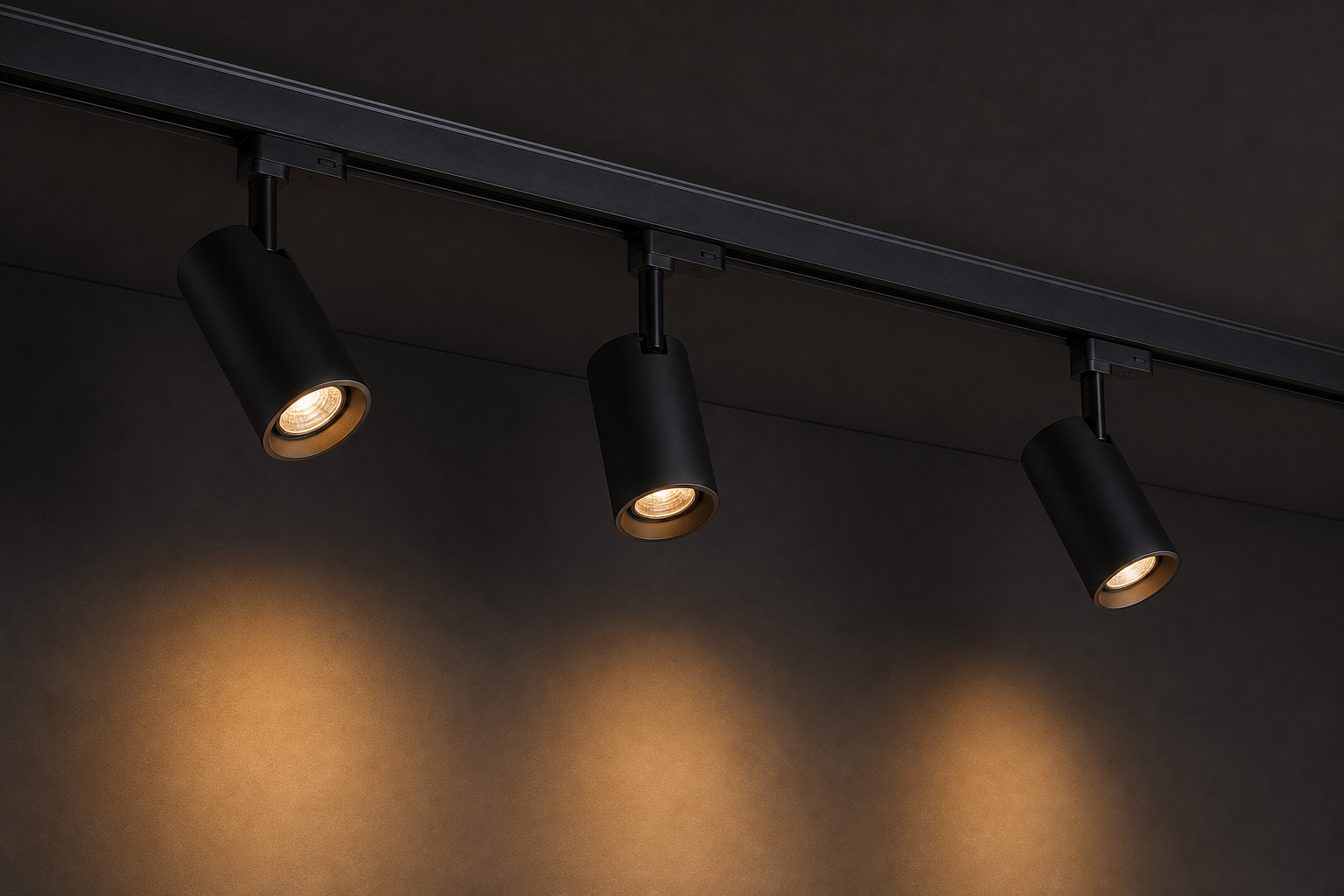
Track lighting is a surface-mounted system in which multiple luminaires — usually adjustable spotlights — draw power from a single metal rail instead of individual ceiling outlets. The rail, or track, houses copper conductors inside an extruded aluminum or polymer body. Each fixture carries an adapter that twists into the track, makes electrical contact, and locks mechanically. Move a head, add a head, aim a head: the wiring never changes. That single property — light that can be re-aimed and re-zoned without an electrician — is why track dominates galleries, showrooms, retail floors and hospitality ceilings.
Three parts define the system's behavior. The track carries the conductors and defines the standard. The live end and end caps feed power into it from a switched circuit, often through a fused connector. The adapters connect the heads, and in multi-circuit systems they also decide which circuit each head belongs to — a rotary selector on the adapter assigns it to group 1, 2 or 3, so one rail can carry up to three independently switched lighting scenes. Suspension kits, pendant adapters, track-to-track connectors and corner pieces complete the kit.
The heads themselves divide into two constructions worth knowing as a buyer. Driver-in-head spots carry the full driver inside the cylinder — simplest wiring, heaviest head, and the construction behind most 12-45 W track lights. Remote-driver systems park the drivers above the ceiling and run low-voltage wiring to lighter heads, which slims the visible fixture and keeps heat and electronics out of the retail sightline. Beam is shaped by interchangeable reflectors and lenses, from 10-15° gallery accents to 60° floods, and color quality is a per-head choice: CRI 80 for general retail, CRI 90+ with R9 specified for merchandise that pays for good light — the reasoning is in our CRI guide.
Track is not interchangeable across brands, and the divisions are regional. In Europe and most export markets, two mains-voltage standards dominate:
North America runs its own set of long-established proprietary standards — the three connector geometries buyers usually hear described generically as H, J and L type — which are not mechanically compatible with the European formats. Within each format, adapter geometry is a brand-family decision: a head from one maker will not always seat on another maker's rail even at the same nominal standard. Distributors should treat "compatible with 3-circuit" as a claim to be tested with a sample adapter, not taken from a drawing.
| System | Voltage | Switching groups | Typical market | Typical load per head |
|---|---|---|---|---|
| 3-wire track | Mains (220-240 V) | 1 | EU, galleries, small retail | 12-45 W LED |
| 3-circuit track | Mains (220-240 V) | 3 | EU, retail chains, hotels | 12-45 W LED |
| North-American standards | Mains (120-277 V) | 1-2 | US, Canada, Mexico | 10-40 W LED |
| 48V magnetic track | 48 V DC | Per driver group | Design-led retail and office | 8-24 W per module |
Values are illustrative industry-typical ranges. Load limits are set by the track's rated current, not by the sum you happen to install — check the rail's rating plate.
Work through four decisions in order. Circuit count first: if the space needs more than one lighting scene on the same rail, 3-circuit is the default answer in export markets. Standards second: the destination market fixes the format — you cannot adapt a European rail to a North-American ceiling by changing heads. Load third: a rail's rated current sets the maximum wattage per circuit; with LED, a typical 3-circuit rail carries dozens of heads with headroom, but drivers and decorative pendants must still be counted. Optics and controls last: beam angles from narrow 10-15° accent optics to wide floods, CRI per merchandise class, and dimming — most LED track heads dim via TRIAC phase-cut, 0-10V or DALI, and the dimmer brand at the wall must match the driver protocol or the project will flicker.
Installation choices shape the schedule as much as the fixture choice. Rails can be surface-mounted directly to the ceiling, suspended on rods or aircraft cable over counters and displays, or recessed into a slot so only the heads show. Feed position matters on long runs — center-feeding keeps voltage behavior and switching logical — and where tracks meet at corners, L, T and X connectors must match the standard and the finish. On a showroom ceiling, the rail is also a visual line: black is the default export finish, with white and silver following market taste. The full system families are indexed on our track and magnetic track lighting page, and the scene logic they serve is in our retail and showroom program.
For design-led interiors, weigh the trade against 48V magnetic track, which trades mains-voltage simplicity for tool-free module changes and a slimmer ceiling presence — the two systems are compared head-to-head in our specifier's comparison.
Track is a system, so the purchase order should be a system document. State the standard (3-wire or 3-circuit), the rail finishes and lengths, connector and suspension quantities — the small parts are what break project schedules when forgotten. Confirm adapter compatibility by physically seating a sample head on the sample rail. State the driver protocol per head and the dimming brand on site. Certification follows destination: CE (LVD/EMC/RoHS) for the EU, UKCA, SAA, SASO — issued via certified partner factories and verifiable by number and database link.
Illustrative commercial terms across the cluster: samples of 1-5 heads ship in 7-14 days; trial orders run 100-200 pcs per SKU; bulk production 25-40 days after deposit, quoted per project. Pre-shipment inspection with photo reports should cover heads, rails and accessories as separate line items before loading.
One procurement habit separates professional track buyers from casual ones: the accessory reconciliation. Before production, the supplier returns a full kit list — per rail length, live ends, end caps, connectors, suspension points — against the reflected ceiling plan, and both sides sign it. Track projects fail on missing clips far more often than on bad heads, and a signed kit list converts that risk into a checklist. For repeat retail rollouts, ask the factory to kitting-label boxes per store so site crews open cartons in order.
The specifier's comparison: standards, flexibility and cost across the two systems.
A buyer's shortlist for the Chinese market, and how to audit who is really making the heads.
When a fixed can beats an adjustable head in fit-outs — and where track wins outright.
How professional buyers work the lighting capital — districts, audits and export routes.
Rail lengths, heads, accessories and finishes — a complete system quotation within 24 hours.