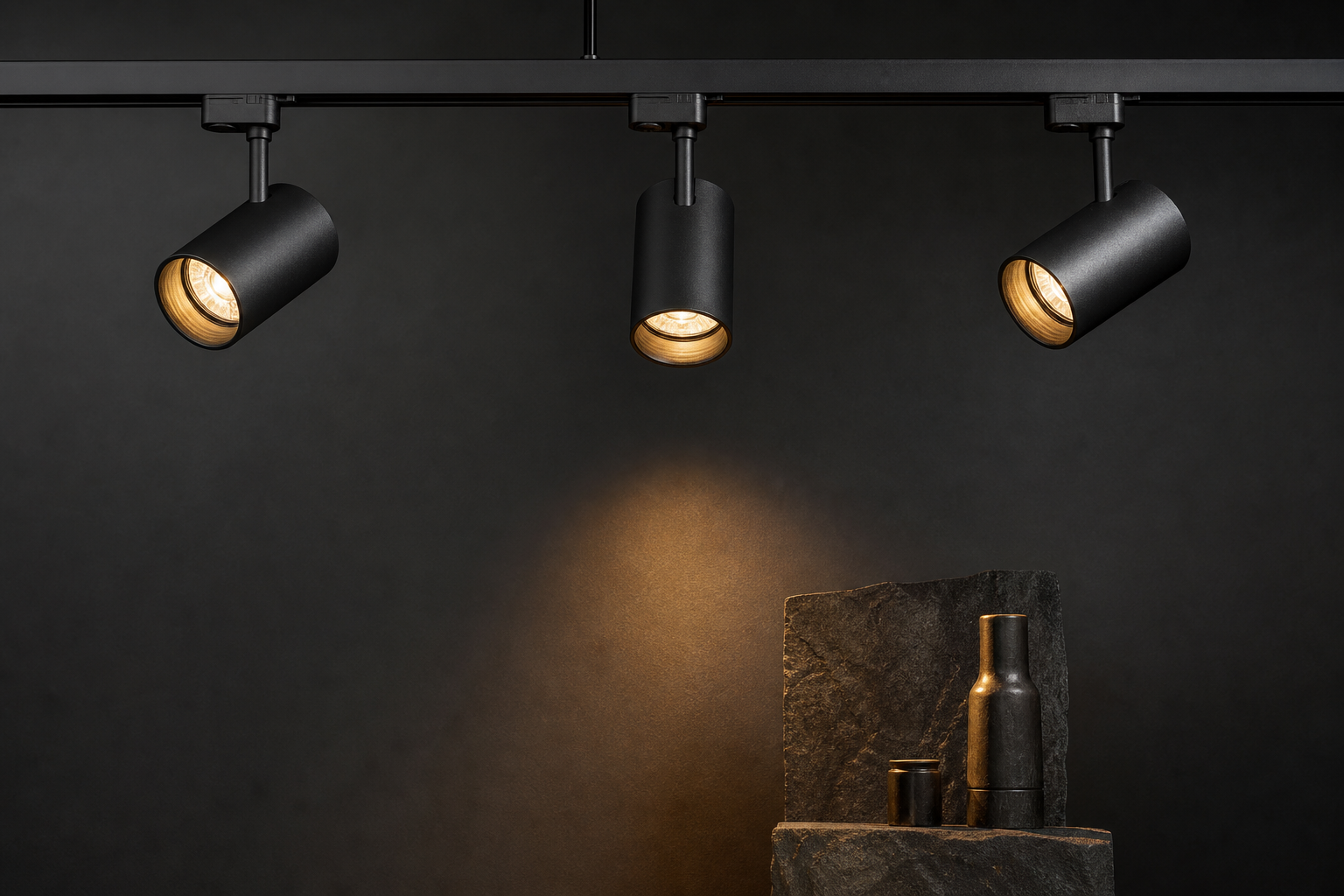
Track lighting is bought on optics and electrical contact, not on looks — here is the shortlist logic that finds factories whose beam quality survives a showroom.
2026-09-10 · 8 min read · Sourcing guide
Anyone can bolt a COB module into an aluminum cylinder and call it a track light. The difference shows the moment a fixture is aimed at merchandise from four meters: edge halos around the beam, color shift between adjacent heads, a gimbal that drifts after two adjustments, or a contact point on the track that arcs. These are manufacturing choices — reflector quality, LED binning, contact metallurgy, gimbal friction design — and they are exactly what a name-based ranking cannot tell you. This guide converts the "top manufacturers" question into a shortlist method: ten checks, four supplier archetypes, and a quote comparison that exposes quality in one round.
AURELUX operates as a cluster sourcing partner in this category, coordinating evaluated partner factories across the Pearl River Delta and Guzhen cluster (40+ evaluated factories across five scene categories; illustrative count) and quoting FOB Zhongshan or Shenzhen. Commercial figures throughout are illustrative.
| # | Check | What to request | Red flag |
|---|---|---|---|
| 1 | Optical quality | Reflector or lens samples in 15/24/36 degree beams; beam-edge cleanliness judged live, not in renders. | Only flood-type optics; "zoom" optics as the whole range. |
| 2 | Color consistency | SDCM window per bin (3-step or tighter); CRI 90+ with R9 stated for retail; macadam documentation. | "CRI 90" without a bin policy — heads will not match on the wall. |
| 3 | Glare control | Deep-recessed construction, UGR data where relevant, snoot and honeycomb accessory range. | Visible COB from low angles; no accessories. |
| 4 | Track system standard | Which track standard the adapter fits (global 3-wire or proprietary); adapter compatibility list in writing. | "Fits most tracks" — the most expensive phrase in the category. |
| 5 | Electrical contact quality | Contact material and spring pressure; insertion-cycle claims; no arcing on dimmed loads. | Loose-fitting heads; contacts that deform after a few insertions. |
| 6 | Dimming & control | Phase-cut, 0-10V and DALI versions with driver brand named per version; low-dim behavior tested live. | Dimming curve untested; one driver "does everything". |
| 7 | Magnetic platform depth | 48V magnetic track range: spot, grid, pendant, linear modules on one system; accessory ecosystem. | Magnetic range of two heads and no plans. |
| 8 | Thermal & finish | Die-cast body, Tc point specified, anodized or powder-coat with salt-spray hours for coastal installs. | Extruded sleeve over a plastic core; finish that fingerprints permanently. |
| 9 | Certification | CE / UKCA / SASO / SAA as applicable via certified partner factories; certificate numbers verifiable in official databases. | One certificate shared across every wattage and beam. |
| 10 | Project support | Photometric files per head; lighting layout support; aim-angle documentation for merchandising plans. | No IES files; layout "by experience". |
Commercial track heads concentrate in two zones of southern China. The Shenzhen-Dongguan electronics corridor leads on driver integration and smart-ready platforms, where dimming protocol support and wireless modules are nearest at hand. The Zhongshan-Guzhen cluster leads on volume commercial production and the decorative-adjacent work — pendant modules on magnetic track, linear systems for boutiques — supported by full-chain component supply and an export apparatus reaching 180+ countries and regions (Zhongshan municipal sources, 2024-25). Retail and showroom programs usually draw from both zones: heads from one, specialty modules from the other, consolidated into one container.
| Archetype | Profile | Best for | Watch for |
|---|---|---|---|
| Optics-driven specialist | Own reflector tooling; beam quality is the sales argument; strong CRI and bin discipline. | Galleries, jewelry, fashion retail where the beam sells the goods. | Unit price above commodity lines; longer sampling. |
| Magnetic-platform house | 48V system with a full module family on one track; strong design-forward catalog. | Modern retail, offices and showrooms specifying one coherent system. | Track and adapter lock-in; confirm future supply of modules. |
| Volume commercial line | Bread-and-butter 20-40 W heads at aggressive pricing; adequate optics, fast repeats. | Multi-site rollouts where spec tolerance is defined and stable. | Bin drift between production runs; lock color code per order. |
| Project custom shop | Modified lengths, finishes, pendant versions and integrated lines against drawings. | Flagship stores and hotel public areas with mixed decorative-commercial grids. | Custom sampling runs 14-21 days (illustrative); plan the program around it. |
Ask every shortlisted supplier for the same demonstration kit: three heads in three beam angles, one dimmable version, one magnetic module, and the matching IES files. Evaluate on a dark wall at real mounting height. Compare beam edges, low-dim behavior at 5-10%, color match between heads, and adapter fit on a sample of your track. Then put the differences in the commercial frame: standard samples in 7-14 days, trial orders from 100-200 pcs, bulk 25-40 days after deposit, T/T 30% + 70% against B/L copy, FOB Zhongshan or Shenzhen (all illustrative). Suppliers who ship a good kit and accept the terms in writing are your shortlist; the rest were a list.
For system fundamentals, start with what track lighting is and how it works, the system choice in traditional vs magnetic track, and the 48V mechanics in what magnetic track lighting is. Category context lives on our commercial lighting catalog and retail lighting solution page.
The least glamorous check on the list — number 4, the track standard — is the one with the longest consequences. Track lighting is an ecosystem decision: once a program commits to a track and adapter standard, every future head, module and accessory must follow, and the cost of escaping grows with every installed meter. The working landscape splits into broadly compatible multi-circuit standards and proprietary systems; within magnetic track, 48V platforms are converging on de-facto common mechanics while remaining electrically and mechanically distinct enough to matter. The buyer's discipline is to fix the standard in writing — adapter model, contact configuration, per-meter ratings — before pricing any heads, and to demand the supplier's written compatibility list rather than a verbal "yes, fits".
Lock-in cuts both ways, and the second half of the decision is supply continuity. A boutique magnetic platform with exquisite optics is a liability if its maker exits the category in three years and your showrooms carry tracks nobody else's heads fit. Ask each candidate supplier two questions: how long the current track generation has been in production, and what the stated roadmap is for future modules on the same track. Volume commercial lines answer easily; platform specialists answer well when the platform is their core business. Either way, get the answers into the specification, because the standard you choose will outlive the supplier relationship you choose it with. The system-level comparison continues in our traditional vs magnetic track guide and the 48V system explainer.
How track systems work, adapter standards and the basics buyers should know.
A specifier's comparison of the two systems across cost, flexibility and optics.
Color rendering for lighting buyers — and why R9 matters more than the headline number.
How professional buyers work the lighting capital — districts, audits and export routes.
Tell us the store type and track standard — a demonstration kit, photometric files and FOB quotation within 24 hours.