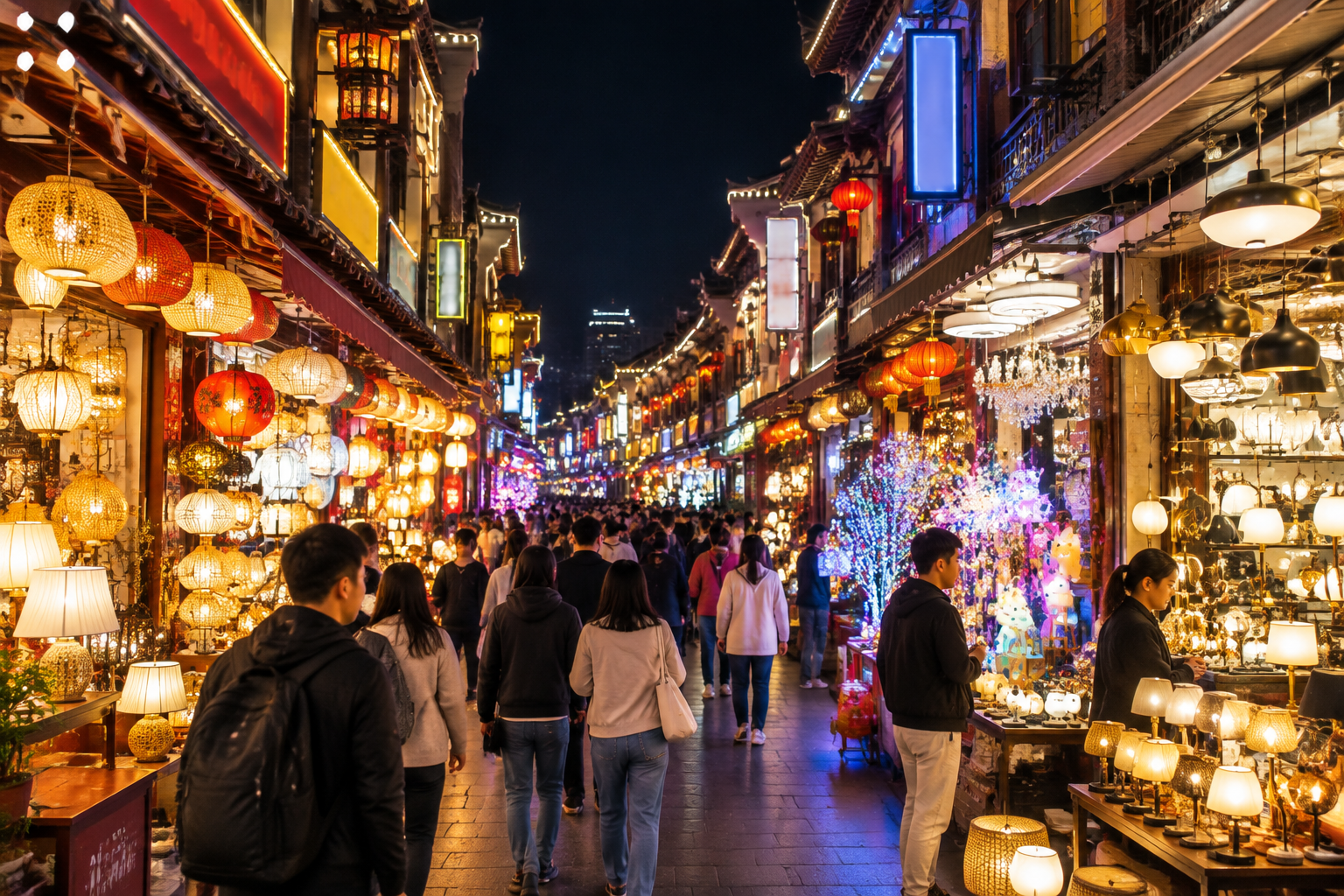
Guzhen, a town in Zhongshan, Guangdong, is not a factory town with a lighting industry — it is a lighting industry that happens to occupy a town. Understanding its scale and structure is the difference between sourcing well and shopping badly.
The cluster's numbers explain the pilgrimage. Annual output value exceeds CNY 100 billion (Zhongshan municipal sources, 2024-25). Lighting products from the cluster reach 180+ countries and regions (Zhongshan Daily, 2025). In decorative lighting specifically, the cluster accounts for about 70% of China's market and roughly half of global production — note the scope: that share is decorative lighting only, not lighting products in general.
The deeper reason is the supply chain. Guzhen's local supply is often described as complete "from a single screw to the finished lamp" — drivers, hardware, glass, diffusers, packaging all procurable within the cluster (Zhongshan Daily, 2025). For a buyer, that means one trip — or one sourcing partner — covers dozens of product categories and price tiers, and sampling cycles measured in days, not months.
The buying area concentrates along the town's main artery, Lighting Capital Avenue (Lighting Capital Ave.). Two distinct layers matter:
First-time buyers typically spend their days in the malls and their evenings realizing the malls showed them only the front row. The factory belt is where a local partner earns their keep.
Three checks separate an export-capable factory from a trading desk:
For orders below full-container scale or assembled from many small suppliers, the cluster operates under China's national market procurement trade pilot (customs supervision code 1039) — a compliant export channel designed for multi-supplier, small-lot trade, in place and reported on since 2018 (Southern News Net, 2018-2025). In practice it lets mixed purchases from the market be declared and exported legally with proper documentation, instead of the grey consolidations that used to be the norm. For buyers it means mixed orders do not have to mean undocumented orders.
The Guzhen Lighting Fair runs in spring and autumn seasons and hosts 350,000+ buyer visits per year from 130+ countries (fair authority figure, both seasons combined). It is the efficient way to see the cluster's breadth in two days — but treat it as a mapping exercise: collect directions, then follow them into the factory belt for actual sourcing.
Three recurring traps, all avoidable:
We are a sourcing organization inside this cluster — we organize, we do not manufacture. Concretely, we do the four things this guide described: shortlist and evaluate partner factories per product line; set one standard across all of them and inspect inline and pre-shipment with photo reports; map certificates to your destination with numbers and verification entries; and consolidate everything into one container under one purchase order with one point of contact. See how programs are shaped, then bring us your item list via the quote form — product schedule and FOB quotation within 24 hours.
Sources and scope: cluster output value — Zhongshan municipal sources, 2024-25; export reach and local supply chain — Zhongshan Daily, 2025; decorative market share — industry estimates, decorative-lighting scope only; fair attendance — Guzhen Lighting Fair authority, both seasons combined; market procurement pilot — Southern News Net, 2018-2025. Figures are cited with their scopes and should not be extrapolated beyond them. This page is part of an illustrative prototype.
Send your item list before the trip — or skip the trip and let the cluster come to you, quoted within 24 hours.