How low-voltage magnetic track works, why 48 volts became the standard, where the system wins and the design limits every specifier should know before quoting it.
2026-09-10 · 8 min read · Knowledge base
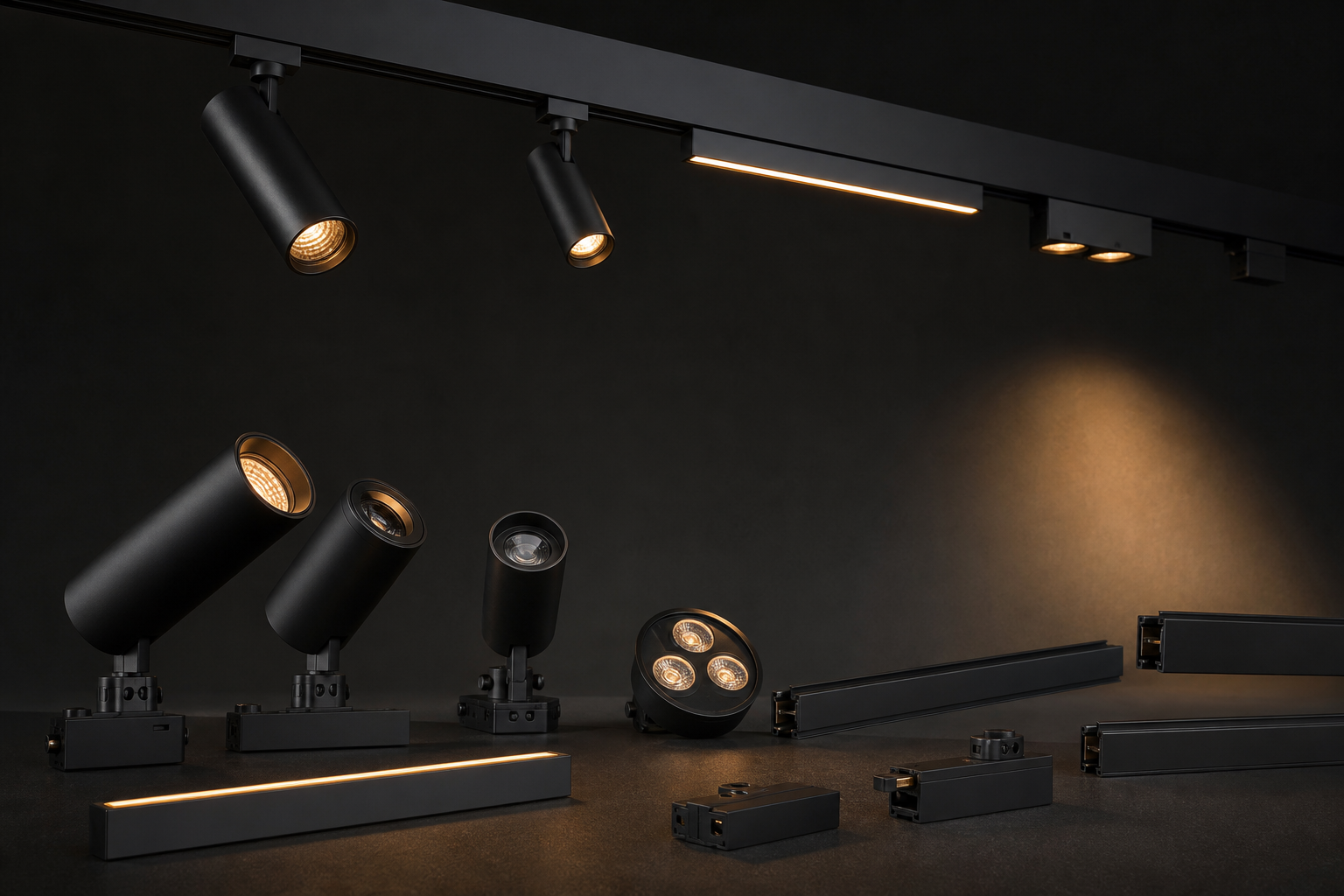
Magnetic track lighting is a low-voltage system in which slim luminaires attach to a narrow aluminum rail by magnets — no levers, no twist-locks, no tools. Pull a module off and re-seat it anywhere along the run in seconds. The rail itself is a shallow profile, typically 20-35 mm wide, that can be recessed into plasterboard so it reads as a hairline slot in the ceiling, surface-mounted, or suspended. That slimmer architectural presence is a large part of why the system took over design-led retail and office ceilings.
The rail carries a 48 V DC bus. mains voltage arrives at a driver — either a compact unit that clips into the track itself or a remote unit above the ceiling — which converts it to safe extra-low voltage. The choice of 48 V is not arbitrary: it sits inside the SELV (safety extra-low voltage) band, so the rail and modules can be touched during reconfiguration without mains-level risk, while still being high enough to keep voltage drop manageable over useful run lengths. Modules draw their power through copper contact strips as they snap onto the rail.
Because the ceiling is effectively a reconfigurable grid, the module family matters as much as the rail: adjustable spots, fixed downlight modules, linear grilles, flood lenses, retractable pendant modules and even small linear battens — all sharing one profile.
The rail itself has become a design language of its own. Export catalogs carry square and round profiles in black, white, bronze and brushed finishes; recessed trims that either show a hairline slot or sit fully flush; corner pieces, flexible connectors and T-junctions that let the grid turn down walls or wrap bulkheads. Because everything clips on magnetically, accessories extend the system beyond light: track-mounted sensors, small speakers and display hooks appear in retail kits. None of this changes the electrical logic — the rail is still a 48 V bus — but it changes what a purchase order must enumerate, and it explains why the sample kit, not a datasheet, is the real product test in this category.
| Module type | Typical power | Typical flux | Beam | Best suited to |
|---|---|---|---|---|
| Adjustable spot | 8-24 W | 700-2,400 lm | 10°-40° | Accent walls, galleries, merchandise |
| Fixed downlight module | 8-18 W | 700-1,800 lm | 24°-60° | Circulation, general office light |
| Linear grille | 12-24 W | 1,000-2,200 lm | Asymmetric / wide | Wall washing, shelving, counters |
| Pendant module | 6-12 W | 500-1,200 lm | Down / decorative | Over tables, reception, joinery |
Figures are illustrative industry-typical ranges; confirm per model against photometric files.
The low-voltage bus is the system's strength and its constraint. Voltage drop grows with run length and load, and at the far end of a long, fully loaded rail it shows up as dimmer modules and slight color shift. The practical controls are feed position (center-feed long runs instead of end-feed), driver capacity per run, and keeping continuous loaded runs within the lengths the manufacturer states — typical guidance lands in the 3-6 m per feed region depending on profile and load, illustrative figures to be confirmed per system. Large ceilings are handled by splitting the layout into several fed zones rather than one heroic run.
Three more limits to state at design stage. Recess depth: the track plus heat sink needs a ceiling void of roughly 40-80 mm depending on profile; shallow ceilings should be checked before the system is specified. Driver placement: in-track drivers simplify wiring but add a visible block in the slot; remote drivers hide cleanly but need access for maintenance. Compatibility: 48V magnetic modules from different brands share the same idea, not the same geometry — a module family and its rail should come from one system and be sample-tested together, the same discipline as mains track.
Controls integration should be decided with the layout, not after it. Most 48V magnetic systems dim through the driver — leading-edge on the driver's input, 0-10V, or DALI where the project already runs a digital bus — and several factories offer DALI-addressable in-track drivers so the grid joins the building's scene control. Beam and color are chosen per module: 10-40° spots for accents, wider lenses for circulation, CRI 90+ where merchandise or faces justify it. Because modules are small, they also mix CCT on one rail deliberately — a 3000K circulation field with 3500K display modules is a common retail pattern, provided bins stay tight.
Choose magnetic 48V when the ceiling will be reconfigured — retail that re-merchandises, galleries that re-hang, offices that re-stack — when the ceiling line must stay visually quiet, or when a mixed module family (spot, linear, pendant) must share one grid. Choose traditional 3-circuit track when runs are long, budgets are per-meter tight, and the layout is stable once installed; mains voltage removes the driver-per-run planning entirely. A full side-by-side is in our traditional vs magnetic comparison.
For fit-out context by scene, see how the system sits inside our retail and showroom and office and education solution pages — magnetic grids are now specified in both far more often than twist-lock track.
Because the system is a kit, the purchase order is a kit list: rail lengths and finishes, in-track versus remote drivers and their wattages, module mix per rail with beam angles and CCT, connectors, end caps and suspension or recessing trims. Ask for the manufacturer's stated maximum run length per feed and the module count limit per run — in writing, not verbally. Certification follows destination (CE, UKCA, SAA, SASO) via certified partner factories, verified by number and database link; the driver's own certification matters since it is the mains-side component.
Illustrative commercial terms: a sample kit — one short rail, one driver and three module types — ships in 7-14 days and is the single most valuable sample in this category, because it tests geometry, seating force and light output together. Trial orders run 100-200 pcs per system; bulk production 25-40 days after deposit; pricing quoted per project. Pre-shipment inspection should function-test modules on the actual rail, not bench-test them loose.
For distributors weighing the line as a program rather than a one-off project, two commercial realities matter. Spare-part depth is part of the product: a magnetic grid survives on the promise that a discontinued module will not strand an installed rail, so stock agreements on modules and drivers belong in the distributor conversation alongside price. And packaging is systems packaging — rails long and thin, modules nested, drivers boxed separately — so carton counts per system should be confirmed before freight is quoted, because volumetric weight, not the fixtures, sets the shipping bill.
The specifier's comparison: standards, flexibility and cost across the two systems.
Mains-voltage track explained: adapters, 3-wire vs 3-circuit and compatibility rules.
Accent ratios and vertical illuminance — the scene where magnetic grids earn their premium.
How professional buyers work the lighting capital — districts, audits and export routes.
Rails, drivers, module mix and accessories — a complete 48V system quotation within 24 hours.