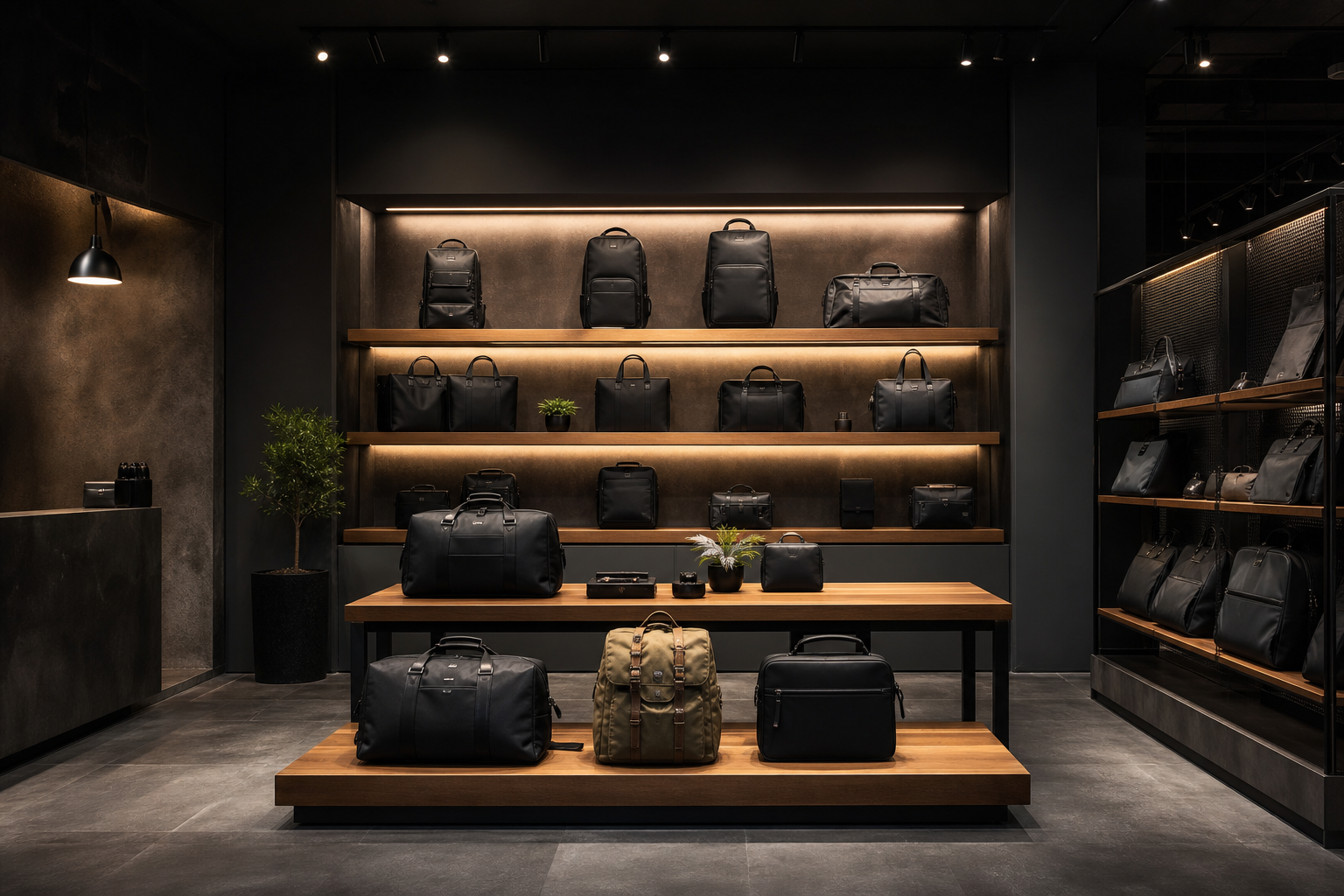
Shoppers buy what they can see, and what they see is mostly vertical. Accent ratios, wall and shelf illuminance, fitting room quality and the specs behind a store that sells.
2026-09-10 · 9 min read · Lighting guide
Retail lighting has a test that offices and warehouses never face: it must change customer behavior. Contrast tells shoppers where to look, color fidelity decides whether a garment looks the same in the fitting room mirror as it does under the store's spots, and the light on a shelf face sells more per lumen than light on the floor ever will. Two concepts carry most of the craft — the accent ratio and vertical illuminance — and both are absent from the majority of failed store schemes. This guide puts them at the center where they belong.
Retail formats divide cleanly by contrast strategy. Value and grocery formats light broadly and evenly: high ambient, low contrast, efficiency first. Fashion and lifestyle stores run moderate ambient with defined accents on tables, mannequins and walls. Premium and jewelry invert the ratio almost entirely: low, intimate ambient with strong, precisely aimed accents. The design goals in each case are the same four: pull the shopper from the window through the planned route, lift the merchandise above its background, keep color true from shelf to fitting room, and do it within an energy budget a landlord will sign. The working color constants: 3000-3500 K dominates fashion and lifestyle floors, dropping to 2700-3000 K in fitting rooms and premium spaces; CRI 90+ is the professional floor for anything wearable or cosmetic (typical practice).
The accent ratio is the illuminance on a highlighted display divided by the surrounding ambient. It is the single lever that decides whether a store reads as energetic or flat. Typical practice:
| Format | Ambient (typical) | Accent ratio (typical) | Effect |
|---|---|---|---|
| Value / grocery | 500-750 lx | 1:1 to 2:1 | Even, efficient, no hierarchy — the price is the story |
| Fashion mid-market | 300-500 lx | 3:1 to 5:1 | Clear hierarchy; tables and mannequins pop without drama |
| Premium fashion | 150-300 lx | 5:1 to 10:1 | Gallery mood; strong focal control along the route |
| Jewelry / watches | 150-300 lx | 10:1+ on cases | Scintillation and sparkle; strict beam and glare control |
Ratios are illustrative of retail lighting practice; brand retail design manuals usually fix the exact figures per concept.
Two beam-angle notes make ratios actually work. Narrow spots (10-24°) make accents but hot-spot the fabric; wide floods blend but flatten. The professional answer is most often a mixed beam set — narrow for mannequins and hero products, medium for bays and tables — which is why track and magnetic systems dominate retail ceilings: aim and re-aim as the floor plan changes without an electrician.
Shoppers walk a floor looking at wall bays, gondola faces and shelf fronts — vertical planes — while most calculations report horizontal lux on the floor. The disconnect is why brightly calculated stores still look dim on the merchandise. The fix is to specify vertical illuminance at 1.5 m on display planes as a first-class target: as a working reference, shelf and bay faces should receive at least the horizontal ambient level, and typically 1.5-3× on featured bays (illustrative). Wall-washer optics deliver it on perimeter walls; adjustable accents deliver it on gondola ends; shelf-integrated strips deliver it where cabinetry blocks ceiling light entirely. Window displays are the extreme case: glass faces daylight, so windows need 1,000-3,000 lx by day to stay visible from the street (typical), stepping down after dusk — one more argument for a separate, dimmable window circuit.
| Zone | Maintained lux (typical) | CCT | CRI | Notes |
|---|---|---|---|---|
| Window display | 1,000-3,000 lx day / 500-800 lx night | 3000 K | 90+ | Separate astro/contactor circuit; watch glare into the street |
| Entrance | 500-800 lx | 3000-3500 K | 90 | Daylight transition; pulls traffic inward |
| General floor | 300-500 lx | 3000-3500 K | 90 | UGR 22 acceptable; uniformity supports wayfinding |
| Featured displays / mannequins | 3-5× ambient (format-dependent) | 3000 K | 90+ | Track/magnetic accents; beam angles per display type |
| Fitting rooms | 300-500 lx, front light at face | 2700-3000 K | 90+ | Vertical fill beside the mirror; dimmable; occupancy control |
| Cash wrap | 500 lx task | 3000-3500 K | 90 | POS screens and counter tasks; a natural brightness anchor |
| Stockroom | 300 lx | 4000 K | 80 | Utility grade; occupancy sensors standard |
Values are illustrative of retail design practice; the brand's retail design manual governs where one exists.
The same framework flexes by category, and buyers should expect the fixture schedule to bend with it. Apparel lives on color and texture: CRI 90+ throughout, verticals on wall bays, and fitting rooms treated as the conversion zone they are — the most-scrutinized light in the store. Footwear wants the strongest verticals in retail: wall rows at 1,000+ lx on shoe faces (illustrative), because the wall is the display. Jewelry and watches invert everything: low ambient, case-integrated accents at extreme ratios, tight beams for sparkle, and zero-flicker drivers because customers lean in and stare. Cosmetics demand the strictest color discipline in commerce — skin tones on every surface — so CRI 95-class sources with documented Rf and consistent binning, lit vertically at mirrors. Electronics flip the goal: dark, contrast-heavy showrooms where screens are the light source and the ceiling stays dim and glare-free, since a store that fights its own displays loses. None of these change the method — zones, ratios, verticals, color data — but they decide the emphasis, and a supplier who answers "what is your format" before "how many fixtures" is the one worth shortlisting.
Retail stores burn long hours, and controls recover cost without touching the customer experience. The standard stack: daylight harvesting on perimeter zones near glazing; daypart scenes (opening, day, evening, cleaning) on a schedule — evening can lift accents slightly and drop ambient as natural traffic thins; occupancy control in fitting rooms, stockrooms and offices; and separate window circuits on astronomical timers. DALI-2 groups make all of it adjustable by the visual merchandising team when the floor resets each season, which is the quiet operational argument for DALI over fixed wiring in fashion retail. One watch-out: whatever the sensor logic, accents over live merchandising must not flicker or step visibly — customers read fixture behavior as product quality.
Retail schedules are judged on three documents. First, photometry with beam options: IES/LDT files per optic, plus a beam-angle matrix per display type. Second, color data: CRI 90+, R9 and (for cosmetics and denim-heavy floors) color consistency across the order — binning discipline matters as much as the CRI headline. Third, a mock-up bay: one wall or table set lit with the proposed fixtures before bulk order; a two-hour mock-up settles beam, ratio and CCT debates that email never will. Add dimming compatibility for the scene system, PstLM/SVM flicker figures for the EU-facing file, and certification by destination (CE, UKCA, SASO and others) issued via certified partner factories with verifiable documentation.
Illustrative commercial terms: samples of 1-5 pcs ship in 7-14 days; trial orders 100-200 pcs per SKU; bulk production 25-40 days after deposit; pricing quoted per project or per store rollout. The retail and showroom lighting page maps formats to fixture families, track and magnetic systems cover the accent backbone, and the commercial lighting line carries the downlights and wall-washers behind the general floor. Send one floor plan and a display photo set; the fixture schedule follows naturally.
Color rendering, R9 and why fashion floors specify CRI 90+.
Choosing the accent backbone for stores that reset every season.
When the general floor needs downlights and displays need spots.
Sourcing commercial and retail fixtures from the Zhongshan cluster.
Beam-angle matrix, CRI documentation and FOB quotation — first response within 24 hours.