2026-09-10 · 8 min read · Comparison
The short answer
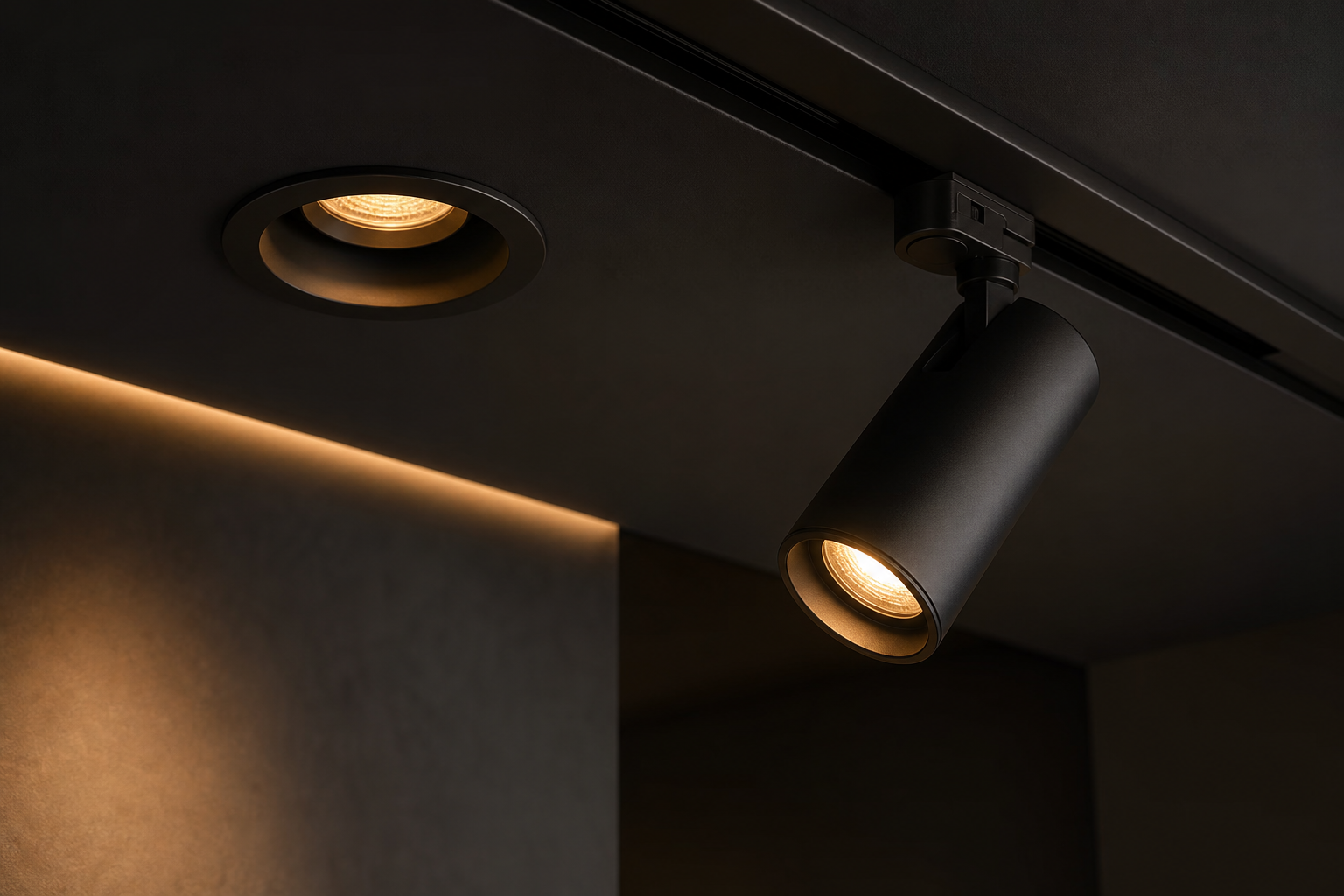
Use a downlight when the job is general illuminance: a fixed, wide-beam fixture laid out in a grid to deliver even ambient light for offices, corridors, guestrooms and open retail floors. Use a spotlight when the job is emphasis: an adjustable, narrow-beam fixture aimed at merchandise, artwork, reception desks or architectural features. In real fit-outs the answer is almost always both, working as two layers of the same scheme — and the quotations that win technical approval price the layers separately instead of forcing one fixture to do both jobs. If you are sourcing either family, our commercial lighting index is organized exactly this way, by application rather than by brochure.
Two different jobs in the layering logic
The ambient layer is what people never notice when it is right. Downlights own this layer: typically 15-60 degree beams (illustrative range for volume product), fixed orientation, spaced on a regular grid calculated from mounting height and target lux. Their success metric is uniformity — no dark patches between fittings, no glare in sightlines, delivered at the lowest cost per point.
The accent layer is what people remember. Spotlights own it: narrow 10-36 degree beams, tiltable heads — 30 to 40 degrees of adjustment is typical — and placement driven by what needs highlighting rather than by a grid. Success here is contrast: a display lit three to five times brighter than its surroundings (illustrative accent ratios common in retail) reads as intentional and premium. A scheme of only downlights feels flat and institutional; a scheme of only spotlights feels like a gallery and under-lights the tasks. Fit-outs layer them because the layers have different jobs.
Optics: beam angle, glare and how each meets the ceiling
Downlights are optical simplicity: a diffuse LED source behind a reflector or lens, flush or semi-recessed in the ceiling plane. The specification that matters most is glare control — in offices and classrooms the tender will often demand UGR below 19, which pushes the choice toward deep-recessed models with honeycomb or microprismatic control. Colour consistency across a grid of downlights matters just as much: a 3-SDCM binning requirement keeps one ceiling from showing visibly different whites.
Spotlights are optical instruments. Center-beam intensity, beam cut-off and the quality of the reflector decide whether merchandise looks rich or washed out — which is why serious retail and hospitality spots are typically COB-based, as covered in our COB vs SMD comparison. Physically, spots come in three housings: recessed adjustable (a tilting module in a ceiling cutout), surface-mounted spots, and track or magnetic-track spots where re-aiming and re-positioning are frequent. The right housing follows the ceiling: plasterboard takes recessed hardware happily, concrete slabs favour surface or track, and exposed-grid ceilings belong to track systems.
Layout logic: grids versus accents
Downlight layout is arithmetic — spacing-to-mounting-height ratios and a uniformity target produce the grid, and our downlight spacing calculator covers the rules of thumb. The cost consequence is predictability: a fit-out designer can price the ambient layer per square metre before drawings are final, which is why downlight quantities survive value-engineering rounds intact.
Spotlight layout is choreography. Points land on the mannequin, the artwork, the reception sign — and they move when the merchandising plan changes. That mobility is the quiet argument for track: when a tenant re-merchandises twice a year, electricians move fixtures in minutes instead of cutting new ceiling holes. In hotels and restaurants the accent layer also carries scenes — dimmed pools over tables, wall features lifted at dusk — which pulls dimming protocol (phase-cut versus DALI) into the spotlight specification earlier than in the downlight layer.
Cost, installation and where the money actually goes
Per unit, volume-grade fixed downlights are the cheapest ceiling point in the catalog — illustrative FOB pricing for basic 7-12 W models often starts in the low single-digit dollars, while quality COB spots with deep reflectors commonly land several times higher. Installation narrows the gap: a downlight needs one cutout and a driver connection either way, while a spotlight adds aiming labour and, on track systems, the rail itself. Over a whole fit-out the ambient layer usually dominates fixture count, and the accent layer dominates the lighting budget per fixture — two different conversations with the client, and both belong in the quotation.
Ceiling build-ups and cutout practicalities
Fit-out reality lives in the ceiling section. Downlights and recessed spots share the same cutout logic but not always the same depth: deep anti-glare downlights need roughly 100-150 mm of plenum (illustrative typical depths), shallow ring-light models exist for tight ceilings, and fire-rated or acoustic ceilings add hood and canopy requirements that differ by fixture. Adjustable spots need extra internal depth for the tilting mechanism, which occasionally forces the recessed-versus-surface decision on purely physical grounds. Coordinate early with the MEP trade: driver placement, emergency packs and insulation clearance all compete for the same plenum, and a fixture that fits the drawing but not the ceiling returns as a variation order. Where the build-up cannot be confirmed before ordering, surface-mounted versions of both families keep the program moving at a modest aesthetic cost.
Spares deserve one line in the schedule: a fit-out that stocks two spare drivers and one spare unit per fifty installed (illustrative ratio) turns year-three failures into a maintenance visit instead of a re-order with fresh tooling risk.
Comparison at a glance
| Dimension | Downlight | Spotlight |
|---|---|---|
| Job in the scheme | Ambient / general illuminance layer | Accent / emphasis layer |
| Beam angle | Wide, typically 15-60 degrees | Narrow, typically 10-36 degrees |
| Aiming | Fixed, downward | Tiltable, often 30-40 degrees of adjustment |
| Layout logic | Regular grid by spacing ratio | On targets; moves with merchandising |
| Glare spec | UGR-driven; deep recess for UGR<19 | Cut-off and reflector quality driven |
| Relative unit cost (illustrative) | Lowest cost per ceiling point | Several times higher per fixture |
| Typical ceiling | Any; grid, plasterboard, stretch | Recessed, surface or track by slab type |
| Natural applications | Offices, corridors, guestrooms, open retail | Retail displays, art, reception, dining zones |
How to choose: three rules
- Layer first, then assign. Fix the ambient level and grid with downlights, then walk the plan and mark what deserves emphasis — those points become spotlights.
- Let mobility decide the housing. Displays and layouts that change justify track or adjustable heads; static architecture takes fixed recessed product.
- Let the room set the specs. Workspaces pull UGR and flicker requirements; retail pulls CRI, accent ratio and beam quality; corridors need neither — resist over-specifying.
Advice for procurement teams and contractors
Quote the two layers as separate line items. It keeps the ambient layer price-competitive (it is a volume product; treat it that way) and it keeps the accent layer quality-driven, where substitution by a cheaper spot is visible to every customer who walks the store. In hospitality fit-outs we routinely quote three downlight grades and two spotlight grades per project so the client can mix value and premium by zone — the same structure works for retail rollouts across multiple sites.
When comparing supplier offers, hold these four items constant before comparing prices: binning tolerance (SDCM), UGR data, driver brand and dimming compatibility, and photometric files (IES/LDT) for the actual model quoted. For projects with long lead times, order aiming accessories and spare trim rings with the main batch rather than as a later add-on — they are cheap freight on a full pallet and expensive as an air shipment. Send your ceiling plan or fixture schedule and we will return both layers quoted with photometrics and FOB pricing within 24 hours.