2026-09-10 · 8 min read · Comparison
The short answer
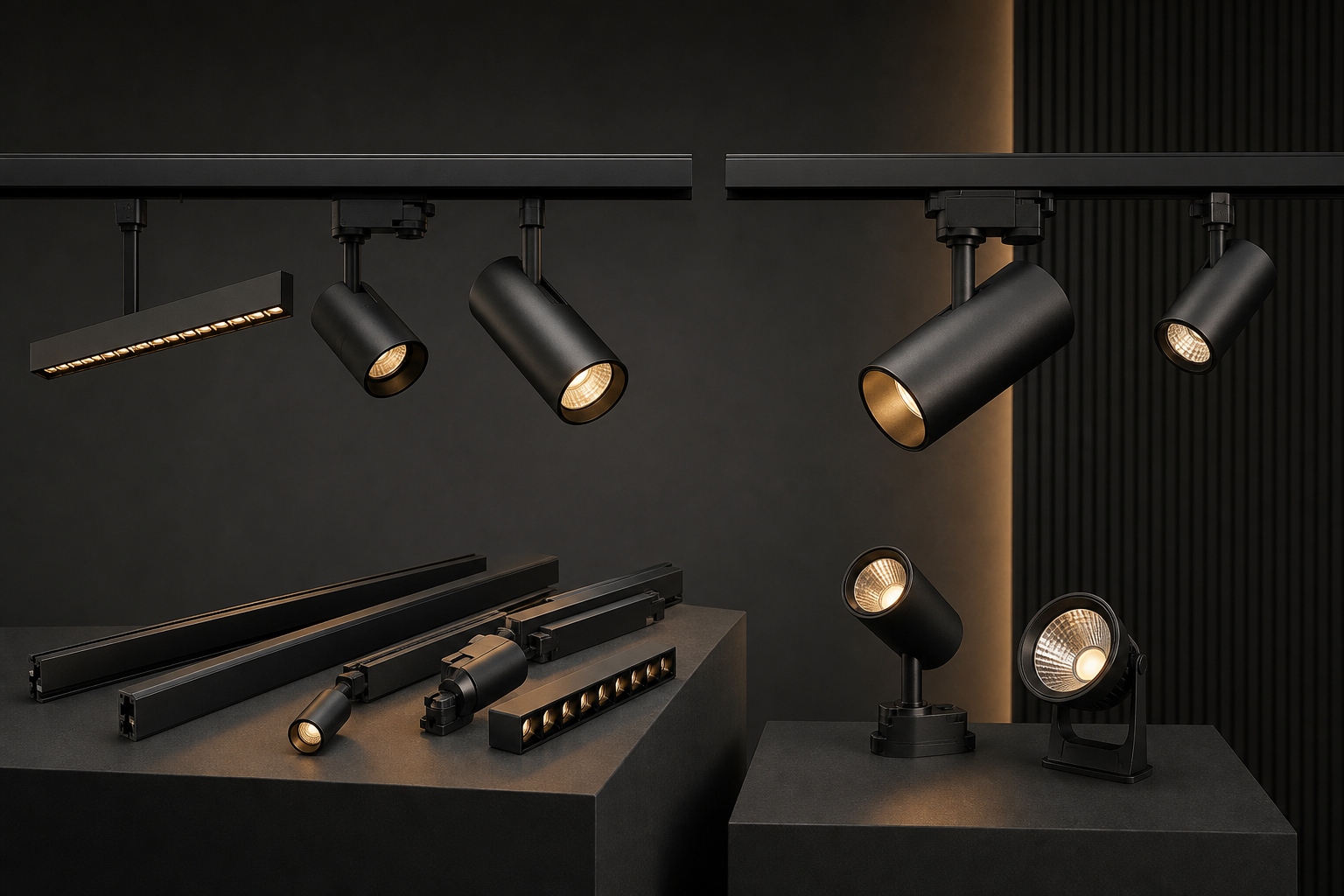
Quote traditional mains track when the project is a standard commercial or retail environment: robust fixtures, proven adapters, competitive cost per metre, and decades of interchangeable product. Quote magnetic track when the design brief drives the decision: a trimless slot in the ceiling, miniature fixtures, tool-free repositioning, and the gallery-grade light quality that high-end retail and hospitality projects now expect. The systems are not competitors so much as price tiers with different architectures — and many showrooms and hotels end up specifying magnetic in the front-of-house zones and mains track in the back. Our track and magnetic program carries both for exactly that reason.
System basics: mains track versus 48V SELV magnetic
Traditional track carries mains voltage — 220-240 V in European three-circuit track, 120 V in North American standards — down the rail to each adapter. That simplicity is its strength: any mains fixture on the compatible standard clips in, power is abundant, and runs extend for tens of metres without voltage-drop anxiety. The catch is compatibility culture: European three-circuit, North American standards and several legacy standards do not interchange, so the track brand decision locks the fixture ecosystem for years.
Magnetic track is a low-voltage system: a 48 V DC rail, typically fed by remote drivers, with fixtures that snap in on magnetized contact pads. Because SELV (safety extra-low voltage) is inherently touch-safe, the track can be exposed as a visible design element, recessed trimless into plasterboard, or even integrated into architectural joinery. Fixtures are smaller than their mains equivalents — a 48 V spotlight the size of a thumb now delivers what once needed a can — and anyone can slide, add or remove them by hand. The trade: every run needs driver planning, and total load per run is finite.
Fixture ecosystem and light quality
Traditional track's ecosystem is deep and cheap. Track spots, floods, wall-washers, cylinders and pendant adapters exist in thousands of SKUs across the cluster, most COB-based with interchangeable reflectors, and replacements are available from any compatible supplier — a real advantage for facilities teams. The fixtures read as "commercial": visible housing, conventional scale.
Magnetic fixtures are the system's premium and its constraint. The catalogue has matured fast — track spots, mini spots, linear modules, wall-washers, grid and foldable variants, even small pendants — but the pool is still smaller than mains track, and fixtures from different magnetic brands do not always interchange mechanically. Light quality, however, is where magnetic earns its price: miniature optics, deep recess and close-to-ceiling mounting produce that clean, glare-free "invisible source" look. In flagship stores and boutique hospitality projects, this is frequently the deciding argument, not the price list.
Ceiling integration and aesthetics
A mains track announces itself: black or white rail, visible adapters, a slightly industrial rhythm. In galleries, showrooms and industrial-chic retail that visibility is a feature. In a minimal plasterboard ceiling it reads as clutter, which is why designers specifying minimal interiors push toward magnetic — recessed trimless channels plastered flush into the ceiling leave only small apertures and light. The build cost is real: trimless installation needs coordinated ceiling detail and a contractor who has done it before, which is why we quote magnetic projects with installation notes rather than just a parts list.
Surface-mounted magnetic profiles offer a middle path: a slim black rail on the ceiling that keeps the tool-free flexibility while looking deliberate rather than industrial. For fit-outs where the ceiling is exposed concrete and cutting is expensive, surface magnetic or mains track on standoffs is usually the pragmatic answer.
Controls, load and safety
Both systems integrate with modern controls, but differently. On mains track, the fixtures are mains devices: DALI or phase-cut dimming lives inside each fixture's driver, and three-circuit track gives simple scene switching by circuit. On magnetic track, dimming lives in the 48 V driver — so a DALI-2 dimmable driver lets every fixture on the rail dim together, while per-fixture addressing is limited (some systems add addressable modules). For large projects, that distinction shapes the controls architecture and belongs in the tender language early.
Load planning also differs. Mains runs are effectively unlimited for practical purposes; a 48 V run typically carries a few hundred watts (illustrative, system-dependent), which is ample for spot-based schemes but forces discipline where many high-output modules concentrate. On safety, SELV gives magnetic track its installation freedoms — exposed rails in reach, joinery integration — that mains track cannot match. Certificates for either family are supplied via certified partner factories and mapped to the destination market per order.
Standards, load planning and the accessories wall
Traditional track's standards zoo deserves a warning label. European three-circuit track dominates EU and Middle East projects, several competing standards share the Americas and Asia, and none of them interchange — so the rail standard must appear on the drawing, not be discovered in the site box. Load planning on the magnetic side is less about standards and more about arithmetic: each 48 V run has a wattage ceiling set by its driver, and a scheme that concentrates high-output modules at one end of a long run will dim at the far end if the run is under-fed. Reputable suppliers publish per-run load tables; ask for them with the quotation.
The accessory ecosystems also differ in kind. Mains track carries decades of pendant adapters, suspension kits and emergency versions — the deep-catalogue advantage noted above. Magnetic systems win on the design accessories: linear diffuser modules, louvred wall-washers, adjustable-fold connectors and joinery mounts that mains track never had a reason to build. If the client's wishlist lives on that second list, the system decision has effectively been made.
Comparison at a glance
| Dimension | Traditional track | Magnetic track |
|---|---|---|
| Voltage / safety | Mains (220-240 V / 120 V) | 48 V DC, SELV touch-safe |
| Fixture size | Conventional commercial scale | Miniature modules, invisible-source look |
| Fixture ecosystem | Deep, interchangeable, low cost | Curated, brand-specific, premium |
| Ceiling integration | Surface rail, visible | Trimless recess, surface slim, joinery |
| Reconfiguration | Adapter clip-in, tool required | Tool-free slide-in by hand |
| Load per run | Effectively unlimited | Finite; driver planning required |
| Cost structure (illustrative) | Lower per metre and per fixture | Rail similar; fixtures and drivers higher |
| Natural projects | Retail chains, galleries, workshops | Flagship stores, boutique hotels, residences |
How to choose: three rules
- Budget-per-square-metre decides the tier. Standard retail and chain rollouts: mains track wins on total installed cost. Design-led flagships: magnetic wins the brief and the customer experience.
- Ceiling build-up decides the detail. Plasterboard with a lighting budget: trimless magnetic. Exposed grid or concrete: surface mains track or surface magnetic profile.
- Merchandising churn decides the mechanism. Frequent re-aiming and re-positioning favour magnetic's tool-free handling; static layouts run fine on either.
Advice for buyers and specifiers
Treat the rail decision as a decade-long ecosystem decision. Before signing, confirm: adapter standard and brand lock-in, fixture availability commitments, driver sizing per run, and the controls protocol at rail level. On price, compare total installed cost — rail, drivers, fixtures, installation detail — not rail per metre; magnetic quotes that look close on the rail often carry the difference in fixture pricing. A typical flagship scheme we quote mixes both families zone by zone (illustrative split: mains track for stockroom-adjacent areas, magnetic for the sales floor), which contains budget without diluting the design statement.
Before committing a full program, order a short sample kit — two metres of rail, one fixture per type, one driver — and let the installer dry-fit it; magnetic systems in particular reward a thirty-minute bench test with zero surprises on site. Send the floor plan, ceiling section and target look, and we will return both systems quoted with a fixture schedule, driver plan and FOB pricing within 24 hours — plus photometric files for the fixture models under consideration.