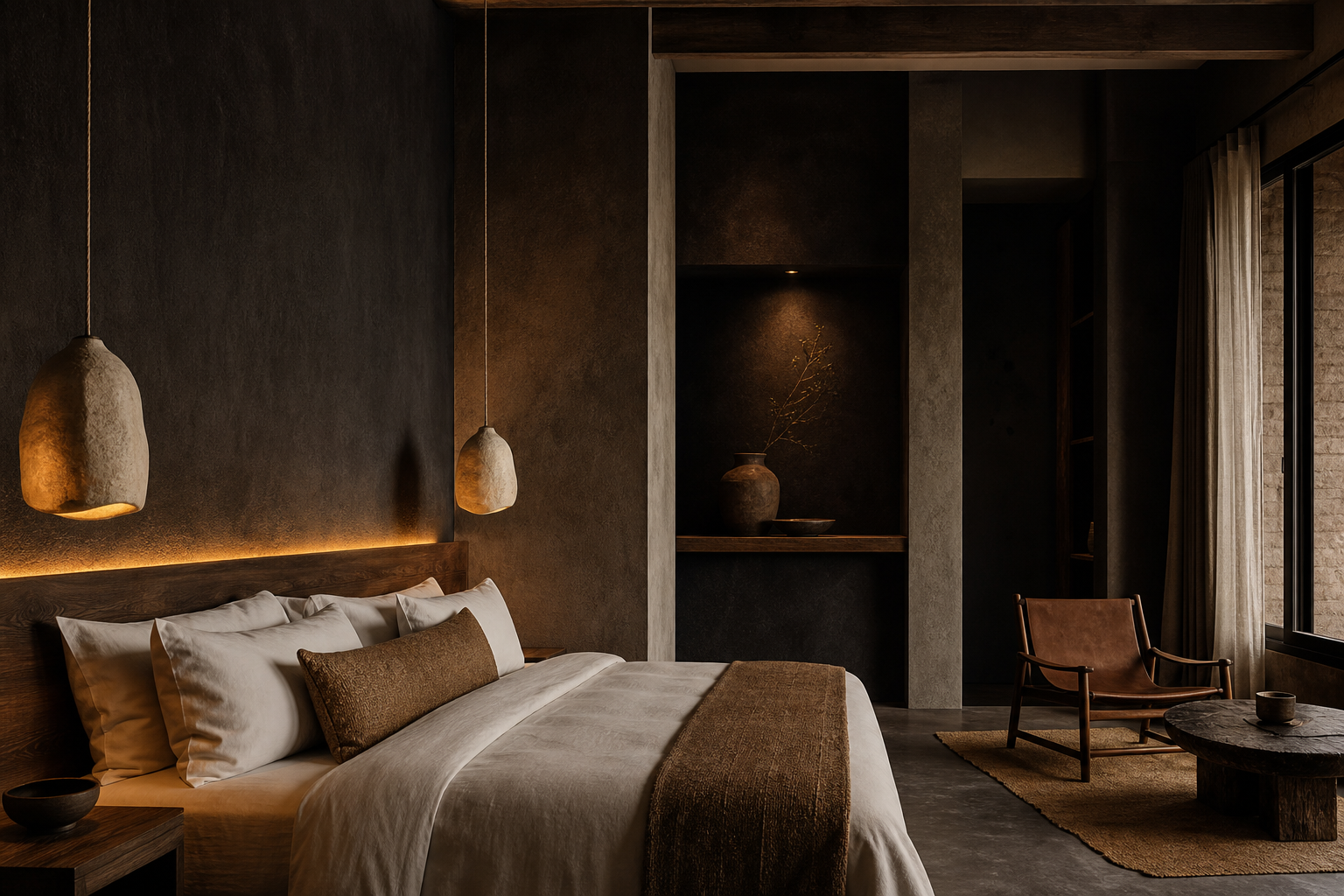
The design-led hotel sells atmosphere and story — how wabi-sabi materials, warm dimming and low-level layering turn that into a buildable specification, and how buyers manufacture it at project scale.
2026-09-10 · 9 min read · Lighting guide
A boutique hotel does not compete on square meters or meeting rooms; it competes on whether a guest photographs the room within ten minutes of arriving. Lighting is the largest single lever on that outcome — more than furniture, more than art — because light is what the camera and the eye actually record. The current design language dominating the segment borrows from Japanese and Mediterranean vernaculars: wabi-sabi materials with visible hand and imperfection, plaster and stone surfaces, warm low light with no visible source, and pieces that look commissioned rather than purchased. The commercial point for buyers is that this trend is unusually friendly to project manufacturing: the aesthetic rewards slight variation and natural material, which suits factory production far better than high-gloss uniformity ever did.
At specification level the look translates into numbers that barely resemble an office project. Ambient levels sit low — 50-150 lux in rooms and lounges, in the style of EN 12464-1 hospitality practice — carried by wall sconces, table lamps and pendants rather than ceiling grids. Color temperature lives at 2200-2700 K, with dim-to-warm drivers that drift warmer as levels drop, mimicking incandescence and candlelight. CRI runs at 90 or better wherever timber, textiles, plaster and stone carry the design. And the layering rule is strict: no space lit by downlights alone, ever.
The wabi-sabi direction also changes what quality means at acceptance. A machine-perfect finish on rattan or plaster is almost a contradiction; the weave will vary, the plaster will hold trowel marks, the stone will glow unevenly — and the design intent is precisely that evidence of hand. What must not vary is the engineering behind the surface: structure, thermal management, electrical safety and dimming behavior are held to tight tolerance while the visible material breathes. Writing that split into the specification prevents both failure modes — sloppy engineering excused as charm, and rejected batches that were simply honest materials.
The boutique formula differs floor by floor, and the zone table is where the aesthetic becomes enforceable. Typical structure, illustrative values:
| Zone | Typical levels | Layers | Character notes |
|---|---|---|---|
| Guestroom | Ambient 50-100, bedside reading 150-200, vanity 300 vertical | Pendant or sconce + bedside task + concealed cove | No bare downlights; warm 2200-2700 K; master switch dims, never kills |
| Bathroom | 300 vertical at mirror, 100 ambient | Backlit mirror or flanking sconces | CRI 90+; front light on faces, not overhead shadow |
| Lobby / lounge | Ambient 100-150, accents 300-500 | Statement pendant + sconces + table lamps + accent | The hero piece carries the brand; 3-5:1 accent ratio |
| Corridors | 50-100 | Sconces + art accents | Presence dimming to 30-50%; art lit warmer than path |
| Restaurant / bar | 100-200, dimmable to 30 | Pendants at tables + cove + accent | Dim-to-warm essential; candlelight is the end of every curve |
Values are illustrative starting points in hospitality practice; the operator's brand standard overrides where one exists.
Material selection is the other half of the spec, and it is where wabi-sabi becomes concrete. The fixture families dominating the trend: alabaster and travertine for glowing stone (our alabaster guide covers the material, and the alabaster vs travertine comparison the sourcing trade-offs), rattan and cane for woven warmth, washi and rice paper for diffused glow, hand-blown glass with seed bubbles as a feature rather than a defect, and hammered brass, blackened steel and plaster finishes for the metal and mineral registers. Each material has a manufacturing reality a buyer should know before falling in love: natural stone varies tile to tile, hand-finishing varies piece to piece, and the specification should write tolerance bands for variation — a sample-approval process that says "within this range is correct," not a promise of machine sameness the material cannot keep. The wabi-sabi trend guide maps the commercial side, and the broader palette sits in our decorative lighting and chandelier and pendant programs.
Procurement for these pieces runs through the FF&E schedule rather than the electrical package, which surprises buyers used to downlights and panels. Lead times, approval cycles and damage liability follow hotel-FF&E conventions — samples approved by the interior designer, mockups in the actual room, containers sequenced to floor completions — and a supplier who understands FF&E logistics is worth a price premium over one who ships electrical goods. Confirm which convention the pieces are bought under before quoting, because it changes packaging, spares and who signs for fragile cartons on site.
Boutique guests never touch a dimmer; the room simply behaves. The control pattern behind that behavior is modest and repeatable: a bedside scene keypad (arrival, relax, night), dim-to-warm drivers on the ambient layer, fades of three to ten seconds so transitions feel like dusk rather than switching, and a master switch that dims the room to a night path level instead of extinguishing it — the detail guests mention in reviews without knowing why. Corridors and back-of-house run presence dimming to a 30-50 percent background; restaurant and bar curves land at candle-level at the bottom of the range, which is where driver quality shows, since the last 10 percent of a dimming curve is where commodity drivers flicker or shift green. Our smart lighting program covers the DALI and scene stack behind these behaviors.
One control detail earns its keep nightly: the master switch behavior. Guests kill the lights from bed, then cross a dark room — the night-path setting, a dimmed floor-level glow from the cove or a low sconce, prevents the stumble that turns into a review mention and, occasionally, an insurance claim. It costs one driver channel per room and ranks among the most-praised details in post-stay feedback, an illustrative observation but one repeated across operator surveys.
Custom decorative manufacturing at hotel scale runs on approvals, so the procurement sequence matters more than price. The closing checklist: material and finish samples for each hero piece, a written variation tolerance for natural materials, structural and thermal data for the custom pendants, dimming curve documentation for the driver of record, photometric files for the functional layers, and packaging engineered for fragile shades and stone — a specialty covered in our flat-pack packaging guide. Certification follows the destination market — CE for the EU, UKCA for the UK, SAA for Australia, SASO/SABER for the Gulf — issued via certified partner factories and verified by certificate number; the matrix is summarized in our certification guide.
Commercially, custom programs carry custom terms: sample and mockup rounds in 7-14 days per round (illustrative), custom production typically 30-45 days after approval depending on complexity, and minimums on bespoke pieces that vary by family — confirm MOQ per item at inquiry, since a 12-key guestroom floor with four fixture types is a different negotiation than a 200-key rollout. The wider hotel program — guestroom, corridor, back-of-house and the operator-standard layers — sits with our hotel lighting solutions team, and the room-level formula is detailed in the guestroom lighting guide. Close the program with the three clauses boutique projects forget: complete spares for every custom piece, the finishing kit (touch-up paint, extra hardware) delivered with the goods, and the as-built schedule so year-three reorders do not start from photographs.
Materials, finishes and bestsellers — the commercial map of the craft aesthetic.
The 4-layer formula operators specify — bedside, vanity, ambient and master switch.
Choosing stone lighting series — glow quality, weight, cost and sourcing trade-offs.
How buyers actually work the Zhongshan lighting cluster — markets, factories and QC.
Mockup plan, custom manufacturing proposal and a per-project quotation — first response within 24 hours.