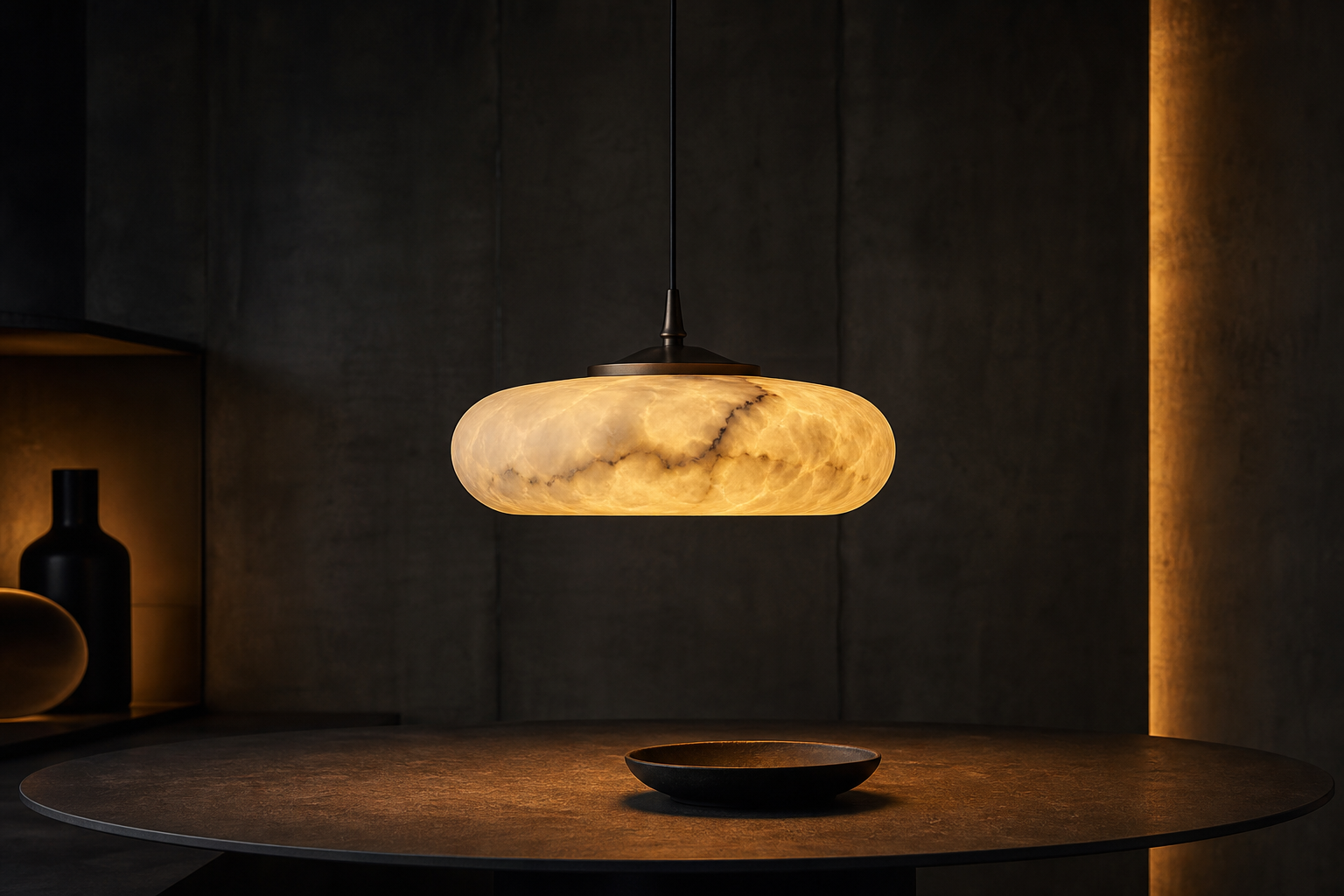
An alabaster lamp is a luminaire whose diffuser or body is carved from alabaster — a fine-grained, translucent stone — so the light source inside is never seen, only the stone's own warm glow. Alabaster is one of the oldest lighting materials in human history: Egyptians carved lamps and vessels from it millennia ago, and its hold on designers has never quite let go. In the current cycle it has returned to the front of high-end residential and hospitality catalogs, riding the broader turn toward natural materials — stone, travertine, rattan, hand-blown glass — as an antidote to plastic-minimalist interiors.
For trade buyers, alabaster lighting is a distinctive category to source: part mineral commerce, part craft production, part LED engineering. No two lamps are identical, production does not scale like a die-cast factory, and the gap between genuine stone and resin imitation is where most of the category's disputes live. This guide covers the material, the making, and the checks that keep a stone lighting program honest.
The material: why alabaster glows
Alabaster in the lighting trade means two related minerals — historically gypsum-based alabaster, and the calcite variety sometimes called onyx marble — both of which share the property that matters: fine, even translucency. Light entering the stone scatters through its microcrystalline structure and emerges softened, picking up the stone's warm palette of whites, creams, honeys and ambers. The effect is unlike any manufactured diffuser. Where acrylic diffuses uniformly, alabaster varies — thicker sections glow deeper, veining throws soft shadows into the light, and the surface holds a matte, tactile, stone-touched finish that photographs of the material undersell.
The stone is also soft — soft enough to carve with hand tools, which is the second reason it dominates this niche. Artisans can shape domes, cylinders, organic pebble forms and thin-walled globes that would be impossible in harder stones like marble or travertine, and can bring walls down to a few millimeters where the design wants maximum glow. The trade-off is fragility: alabaster scratches, chips and can crack under point loads, which shapes everything about how the lamps are engineered, packed and shipped.
Color and veining are the material's character and its commercial complication. Blocks from different quarries — with historically important sources in Egypt, Spain's Aragon region and producing areas in Asia — differ visibly, and even within one quarry the stone ranges from near-white to deep honey with clouds and veins that no two pieces repeat. Buyers should treat that variation as the product's identity and write an acceptance band around it, rather than expecting catalog-identical units — the point elaborated in our alabaster versus travertine comparison.
How alabaster lamps are made
Production is craft-scale by nature. Blocks are selected by grade — color consistency, translucency, freedom from structural cracks — then cut, roughed to shape and carved, most of it by hand against templates for repeat models. Walls are brought down to the target thickness for glow, surfaces are sanded through progressively finer grades, and the piece is sealed. Electronics follow: a lamp holder or LED module, often warm 2700K-3000K to partner the stone's own warmth, sometimes dimmable, mounted into a metal or wooden canopy assembly. Each finished lamp is a one-off in detail even when it is exact to a model.
| Material | Light quality | Weight | Uniqueness | Typical positioning |
|---|---|---|---|---|
| Natural alabaster | Warm, varied, deep glow with veining | Heavy | Every piece unique | High-end residential, boutique hospitality |
| Resin imitation | Uniform, often flatter glow | Light | Repeats | Budget lines, sometimes passed off as stone |
| Travertine | Opaque texture; glow only at thin edges | Heavy | Veined but non-translucent | Wabi-sabi trend fixtures, bases and bodies |
| Glass (opal/amber) | Even, controlled diffusion | Medium | Repeatable | Volume decorative programs |
Category-typical characteristics, illustrative — material declarations and samples settle every real order.
The resin question deserves directness: molded imitations are common, sometimes openly sold as resin, sometimes presented ambiguously as "alabaster-effect." The difference is detectable — weight, temperature to the touch, veining that repeats between units, glow uniformity — and for order quantities it is checkable at pre-shipment inspection. Our Guzhen sourcing guide covers inspection practice in the cluster where much of this production concentrates.
LED integration and product engineering
Modern alabaster lamps are LED products with stone shades, and the engineering centers on three points. First, LED color temperature: warm white — 2700K or 3000K — is near universal, because cool light kills the honey depth that makes the material desirable; high CRI matters for the same reason the stone is chosen, since the glow should carry skin-tone-adjacent warmth. Second, heat: LED sources run far cooler than the incandescent lamps that lit alabaster historically, which both protects the stone and allows thinner glowing walls; drivers nonetheless need placement that keeps their heat from sitting against the stone. Third, serviceability: quality designs make the LED module or lamp holder replaceable without dismantling the stone, because the stone is the part nobody wants to replace. Weight is the fourth, less obvious spec — genuine stone shades at chandelier scale add real kilograms, so suspension systems, ceiling fixings and, again, packaging are engineered around the mass.
Sourcing alabaster lighting for trade programs
- Material declaration in writing. Natural stone versus resin stated on the quotation and BOM; sample approvals from production-intent material, not showroom-best.
- Color band and batch approval. Agree the acceptable color range and veining character; approve reference photos per batch. This single practice prevents most disputes.
- Certification of the electrical assembly. CE (LVD/EMC/RoHS) for the EU, UKCA for the UK, SAA for Australia — via certified partner factories and verified per order; the stone is natural, the lamp must still be a compliant electrical product.
- Fragile-goods packing. Foam-formed cavities, stone elements isolated from metal parts, drop-test cartons. Breakage claims in this category are packing claims.
- Lead time realism. Made-to-order carving does not follow die-cast schedules. Illustrative export reference: 45-60 days for typical made-to-order programs, longer for multi-tier chandeliers; FOB quotation within 24 hours of the item list.
- Spare parts by design. Order spare LED modules and holders with the first batch; a five-year program should never scrap stone for electronics.
Common mistakes when buying alabaster lighting
- Ordering stone like a commodity. Expecting 50 identical units contradicts the material. Programs define a band and approve per batch.
- Accepting ambiguity about material. "Alabaster-effect" is resin. The declaration costs nothing and settles warranty questions before they exist.
- Wrong color temperature. 4000K electronics in an alabaster body neutralize the stone's warmth — a product error no packaging recovers from.
- Under-engineering suspension. Stone is heavy; canopy fixings and chains specified for glass will not do. Weight belongs on the drawing.
- Ignoring lead time in project planning. Carving queues are real; boutique hotel fit-outs that order stone lighting at fit-out speed pay in delays.
- Treating veining as a defect. Inspection teams briefed to reject "stains" reject the product. Brief them on the band, not on perfection.
Alabaster rewards buyers who treat it as what it is: a natural material shaped by hand around modern light. Specify the band, verify the material, engineer for weight — and the category delivers the one quality no mass-market diffuser can fake. The current shapes and bestselling forms are tracked in our alabaster lighting trend report, and the wider stone-and-craft line sits within the decorative lighting range.