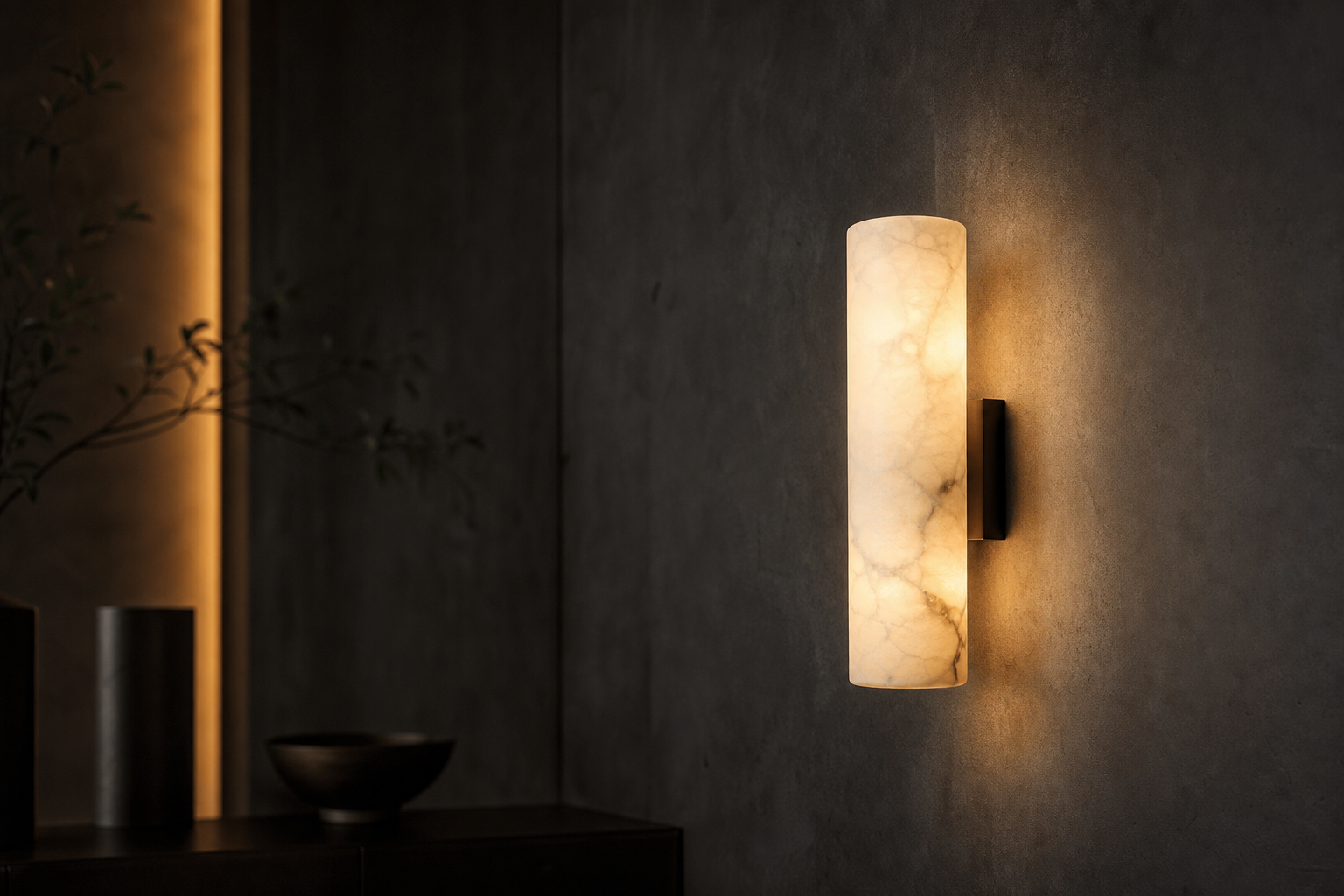
The glowing stone has moved from museum objects to hotel lobbies and catalog bestsellers. What is driving it, how the material grades differ, and the sourcing rules that keep a stone program out of trouble.
2026-09-10 · 8 min read · Sourcing guide
Alabaster lighting is not new — carved alabaster vessels and shades are ancient — but its current commercial wave is recent, and it has three identifiable drivers. First, the warm-minimalist interior cycle: after a decade of polished metals and crisp geometry, hospitality and high-end residential buyers want warm, tactile, natural materials, and glowing stone is the strongest possible statement of that direction. Second, LED technology finally suits the stone: low-heat, compact, 2700K LED modules let light pass through thin alabaster walls without cooking the mineral or the diffuser, which halogen-era designs struggled to manage. Third, social-media scale: alabaster's after-dark glow is uniquely photogenic, and every hotel lobby that installs a stone wall or glowing pebble pendants generates demand in channels that never read lighting magazines. AURELUX tracks this from its position as a cluster sourcing partner coordinating stone-material studios in the Guzhen decorative cluster; all commercial figures below are illustrative and confirmed per order.
Alabaster is a fine-grained gypsum (in trade terms; "Egyptian alabaster" is technically calcite) prized for translucency — the property that makes a lamp of it. Two origins dominate the international trade: Spanish alabaster, notably from the Aragon region, regarded as the premium source for consistent white, highly translucent blocks; and Egyptian and Middle Eastern material, often warmer in tone and more veined, with its own design following. Within either origin, grade is decided by color evenness, vein character, translucency and freedom from cracks or resin repairs — and grade drives price more than any other variable. The professional rule: buy blocks or approved slab ranges, not abstract "grade A" claims.
| Attribute | Premium tier | Working tier | What to reject |
|---|---|---|---|
| Color | Even snow-to-honey white across the shade | Mild tonal movement, acceptable veining | Gray or yellow patches; mismatched panels in one shade |
| Translucency | Even glow, no hot spots at working wall thickness | Soft clouding that still reads uniform when lit | Opaque streaks; bright rings over the light source |
| Integrity | Crack-free; natural veins only | Minor filled fissures disclosed in writing | Undisclosed resin repairs; hairline cracks at edges |
| Veining | Fine, scattered, symmetric placement on visible faces | Pronounced veins accepted as character | Vein pattern wildly different from approved sample range |
Grading language varies by studio; the table is a buyer's frame, not a trade standard. Approve material as a photographed range, in writing.
The alabaster look is an optical system, not just a mineral. Wall thickness decides everything: thin, even walls (typically in the low centimeters for shades and discs; illustrative working range) glow evenly; thick or uneven sections hot-spot above the module. The light engine should be 2700K with high CRI to bring out the stone's warm tones, mounted with an intentional gap or diffusing layer so the source never prints through the surface, and binned consistently across a collection so two lamps in one room match — natural material already varies; the LED must not add its own variance. Dimming deserves an explicit decision: warm-dim modules that deepen toward 2200K on low output flatter alabaster dramatically, and phase-cut compatibility should be tested with the driver before the order, not discovered in the showroom.
Alabaster is natural stone; no two shades are identical. A professional order therefore does four things. One, approve a photographed sample range — three to five pieces spanning the acceptable tonal band — rather than a single golden sample. Two, write the acceptance window into the purchase order: tone range, vein character, repair disclosure policy. Three, require lit inspection: every shade checked powered, because translucency defects are invisible unlit; a pre-shipment inspection with a 100% lit check on shades is the working standard for stone programs. Four, plan spares: a 1-3% spare ratio per program (illustrative, per project norms) covers transit damage in a fragile, non-reproducible material.
Stone changes the logistics conversation. Shades are heavy for their size — a wall lamp that ships in one carton as a metal fixture may need molded foam cradles and double cartons as stone — and assembled pieces accumulate weight fast, so container weight limits arrive earlier than they do in metal programs. Require drop-tested packaging with per-piece cradles, humidity-buffered wrapping for ocean freight, and hardware bags that account for the stone's mass (anchors and fixings rated for the real weight; ceiling boxes must be specified accordingly). Flat-pack strategies apply to frames and arms; the stone elements themselves travel crated. Consolidating stone lines with the rest of a decorative program works well in a mixed container — provided the loading plan keeps stone away from crush zones, which is exactly the kind of detail a cluster partner manages at stuffing.
For the material fundamentals, start with what an alabaster lamp is and the stone-on-stone comparison in alabaster vs travertine lamps. The craft context lives in our wabi-sabi trend guide, the deployment logic in our hotel lighting program, and the full series in the decorative lighting catalog.
Alabaster's current catalog has consolidated around a recognizable set of forms, and distributors building a series benefit from knowing which carry volume and which carry image. The glowing pebble and sphere pendant — a rounded, softly irregular stone volume on a slim cord — is the trend's signature and its entry SKU, usually sold in clusters of three or five at staggered heights for stairwells and lobbies. The dome and hemisphere family covers pendants and wall lamps with a flat or curved glowing face, the workhorse of hotel corridor and bathroom-adjacent programs. Slab and disc sconces — a thin vertical or circular stone panel wall-mounted with edge light — are the series's most photographed piece and its best social-media asset. Column and cube floor lamps extend the material's presence to the room's floor plane, and linear stone pendants over counters and bars translate the language to commercial scale.
Two engineering notes apply across the set. First, form determines wall thickness, and wall thickness determines both glow quality and weight — domes glow more evenly than flat slabs of equal thickness because curvature distributes the light, and every added centimeter of stone moves the fixture into structural-fixing territory. Second, the forms that look simplest are the most material-hungry: a large, even-toned dome consumes premium blocks that a veined sconce would reject, which is why identical-size pieces can differ sharply in price and why the grade conversation from earlier in this guide is really a form-by-form conversation. Build the series around one or two volume forms in working grade and let premium pieces carry the imagery — the structure that keeps a stone program profitable as well as beautiful.
The stone that glows — the material science behind the moment.
Choosing between the two stone families for a coherent series.
Cutting freight cost without breakage — the fragile-line discipline this trend demands.
How professional buyers work the lighting capital — districts, audits and export routes.
Tell us the program — a stone series with graded sample ranges, lit inspection and FOB quotation within 24 hours.