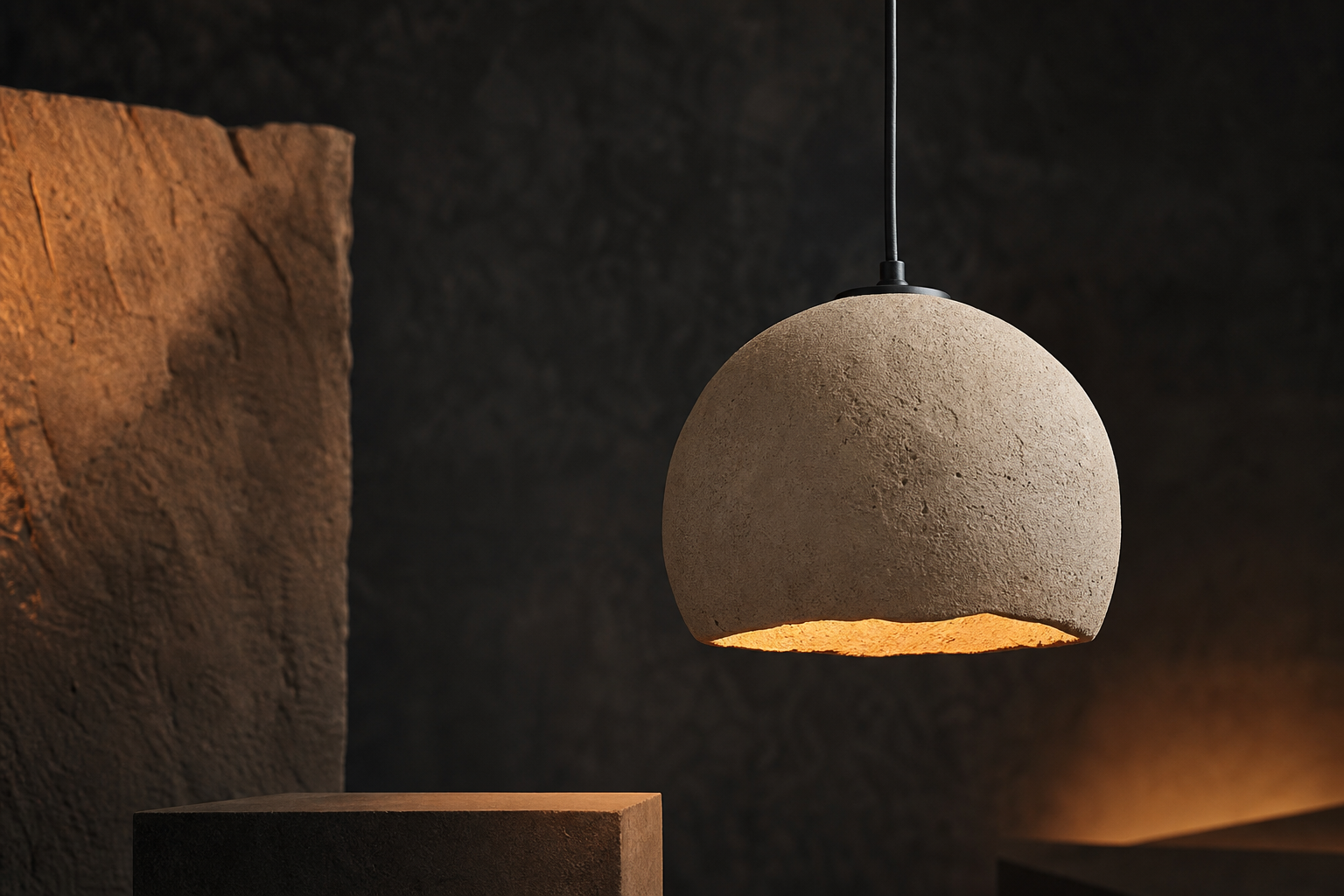
The imperfect, handmade look is now a commercial category. What it is made of, which forms sell, and how to source handmade variance without inheriting quality chaos.
2026-09-10 · 8 min read · Sourcing guide
Wabi-sabi borrows a Japanese aesthetic idea — beauty in imperfection, impermanence and incompleteness — and turns it into a product language your buyers already recognize from boutique hotels and design retail: asymmetric hand-thrown ceramic pendants with visible throwing rings, rice-paper shades that glow rather than shine, rattan and bamboo weaves with honest irregularity, and hand-blown glass with seeds and ripples kept in. Commercially, the trend is a reaction against the polished minimalism of the last decade: buyers want objects that read as made by a person. For a sourcing partner like AURELUX — organizing decorative workshops across the Guzhen cluster, where entire districts specialize in ceramic, rattan and glass crafts — the trend is less a novelty than a re-weighting of existing craft supply toward export programs. Every commercial figure here is illustrative and confirmed per order.
| Material family | Character & light effect | Finish notes | Sourcing consideration |
|---|---|---|---|
| Raw / unglazed ceramic | Matte, earth-toned; throwing rings and asymmetry are the point; warm pools of indirect light. | Speckled clay bodies, oatmeal and rust glaze dips, partial glazes. | Hand-thrown = piece-by-piece variance; approve a sample range. |
| Washi-style paper & fabric | Soft, even glow; the fixture disappears into its light; strong in hospitality bedrooms. | Laminated paper over frames, linen-look fabrics, org-shaped forms. | Frame rigidity and fire-safety treatment belong in the spec. |
| Rattan & bamboo | Patterned shadow play; natural tone shifts; coastal and resort projects' favorite. | Natural, smoked, whitewashed weaves; open vs tight weave density. | Weave density drives both look and durability; inspect knots. |
| Hand-blown glass | Ripples, seeds and gradient tints; premium tier of the trend. | Smoked, amber, opal gradients; irregular silhouettes. | Higher breakage planning in packaging; weight varies per piece. |
| Hemp rope & paper cord | Woven texture, warm dim read; pairs with black steel frames. | Natural and charcoal wraps; single-cord vs dense weave. | UV stability matters in sunlit retail; ask about fiber treatment. |
Across hotel and retail programs, five forms carry most of the volume. Org-shaped paper pendants — the ellipsoid rice-paper form popularized by mid-century designers — remain the trend's entry point and its best seller. Asymmetric thrown-ceramic pendants in 20-40 cm sizes anchor the mid tier, usually in single-pendant and three-cluster versions. Wide shallow rattan bowls over tables sell in resort and coastal markets. Cluster arrangements — five to nine small pendants at staggered drops on one canopy — translate the trend to double-height lobbies where a single small pendant would vanish. And floor and table versions of the same paper and ceramic language extend the collection beyond the ceiling, which matters because distributors sell collections, not fixtures. Keep the range narrow and deep: four or five forms in three finishes outsells a sprawling catalog with shallow stock.
Handmade variance is the product, and it is also where naive orders go wrong. A hand-thrown ceramic pendant will vary in height, lip diameter, glaze pooling and weight from piece to piece; a rattan weave varies in tone with each harvest batch. The professional move is to convert variance from a complaint into a specification: approve a sample range rather than a single golden sample, write the acceptance window (size tolerance, tone range, glaze character) into the order, and mirror that language in your own catalog and website — "each piece varies; that is the point" — so the end customer expects what the factory ships. Packaging must respect fragility as a design fact: molded pulp or foam cradles per piece, drop-tested cartons, and spare parts bags (hardware, diffusers, extra cord) in every box.
The craft capacity sits in the decorative districts of the Guzhen cluster and its surrounding workshop towns, where ceramic studios, weaving shops and glass-blowing lines have supplied domestic showrooms for decades and now run export programs. Working terms reflect the handmade reality: samples 7-14 days for standard forms; custom and scaled forms 14-21 days; decorative lines quote per project rather than against fixed MOQs, though repeatable forms settle into trial-order rhythms of 100-200 pcs (all illustrative). Certifications for destination markets are organized via certified partner factories with verifiable certificate numbers. Because these pieces are light but bulky, freight planning matters: flat-packable paper and textile forms ship economically, ceramic and glass ship crated — consolidation into a mixed decorative container is where a cluster partner earns its fee.
See the material families live in our decorative lighting catalog, the hospitality deployment logic in our hotel lighting program, and the sourcing mechanics in the Guzhen sourcing guide. For the trend's stone sibling, read why alabaster is having a moment.
Selling the trend requires a finish language precise enough to survive translation from designer to factory. The working palette clusters into four families. Undyed naturals — raw clay in oatmeal, sand and terracotta tones, bleached and natural rattan, undyed paper — carry the authentic hand of the material and are the trend's core. Charcoals and smokes — black-washed rattan, smoked glass, dark glazed ceramic — give the same forms an evening and hospitality register. Whitewashes and chalks soften weaves and ceramics for coastal and Scandi-adjacent interiors, and accent glazes — pooled amber, mossy green, iron-speckled — supply the collectible, limited-run feel that premium programs charge for. Specify finishes with physical references (glaze tiles, weave samples) rather than color names; "sand" means six things in six factories, and the sample cycle is where that ambiguity gets expensive.
Collection architecture is the other commercial decision worth making deliberately. The pattern that works for distributors is a narrow-deep grid: four to six forms, three finishes each, one light-engine specification across the range, plus a floor and table extension sharing the same visual language. That grid creates enough combinations to fill a catalog page while keeping stock depth per combination viable — and it standardizes the LED module and driver across the collection, which quietly solves certification, spare parts and color consistency in one move. Resist the catalog temptation to add forms before depth; in handmade categories, every additional form is another sampling cycle, another variance negotiation and another SKU to keep lit on the floor. The series architecture examples in our decorative catalog follow exactly this logic.
Quality control for handmade lines deserves its own checklist rather than the standard commercial one. On top of the variance range and the lit inspection, three checks earn their place: a pull test on suspensions — cords, canopies and internal frames carry the piece's weight for years, and hand-tied knots are the quiet failure point; a fire-treatment certificate for paper and fabric shades, since both hotel inspectors and EU market-surveillance authorities ask; and a carton audit that opens packed boxes at random, because handmade lines are exactly where a well-meant factory substitutes foam for pulp or skips the spare-parts bag when a deadline presses. Pre-shipment inspection with a slightly raised sampling level is cheap insurance for a category where every unit is slightly different by design — and where that same uniqueness is your sales argument, the inspection protects both sides of the transaction at once.
The stone that glows — origins, grades and the light sources that make it work.
Choosing between the two stone families for your lighting series.
Where wabi-sabi and local-craft trends actually get specified — room by room.
How professional buyers work the lighting capital — districts, audits and export routes.
Tell us the mood and the market — a curated wabi-sabi series with sample ranges, variance terms and FOB quotation within 24 hours.