2026-09-10 · 8 min read · Comparison
The short answer
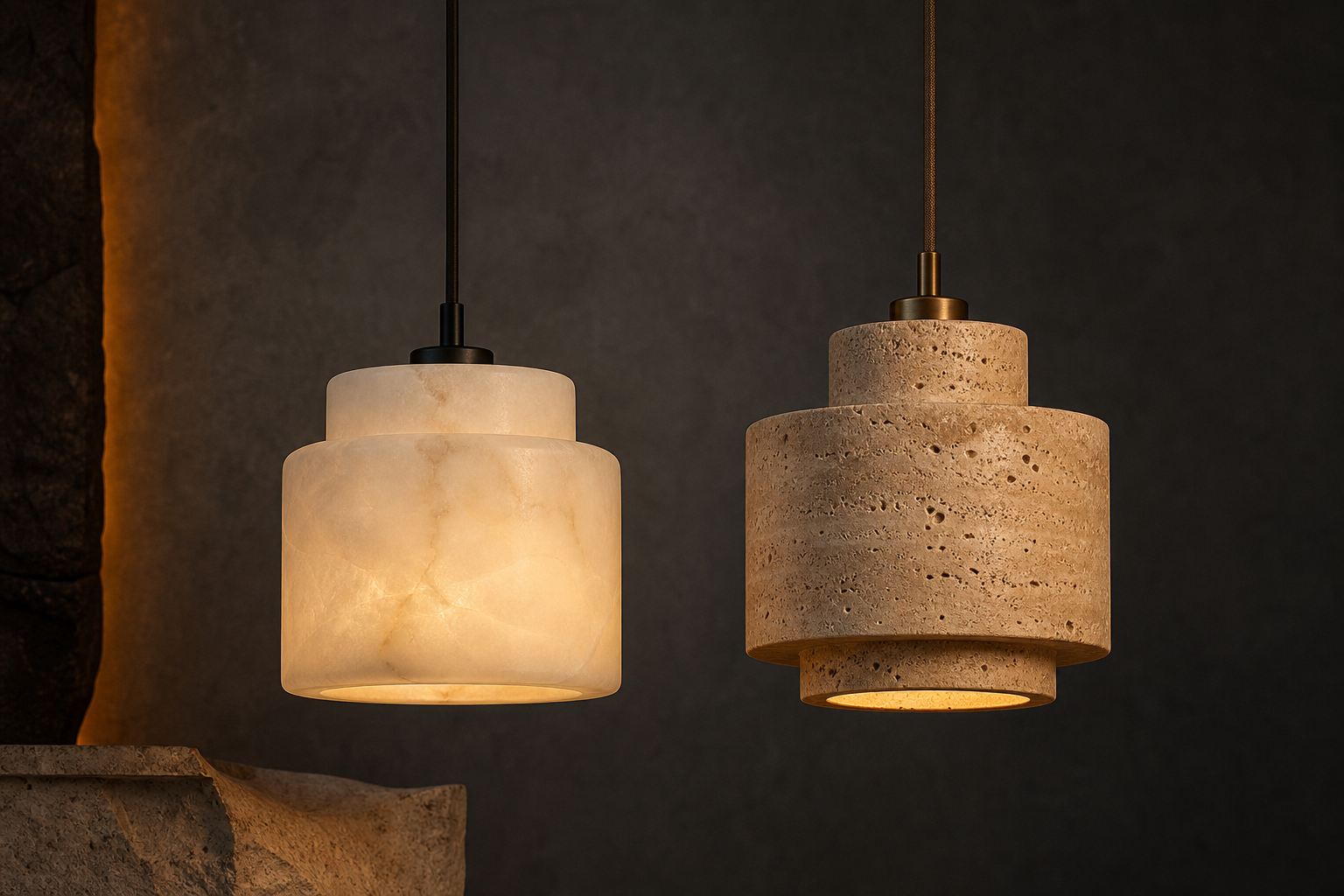
Choose alabaster when the product's promise is glow: a translucent stone that turns the lamp itself into the light source, ideal for pendants, sconces and statement pieces in boutique hotels and premium residential programs. Choose travertine when the promise is texture: an opaque, warm-toned stone whose pitted surface and mineral banding make the fixture read as sculpture whether lit or unlit. Both are natural materials with variation that buyers must manage deliberately, both ride the same earth-tone design wave, and a strong decorative lighting series can carry both as siblings — alabaster for mood, travertine for mass. The sections below cover what actually differs when you are approving samples and pricing a line.
Two stones, two lighting behaviours
Alabaster is translucent: light passes into the stone, scatters, and exits with a soft, deep warmth no diffuser replicates. A lit alabaster pendant glows from within, its veining visible like clouds in amber milk. This behaviour dictates the engineering — LED sources sit close behind the stone, low colour temperatures (2700K and below) flatter it best, and the fixture's quality lives or dies on stone thickness and light placement. Too thin and it looks like plastic; too thick and it goes dark. Factories that know alabaster control thickness within a narrow window per design, and that control is exactly what a buyer should verify in samples.
Travertine is opaque: light never enters, so the design grammar is borrowed from sculpture and architecture rather than from glow. The stone's appeal is its surface — warm creams and greys, horizontal banding, open pores — usually shaped into cylindrical or geometric forms and lit by internal uplight, downlight or an adjacent source that grazes the texture. Travertine lamps anchor space by mass and material honesty; they photograph beautifully in lobbies exactly because the stone reads even when the fixture is off. In hospitality projects, that off-state presence matters more than buyers expect: lobbies are lit all day, and only a material with inherent character survives being seen unlit.
Material character: veining, colour and variation
With alabaster, variation is performance. Veining density changes how evenly the stone transmits; cloudy pieces produce uneven patches; whiter, finer pieces glow uniformly. Egyptian and Iranian alabaster (the trade's main sources) differ visibly in tone and transparency, and factories mix them freely unless told otherwise — so the specification conversation must cover origin preference, tone band (cream, amber, grey-green) and veining intensity, confirmed with photos of the actual block or finished units, not catalogue renders. A "natural variation" clause with an agreed photographic range protects both sides.
Travertine's variation is more forgiving but still real: hole density (filled versus unfilled surfaces), banding direction and tone shift between quarries and batches. Unfilled travertine shows the raw pitted character designers currently want; filled and honed pieces read cleaner and suit larger volumes. The QC question is simpler than alabaster's — tone matching across a production batch and consistent surface finish — but the consequences of skipping it are identical: a shelf of mismatched stock and a discount conversation. For both stones, our partner factories photograph and pre-approve production units against the approved sample before packing; that step is standard in our chandelier and pendant programs and worth insisting on anywhere.
Workability, weight and what it means for forms and freight
Alabaster is soft — carveable with woodworking-adjacent tools — which is why the market's alabaster forms run from crisp globes and drums to intricate ribbed and sculptural shapes. Softness also means vulnerability: chipped edges and scratches in transit are the category's signature complaint, so foam-in-mould packaging and drop-test evidence belong in the supplier audit. Travertine is harder and heavier; it machines cleanly into cylinders, cubes and slabs but resists the delicate profile work alabaster takes easily, and its weight loads both the suspension hardware and the freight bill.
Weight drives two commercial consequences. First, structure: a large travertine pendant needs rated canopies, positive-fixing to the ceiling and sometimes two-person installation — worth stating in the product sheet your customers receive. Second, logistics: stone products are freight-dense, and carton volumetrics decide the landed cost more than unit price does. Flat-packable metal components combined with individually boxed stone elements is the standard solution our factories ship with, and mixed-SKU container loading keeps a stone series economically shippable alongside lighter product lines.
Sourcing, QC and price positioning
Both categories cluster in Zhongshan's Guzhen manufacturing ecosystem, where stone-import workshops, metal shops and assembly lines sit within a few kilometres — the sourcing mechanics are described in our Guzhen sourcing guide. The QC emphasis differs by stone: for alabaster, approve the actual blocks or first articles and lock thickness, tone band and veining range in writing; for travertine, lock quarry tone, fill and finish state and banding orientation. In both cases, colour temperature and CRI of the internal source should be contractual — 2700K, 90+ CRI is the common hospitality default (illustrative specification).
Price positioning separates the lines cleanly. Alabaster's raw material cost, yield losses in carving and fragile-goods freight put finished lamps in the premium tier — illustratively several times the price of a same-size fabric or glass pendant — and retail accordingly. Travertine sits somewhat below alabaster for equivalent sizes, though large solid pieces close the gap quickly. For a distributor, that makes alabaster the margin-and-image line and travertine the broader-appeal line; many programs launch with a travertine family and add alabaster SKUs as the brand's premium tier proves out.
Comparison at a glance
| Dimension | Alabaster lamps | Travertine lamps |
|---|---|---|
| Light behaviour | Translucent; glows from within | Opaque; texture lit by grazing sources |
| Signature look | Soft amber glow, visible veining | Earthy mass, banded mineral surface |
| Forms | Globes, drums, ribbed and sculptural carving | Cylinders, cubes, slabs, geometric bodies |
| Weight / handling | Moderate; fragile edges | Heavy; robust but structural load on ceilings |
| Key QC focus | Thickness, tone band, veining range | Tone match, fill state, banding orientation |
| Transit risk | Chips and scratches; foam-in-mould packing | Cracking from impact; weight-managed packing |
| Price tier (illustrative) | Premium; several times fabric/glass equivalents | Premium but typically below alabaster per size |
| Natural fit | Boutique hotels, mood-driven residential | Lobby anchors, earth-tone interiors |
How to choose: three rules
- Decide what the lamp does when lit. If the light effect is the product, alabaster. If the object is the product and light completes it, travertine.
- Match the stone to the customer's ceiling and budget. Structural limits and freight budgets constrain travertine's big forms; alabaster's premium constrains volume positions.
- Buy stone with a camera, not a catalogue. Approve real blocks or first articles, agree a variation range in writing, and require pre-shipping photos of production units — for both stones.
Advice for importers and brand buyers
The stone lighting wave is design-driven and moves faster than conventional fixture lines, so the operational advice is about speed with control. Sample two or three factories per series rather than one, compare the same design across them, and keep the approved golden sample as the contract reference. Specify the light source (CCT, CRI, dimming protocol) as firmly as the stone — the glow that sells alabaster is a lighting spec, not an accident — and confirm certification paperwork for the destination market via certified partner factories before committing shelf space.
Send the series concept, target sizes and quantity bands, and we will return factory options, sample pricing and FOB quotations within 24 hours, with first-article photos before any deposit goes further than it should.