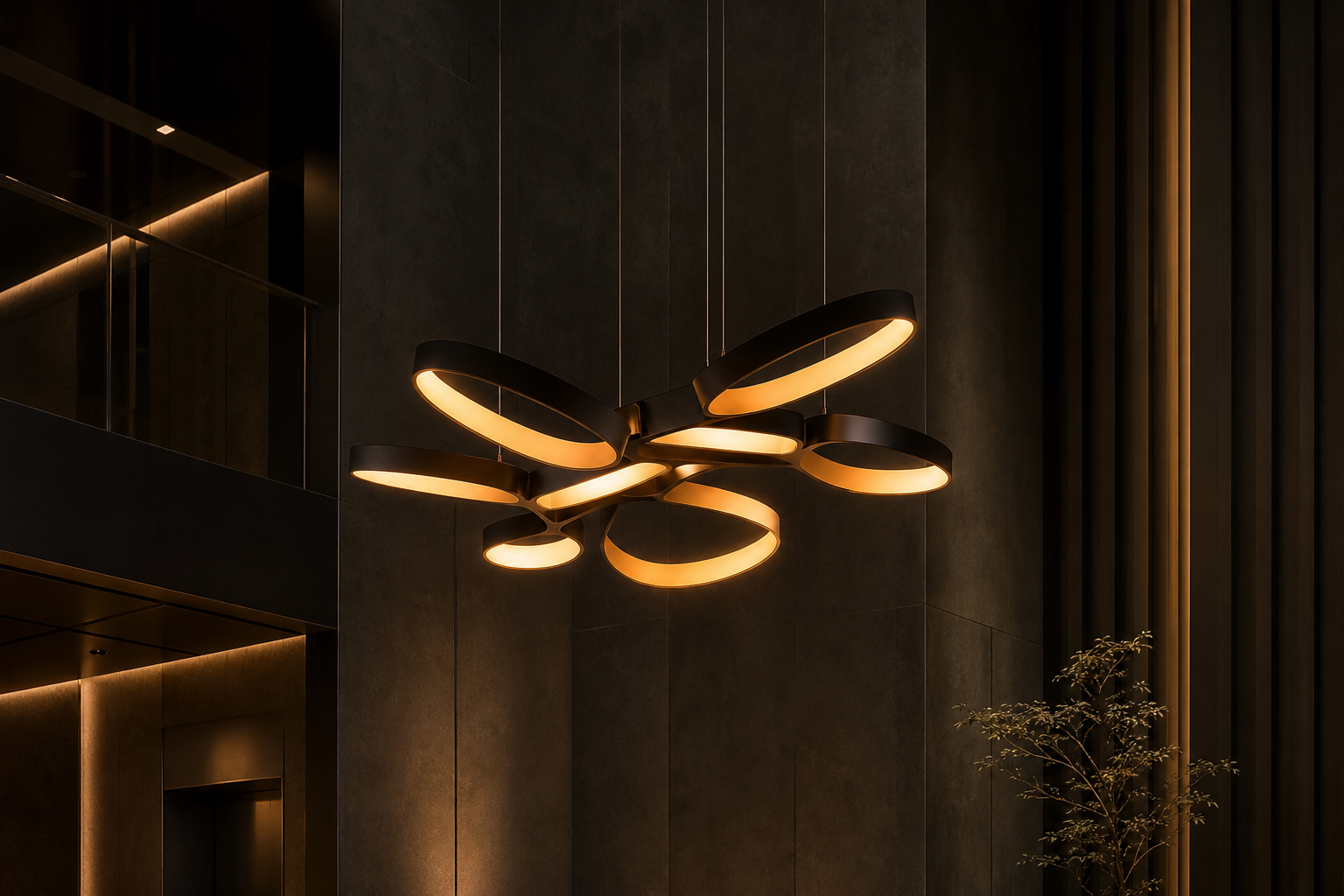
What makes a chandelier a chandelier, how the main types differ, the sizing rules that prevent the most common fit-out regret, and what export buyers should verify before ordering.
2026-09-10 · 8 min read · Knowledge base
A chandelier is a suspended, multi-arm or multi-element luminaire that functions as the visual centerpiece of a room first and a light source second. Pendant, chandelier and suspension lamp overlap heavily in modern catalogs, but the working distinction holds: pendants hang singly and light a zone, while chandeliers command a volume — a lobby double-height space, a dining room table, a staircase — and are specified as much for their daytime silhouette as for their after-dark output. In project terms, a chandelier is the one fixture on the schedule that the owner's interior designer will have opinions about.
Two practical consequences follow. First, chandeliers are weight-bearing products: metal frames, glass and stone elements routinely push a mid-size fixture into the 10-40 kg range, with large lobby pieces well beyond that, so installation is a structural matter, not a ceiling-rose swap. Second, they are assembly-intensive — arms, crystals, diffusers and LED modules arrive as kits — which makes packaging design and assembly instructions part of the product, not an afterthought.
Export catalogs cluster the category into a handful of families:
| Type | Typical diameter | Typical materials | Best suited to |
|---|---|---|---|
| Crystal / tiered | 60-150 cm | K9 or cut crystal, brass frame | Ballrooms, formal dining, classic lobbies |
| Modern sculptural | 50-120 cm | Brass, black steel, alabaster | Hotel lobbies, boutique residential |
| Linear / ring | 90-200 cm long | Steel, acrylic diffuser | Dining tables, conference rooms |
| Lantern / foyer | 40-80 cm wide, tall | Metal frame, glass panels | Stairwells, double-height entrances |
Dimensions are illustrative industry-typical ranges; project pieces are built to order and sized per the reflected ceiling plan.
Materials deserve a buyer's vocabulary before sizing. "Crystal" spans a wide range: K9 optical glass is the workhorse of export product — consistent, lead-free, well-cut — while premium tiers use higher-refractive machine-cut and hand-cut crystal whose edges throw far more sparkle per element; the grade should be stated on the quotation, not implied. Metal frames divide into electroplated steel or iron (the volume standard) and solid or hollow brass, priced and finished differently; finishes should carry salt-spray hours if the fixture serves a coastal hotel. Stone elements — alabaster and travertine above all — are natural materials, so samples approve a range, not a single identical look, and the order should acknowledge that variance in writing.
Chandelier complaints are overwhelmingly size complaints — usually too small. Two rules of thumb keep orders honest. For an open room, add the room's width and length in feet and read the result as inches of fixture diameter: a 14 by 16 foot room suggests a roughly 30 inch (about 75 cm) chandelier. Over a dining table, the fixture's width should land about 12 inches narrower than the table on each side, with the bottom of the fixture 30-36 inches (75-90 cm) above the tabletop — tall enough not to block sightlines, low enough to belong to the table. In circulation spaces, keep a clear 7 feet (2.1 m) from floor to fixture bottom; in double-height volumes, stairwell pieces are sized by the vertical run and viewed from multiple floors, which changes the calculus entirely.
Our chandelier sizing guide walks these rules through worked examples for rooms, tables and stairwells.
The electrical part is ordinary; the structural part is not. Specify a reinforced or independently rated ceiling box for anything beyond a lightweight fitting, and state the fixture weight on the datasheet — installers quote labor against it. Dimming should be decided at order time: most modern chandeliers carry integrated LED modules or E14/E27 LED-candle lamps, and the driver or lamp must match the wall dimmer's protocol (phase-cut, 0-10V or DALI) or the room will flicker during dinner service. Where the fixture hangs in a stairwell, add a maintenance note — lamp access above 4 m is a lift hire, so integrated long-life LED with adequate driver access is usually the cheaper life-cycle choice. Finish and color temperature belong in the same conversation: a 3000K, consistently binned fixture over a 2700K downlight field will read mismatched the day it is switched on.
Installation is also when the project's lighting layers are checked as a set. A chandelier is a decorative layer; it carries mood and silhouette, while downlights, coves and wall washers carry the working lux. Budgeting the chandelier to "light the room" almost always produces an overbright centerpiece and an underlit floor — the layering logic in our hotel lighting program and the indirect-layer options in the cove lighting guide both exist to prevent exactly that. Confirm, too, who assembles: on-site assembly of a large fixture is hours of labor at height, and flat-packed export cartons assume an installer with the instruction sheet and spare parts bag in hand before the ladder goes up.
Chandeliers are the category where factory capability matters most per dollar. Ask how crystals and stone elements are sourced and graded, whether finishes are salt-spray tested, and whether the frame has been load-tested at a stated safety factor. Certification follows destination (CE, UKCA, SAA, SASO) via certified partner factories, verified by certificate number and database link. Then interrogate the packaging: mature suppliers ship chandeliers flat-packed — frame, arms and elements in layered foam — which cuts freight dramatically; our guide to flat-pack chandelier packaging covers the trade-offs. Assembly instructions in the destination language, spare crystals and touch-up paint in the carton are standard for export-grade product.
Illustrative commercial terms: samples or single showroom pieces ship in 7-14 days; production runs 35-55 days after deposit for larger fixtures — longer than commodity fittings because finishing and assembly are sequential — and pricing is quoted per project, scaled by size, material and crystal grade. Pre-shipment inspection should include a full assembly dry-run with photos before packing. For sourcing context, see our Guzhen sourcing guide — the decorative cluster around Zhongshan is where these fixtures are made at scale — and the scene-level thinking in our hotel lighting solution page.
Match fixture to room and table with worked rules of thumb for every ceiling volume.
A 2026 sourcing guide to the Chinese market — who to quote and how to audit them.
Finishing the hotel project right — how frame finish changes the whole fixture's read.
How professional buyers work the lighting capital — districts, audits and export routes.
Room dimensions, finish and target mood — sizing advice, renders and FOB quotation within 24 hours.