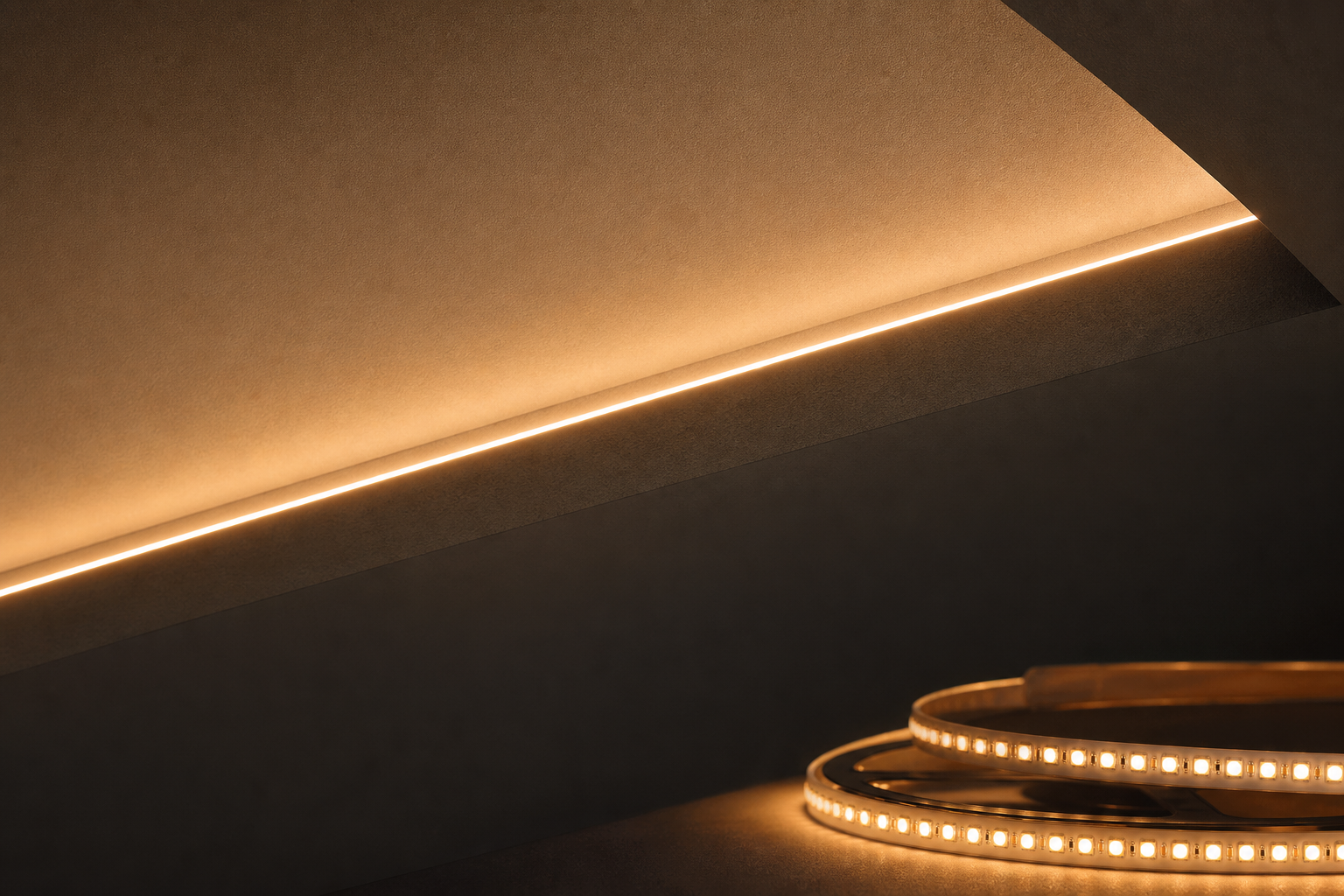
Cove lighting is indirect lighting built into a ledge, recess or crown — the "cove" — so the light source is hidden from view and the surface it aims at, usually the ceiling, becomes the visible light. Nothing in the field of view says "lamp." The ceiling glows evenly, edges of the architecture are drawn with light, and the room picks up a soft ambient layer that no downlight can imitate. It is a signature element of hotel rooms, upscale restaurants, retail feature ceilings and residential interiors, and in export trade it lives almost entirely in the LED strip and profile category.
Because the fixture disappears, buyers sometimes treat cove lighting as an afterthought — a cheap strip stuck in a gypsum channel. That is exactly how coves end up with visible bright dots, color drift between runs, or a strip that yellows in three years. The difference between a clean glow and a flawed one is decided by a handful of measurable things: strip output and spacing of its LEDs, cove geometry, heat management and driver quality.
How cove lighting works
The principle is borrowed from theater: aim the source at a large, diffuse, high-reflectance surface and let that surface become the luminaire. In a classic ceiling cove, the LED strip sits on a ledge pointing up; light strikes the ceiling, spreads across it and drops into the room as soft, shadowless ambient light. The same logic serves other geometries — coves washing a wall behind a bed head, perimeters above cabinetry, floor-level uplight coves behind a mirror or along a stair, and modern reveal profiles where a slim aluminum channel replaces the built ledge.
Indirect light has distinct optical character: high perceived comfort because the source is invisible and the surface is diffuse, but lower efficiency than direct lighting, because a share of the lumens is absorbed by the ceiling itself. Dark or low-reflectance ceilings can swallow 40 percent or more of the emitted light. That absorption is the first calculation in any honest cove layout — the strip must be sized for the light that reaches the room, not the light that leaves the board.
Choosing the strip: output, color, quality
Strip selection drives everything else. The parameters that matter, in the order buyers should weight them:
- Lumens per meter, not watts. Decorative perimeter glow typically starts around 300-500 lm/m; coves carrying real ambient duty commonly run 800-1,500 lm/m. LED density on the board (chips per meter) controls whether the line reads continuous or dotted, especially near reflective surfaces.
- Color temperature to match the scheme. Hospitality and residential coves almost universally run warm: 2700K or 3000K, with 2700K preferred where the cove is the dominant evening layer. Tunable-white strip is increasingly specified where a space shifts from work to evening modes.
- CRI and consistency. Coves light skin tones and finished surfaces across a whole room, so 90+ CRI is the hospitality standard, and binning consistency matters when one room takes several reels of strip.
- Board and copper quality. Double-layer copper boards with adequate trace width hold voltage along long runs; thin boards dim noticeably toward the far end of a five-meter run.
- Heat management. Strip life is board temperature. Aluminum profile is the heat sink, and in enclosed coves it is not optional — see the sourcing section below.
The comparison below is the shortlist conversation in most hotel and residential projects. Values are category-typical and illustrative.
| Strip class | Typical output | Best fit | Watch-outs |
|---|---|---|---|
| Decorative 2700-3000K, 90+ CRI | 300-500 lm/m | Perimeter glow, headboard walls, cabinetry | Not enough alone to light a room |
| Ambient high-density strip | 800-1,500 lm/m | Coves as the main light layer in rooms and lounges | Needs real heat sinking and voltage-run planning |
| Tunable white (2700-6500K) | By spec | Spaces with day-to-evening scene changes | Control system and driver cost step up |
| Neon-flex / silicone-diffused | 300-800 lm/m class | Exposed lines, curves, wet zones | Lower output per meter; diffuser yellows if cheap |
Category-typical ranges, illustrative only — strip choice is confirmed against the cove geometry and photometric targets of each project.
For a deeper contrast of the last row against bare strip, see our LED strip versus neon flex comparison; for the color choice, the 2700K vs 3000K guide covers the hospitality judgment directly.
Cove geometry: the part drawings get wrong
Three dimensions decide whether the ceiling reads as one smooth glow or a striped disappointment. First, the distance from strip to the surface it washes: the closer the strip sits to the ceiling plane, the narrower the visible pool and the higher the risk of a bright line at the lap. Second, the height of the cove lip: the lip must occult the strip itself from all standing and seated sightlines — this single check, done in section, eliminates the majority of site complaints. Third, strip position within the cove: placed too far back, light clips the lip and a dark band appears; too far forward, the strip becomes visible in reflections. A few centimeters of setback, shown on the section drawing, is the difference.
Uniformity along the run is the second geometry: continuous runs with connectors hidden at joints, feed points arranged so voltage drop stays invisible (feed long runs from both ends or in segments), and corners handled with factory-bent or soldered joints rather than tight dry bends that crack solder. Where the cove turns a visible corner, poor joints show as a dark spot exactly where the eye lands.
Sourcing cove packages for projects
- Specify the system, not just the strip. Strip, profile, diffuser, driver and control together form the deliverable; mixing brands across those five parts is where flicker and color mismatch enter.
- Drivers sized and located. Constant-voltage drivers need derating in warm ceiling voids, and placement must allow convection and future access. Flicker metrics (see our PstLM/SVM guide) are now part of EU tenders.
- Documentation. CE/UKCA via certified partner factories, verified per order with certificate numbers; photometric data for strip-plus-profile assemblies so the designer can predict cove output rather than guess.
- Meterage-based ordering with spare. Orders cut per run length with a small spare percentage; reels of a single production batch avoid reel-to-reel color shift within one room.
- Lead time. Illustrative export reference: standard strip and profile volumes 25-35 days; custom lengths, tunable-white and project binning typically add one to two weeks; FOB quotation within 24 hours.
Common mistakes in cove lighting
- Bare strip without profile. Saves a little up front, costs the project in heat aging, visible dots and dead sections. Profile is the heat sink and the optic, not decoration.
- Sizing by watts. Two strips at the same watts differ hugely in delivered lumens. Spec lumens per meter at a stated CRI and CCT.
- No section drawing. Without a drawn cove section, lip height and setback are left to the site — the main source of visible strip and dark bands.
- Long runs fed from one end. Voltage drop shows as a visible fade along the cove. Segment the feeds.
- Mixing production batches in one room. Reel-level color differences become obvious on a ceiling plane. Order by meterage in one batch.
- Ignoring driver access. A driver sealed into a cove turns every future fault into a ceiling-opening job. Plan serviceability at design stage.
Cove lighting is a small bill of materials with an outsized effect on how a finished space feels — which is why we quote it as a complete system: strip, profile, drivers and controls selected together against the drawn section, with documentation verified per order. See how the layer fits within full schemes in the hotel and hospitality solution and the decorative lighting range.