2026-09-10 · 8 min read · Comparison
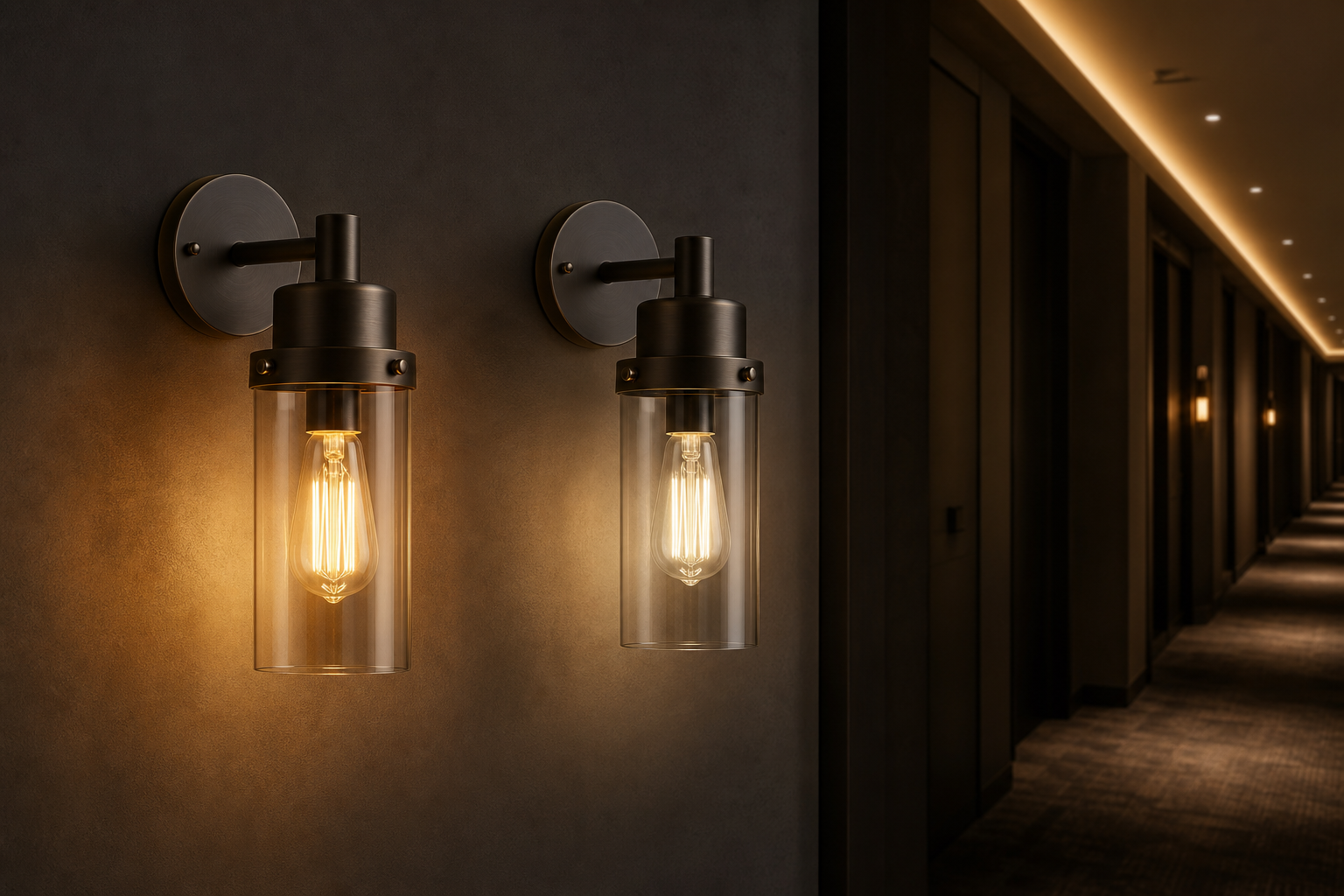
The short answer
Specify 2700K where the product is relaxation: guestrooms, suites, fine-dining rooms, spa areas and any evening-oriented space where amber warmth is the atmosphere. Specify 3000K where the space must stay energized and legible all day: corridors, back-of-house transitions, bathrooms, retail-in-hospitality corners and lobbies that blend daylight with artificial light. Neither is the "correct" warm white — the decision is zoning, and most well-specified hotels run both, deliberately. What separates professional schemes from average ones is not the pick itself but three disciplines this article covers: where each temperature goes, how dimming changes it over the evening, and colour consistency across every fixture in the building.
What actually differs between the two
Correlated colour temperature (CCT) describes the appearance of white light: 2700K reads as the amber-rich tone of incandescent lamps and candlelight, while 3000K sits a visible step whiter — closer to halogen — with less red-orange content. The gap sounds small on paper and is unmistakable side by side on a wall: a 3000K corridor next to a 2700K guestroom doorway reads as a different building zone before a guest registers why.
The difference also acts on materials. Wood, brass, terracotta and skin tones deepen under 2700K; the same surfaces look cleaner and slightly cooler under 3000K, which is why 3000K suits spaces where crispness and visual acuity matter — wayfinding, work surfaces, retail displays. Neither affects circadian physiology meaningfully at typical interior levels; the choice is perceptual and material, not medical. Our hospitality lighting program defaults to this zoning logic across guestroom and public packages, adjusted per brand standard.
Zone by zone: where each temperature earns its keep
Guestrooms and suites: 2700K. The evening use case dominates — reading in bed, winding down, warm bathroom glass. Decorative fixtures in the room (bedside pendants, floor lamps) carry the temperature, and 90+ CRI makes fabrics and wood look expensive. Rooms with strong daylight exposure can run 3000K in ceiling ambient layers for daytime freshness, returning to 2700K in the evening scene — which is a controls decision, covered below.
Corridors, lift lobbies and back passages: 3000K. These are legibility spaces, often lit continuously; 3000K keeps them clean and slightly alert without tipping into institutional. Bathrooms: 3000K around mirrors for grooming accuracy, with 2700K acceptable in spa-style bathing zones where mood outranks precision. Restaurants: 2700K or lower in dining rooms — the candle effect is the point — with 3000K defensible only at bars and pass areas where staff work fast. Lobbies: a managed blend. Daylight arrivals favour 3000K; evening arrivals favour 2700K. High-performing lobbies scene-switch rather than compromise at 2800K, which disappoints both halves of the day.
Dimming: the third dimension most schedules forget
A fixed-CCT lamp dims down in brightness but not in warmth — a 3000K pendant at 10 percent still reads white, and an evening scene built on it feels flat. That is why hospitality specifications increasingly ask for warm-dim (often called dim-to-warm) sources, which shift from 3000K toward roughly 1800-2200K as they dim, mimicking the candle behaviour guests instinctively read as intimacy. In dining rooms and suites, warm-dim on the decorative layer is one of the highest-impact upgrades per dollar in the entire lighting budget.
The specifying discipline is to assign dimming behaviour per layer, not per building: warm-dim where evenings are the product, fixed 2700K where warmth is constant, fixed 3000K where clarity never yields. Each strategy prices differently — warm-dim drivers and modules carry a premium, and the quotation should show both variants while the decision is open. Compatibility with the controls protocol (phase-cut, DALI, or ecosystem-specific) belongs in the same line item so the fit-out does not discover it at commissioning.
The zones most schedules forget
Back-of-house and threshold areas decide whether the zoning plan feels coherent. Staff corridors and linen rooms can run 3000K economy product without guest impact, while the guestroom threshold — corridor approach, entry, wardrobe reveal — should already speak 2700K so the suite greets warm rather than transitional. Entrance doors and covered drop-off areas face the opposite problem: 2700K at night reads gold against cool street lighting, so 3000K on exterior thresholds keeps the arrival photograph flattering. Spa and pool areas split by function — 2700K in relaxation halls, 3000K over lap lanes and task edges. None of these zones carries much wattage, which is exactly why they get skipped in value engineering, and why the mockup walk should include them.
Consistency: the detail guests notice and tenders miss
Nothing undoes a good zoning plan like binning drift. When fixtures in one corridor span 2700K to 3200K because suppliers mixed bins, guests read the building as sloppily maintained, and no one can fix it fixture by fixture. The professional controls are contractual: a colour tolerance of 3-SDCM or tighter across all warm fixtures, one LED bin per area locked in the purchase order, and sample approval against the golden sample before mass production. Pair the CCT spec with CRI 90+ (and R9 above roughly 50 for skin and wood, illustrative threshold) and the warm palette performs as intended. One more consistency trap is mixed source types: a filament-look lamp and a smooth COB spot at the same CCT still render differently at the beam edge, so keep a room on one source family wherever fixtures share a sightline.
Regional brand standards also lean differently: Middle East hospitality specifications often default public areas to 3000K with 2700K reserved for suites and dining (illustrative convention), while European boutique properties push 2700K nearly everywhere. Neither is wrong; both are reasons to confirm the operator's brand standard before quoting, since it changes SKU counts and pricing across the entire schedule.
Comparison at a glance
| Dimension | 2700K | 3000K |
|---|---|---|
| Visual character | Amber-rich, incandescent-like warmth | Whiter warm tone, halogen-like clarity |
| Best zones | Guestrooms, suites, dining rooms, spa | Corridors, bathrooms, back-of-house, bar areas |
| On warm materials | Deepens wood, brass, terracotta, skin | Neutral-crisp; slightly cooler on the same surfaces |
| Daylight blending | Can look dim-gold at midday | Blends with daylight convincingly |
| Dimming strategy | Fixed warm, or warm-dim for evening depth | Warm-dim strongly recommended for evening scenes |
| Typical pairing | CRI 90+, R9 50+ for fabrics and skin | CRI 90+ where grooming and tasks occur |
| Consistency spec | 3-SDCM or tighter, single bin per area | Same — drift is more visible between zones |
| Natural risk | Feels dim in daylight-heavy public zones | Feels flat in evening-oriented dining rooms |
How to choose: three rules
- Zoning beats compromise. Assign 2700K to evening spaces and 3000K to all-day spaces; avoid averaging to 2800K, which serves neither mood well.
- Let the evening scene decide the dimming. If a zone's business happens after dark, warm-dim belongs on its decorative layer regardless of whether you started at 2700K or 3000K.
- Write consistency into the contract. CCT tolerance, single binning per area and CRI minimums go in the purchase order — not in the showroom conversation.
Advice for procurement and FF&E teams
Build a mockup room before committing the schedule. The 2700K-versus-3000K debate resolves in ten minutes when the operator sees both temperatures on the actual wall finishes, fabrics and stone; the same mockup validates the warm-dim curve at its evening minimum. Then lock one supplier bin per area across all fixture types — decorative pendants and chandeliers, downlights, cove strip — because mixed sources in one room is where colour drift becomes visible, and our decorative collections are binned to match architectural fittings for exactly this reason.
Send the room-by-room schedule or the brand standard, and we will return both CCT options quoted per zone — fixed and warm-dim variants, driver and controls compatibility included — with FOB pricing within 24 hours.