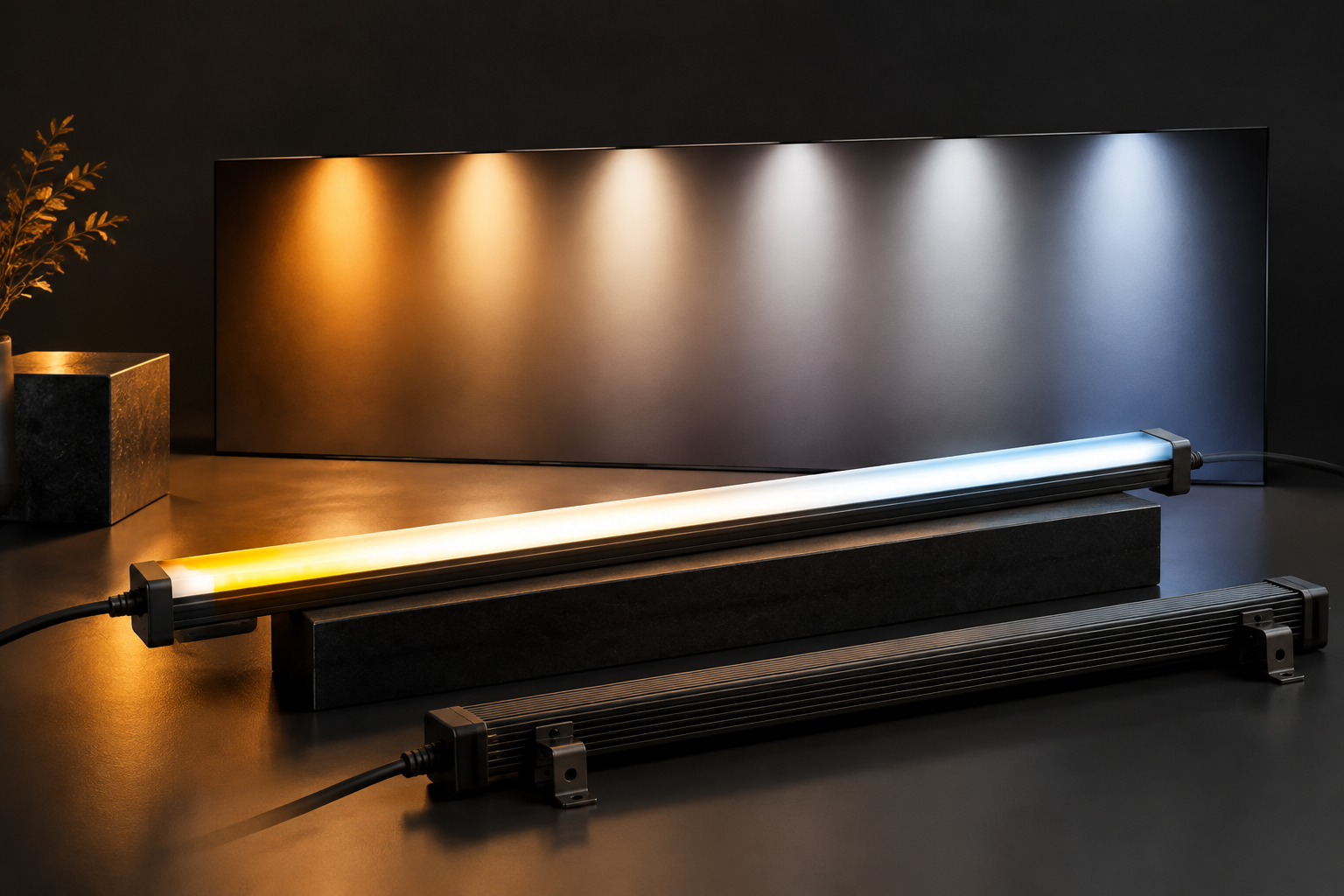
The full Kelvin scale from 2200K to 6500K, mapped to the rooms and applications where each range belongs — plus the binning rules that keep a whole project matching.
2026-09-10 · 6 min read · Reference guide
Color temperature — measured in kelvin (K) — decides whether a space feels like a spa, a showroom or a surgery. It has nothing to do with brightness: a 2700K and a 6500K lamp can deliver identical lumens and still change everything about how the room reads. Use the chart below in two directions: to name the CCT a client is describing ("warm, like a restaurant" is almost always 2700-3000K), and to lock consistent CCT values across a mixed fixture order, where mismatched whites are the most common complaint in multi-factory projects.
| CCT | Appearance | Typical applications | Pairing note |
|---|---|---|---|
| 2200K | Deep warm, candlelight | Heritage interiors, candle lamps, porch accents | Use sparingly; pairs with brass and stone |
| 2400K | Very warm, gaslight | Boutique hotels, high-end restaurants, wine rooms | High CRI (Ra 90+) to avoid muddy reds |
| 2700K | Warm white, standard home | Residential, hotel guestrooms, restaurants | The default warm choice; dimmable to 5-10% |
| 3000K | Warm white, commercial | Hotel lobbies, retail warm zones, showrooms | Crisper than 2700K under high ceilings |
| 3500K | Neutral warm | Offices blending with daylight, modern retail | Compromise CCT for mixed daylight zones |
| 4000K | Neutral white | Offices, classrooms, hospitals, back-of-house | EN 12464-1 workhorse; specify UGR with it |
| 5000K | Cool white | Workshops, garages, print and textile inspection | Ra 90+ for any colour-critical task |
| 5700K | Daylight-equivalent cool | Warehouses, high bays, security and logistics | Max perceived brightness per lumen |
| 6500K | Daylight, blue-leaning | Specialist tasks, studios, screen-matching areas | Rarely right for hospitality; feels clinical |
Typical industry usage; individual brands and markets vary. Coastal and Middle East hospitality markets often run warmer than Northern European commercial projects at the same nominal brief.
| Project type | Guest/brand areas | Working areas | Back-of-house |
|---|---|---|---|
| Hotel | 2400-2700K | 2700-3000K (bathroom 3000K) | 4000K |
| Retail | 2700-3000K warm zones | 3000-3500K fitting rooms | 4000K stockroom |
| Office | 3000K reception | 4000K workstations | 4000-5000K plant rooms |
| Industry | — | 5000-5700K production | 5700K high bay, storage |
Nearly every AURELUX product family ships in 2700K, 3000K and 4000K as standard, with 5000-5700K on industrial and outdoor lines. Hospitality and decorative schemes — pendants, chandeliers and wall lights in the hotel lighting programme and the decorative lighting range — live in the 2200-3000K band, while panels and downlights for office lighting default to 4000K. State CCT per room on the inquiry, and each fixture line is binned to match before it ships; for a deeper dive on the two most common choices, see our 2700K vs 3000K comparison.
Choosing warm white for hospitality projects, with side-by-side guidance.
Neutral and cool white for commercial spaces — where the line sits and why.
The physics behind kelvin ratings, explained for buyers without a lab.
CE, UKCA, SAA and SASO: which marks your market needs and how to verify them.
Send the CCT per room — mixed fixture orders ship from matched bins with the golden sample kept on file for repeats.