2026-09-10 · 8 min read · Comparison
The short answer
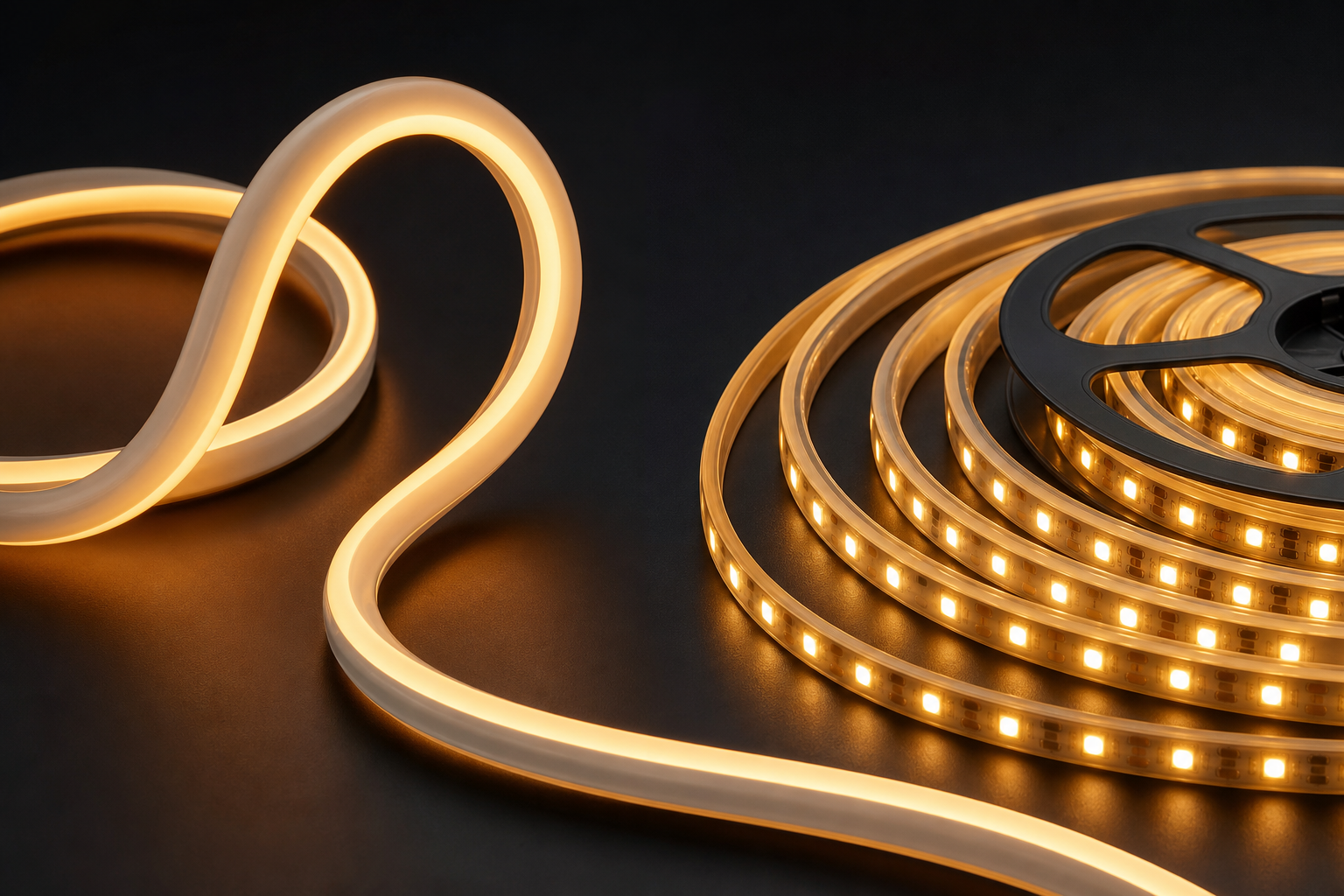
Stock LED strip as your architectural workhorse: high efficacy, endless configuration (voltage, CRI, binning, IP tiers), and its natural habitat inside aluminium profiles — coves, joinery, shelves, indirect decorative schemes. Stock neon flex as your exposed-line product: a continuous dot-free tube of light in a silicone jacket that bends, survives weather, and signs building contours, facades and creative installations without any profile at all. They overlap far less than buyers assume, and the distributors who treat them as two distinct lines with distinct customers outsell those who push whichever has the better margin that month. Where the two lines meet in projects, it is usually an indoor-outdoor sequence — interior coves in strip, exterior contour in flex — as our landscape and facade projects routinely show.
Construction: bare PCB strip versus jacketed neon flex
LED strip is what the name says: SMD LEDs and resistors on a flexible printed circuit, usually 8-12 mm wide, sold on 5 m reels in 12 V or 24 V versions. Everything else — diffusion, waterproofing, mounting — is added by accessories: aluminium profiles with opal diffusers, silicone sleeves, adhesive or clip fixing. That modularity is the strip's superpower. The same basic reel becomes a cabinet light, a cove light, a shelf light or a facade washline depending on the profile and IP treatment you pair with it.
Neon flex inverts the logic: the LEDs are sealed inside a single extruded silicone jacket that both diffuses and protects. The light leaves as one continuous, even line with no visible dots — the visual reference is, of course, glass neon, minus the transformers, gas and breakage. The jacket is the product: it provides IP65 to IP68 sealing as manufactured, bends in one plane on a tight radius, and cuts at marked points. You lose the configurability of the profile system and gain a product that installs in minutes and survives outdoors as shipped.
The light line: dots, diffusion and continuity
In a profile with a good opal diffuser at adequate depth, a quality strip produces a dot-free line — but the keywords are quality and depth. Budget strip behind thin diffusers shows micro-dots at close range, and high-density strip (more LEDs per metre) is the standard fix customers now expect as default in joinery and hospitality work. Colour consistency along the run matters just as much: one reel from one bin is fine, but a long cove assembled from mixed reels shows colour steps that clients photograph and send back.
Neon flex is continuous by construction — the silicone jacket is thick enough to blend the diodes into a solid line regardless of viewing angle, which is precisely why sign makers and facade designers accept no substitute. The trade-off is optical fixedness: a flex line emits from its face (side-bend and top-bend variants exist for different radii and orientations), and you cannot swap a diffuser to change the look. For curved brand outlines, cursive signage and organic facade lines, flex is the only practical answer; for straight architectural coves, strip-in-profile delivers the same visual result with better efficacy and more light control.
Environment: IP ratings, bending, UV and yellowing
Strip's weather resistance is an assembly decision: IP20 as bare PCB, IP65 with silicone sleeve, IP67/IP68 with full potting for exterior and underwater work. Every additional layer slightly reduces light output and adds cost, which is why serious projects specify the IP tier per zone instead of defaulting everything to fully potted. Flex arrives sealed — IP65 standard, IP68 variants for submerged or buried applications — so its outdoor readiness is not a configuration question, a genuine advantage for distributors selling to installers who do not read datasheets twice.
The outdoor failure mode to interrogate is yellowing: cheap silicone or PVC jackets discolour under UV within a season or two, turning a white line cream and losing output. Ask suppliers for UV-stable, food-grade or platinum-cured silicone and for outdoor ageing samples — reputable neon flex factories will provide sun-exposure references. Bending radius also differs: flex bends smoothly in one plane (check whether the SKU is top-bend or side-bend), while strip in a profile is effectively straight, and flexible PCB strip without a profile handles curves poorly with visible solder-pad stress. For exterior compliance in your destination market, certificates for both lines come via certified partner factories, mapped per order.
Installation and product-line economics
Strip's installed cost is a system cost: PCB plus profile plus diffuser plus endcaps plus labour to assemble — easily double the bare reel price (illustrative). That complexity is also the margin opportunity: the distributor who sells the complete kit, pre-cut and pre-wired, captures the assembly value installers would otherwise add themselves. Flex sells closer to a commodity: per-metre pricing, cutting at marked points, clip mounting, done. Fewer accessories, fewer specification conversations, faster turnover.
For a stockist, the two lines also differ in SKU burden. Strip rewards depth: 24 V, high-density, 90+ CRI variants in three IP tiers and a profile family is a defensible premium range — but each variant is a stocking decision. Flex rewards breadth at the top: a few CCTs, a few IP tiers, standard and side-bend, plus a constant-voltage accessory box. Controls attach to either — addressable pixel strip and CCT-tuning strip feed the smart lighting segment, and dimmable flex via compatible drivers serves scene-based retail — but strip remains the deeper controls platform.
Comparison at a glance
| Dimension | LED strip | Neon flex |
|---|---|---|
| Light line | Dot-free inside profile with opal diffuser | Continuous by construction, any viewing angle |
| Construction | Bare flexible PCB; accessories add IP and optics | LEDs sealed in extruded silicone jacket |
| IP as shipped | IP20 to IP68 depending on build | IP65 standard; IP68 variants |
| Bending | Straight in profile; PCB-only curves are risky | Smooth one-plane bends, tight radius |
| Outdoor weak point | Adhesive and potting quality at joints | Jacket yellowing under UV on cheap product |
| Efficacy (illustrative) | Higher per watt in profile applications | Moderate; diffused line costs output |
| SKU structure | Deep: voltage, density, CRI, IP tiers, profiles | Broad but shallow: CCT, bend, IP variants |
| Natural applications | Coves, joinery, shelves, indirect lighting | Signage, contours, facades, creative lines |
How to choose: three rules
- Hidden or exposed decides the product. Light you should not see the source of: strip in profile. A visible line of light as the design element: neon flex.
- Straight or curved decides the format. Architectural straight runs and joinery: strip. Curves, letters and organic outlines: flex, choosing top-bend or side-bend per drawing.
- Stock both as tiers, not substitutes. Position strip as the configurable architectural line and flex as the fast-turn exposed-line product; quote them against each other only when a customer genuinely asks for one product to do both jobs.
Advice for distributors and product managers
When we build strip and flex programs for partners, three QC commitments do most of the work: locked binning so long runs never mix colour steps, UV-ageing references for every outdoor flex SKU, and reel-level traceability so warranty claims resolve without argument. Both are standard in our partner factory audits, and sample reels for ageing tests ship with every program quotation. Price the strip line as a kit (reel, profile, driver, connectors) and the flex line per metre with clips included — those are the framings each customer type expects, and they protect your margin from being compared against a bare-PCB commodity.
Send your target market — indoor architectural, signage, retail brands, facade contractors — and we will return a starter SKU structure for both lines with FOB pricing within 24 hours, including sample quantities for ageing and colour checks before you commit shelf space.