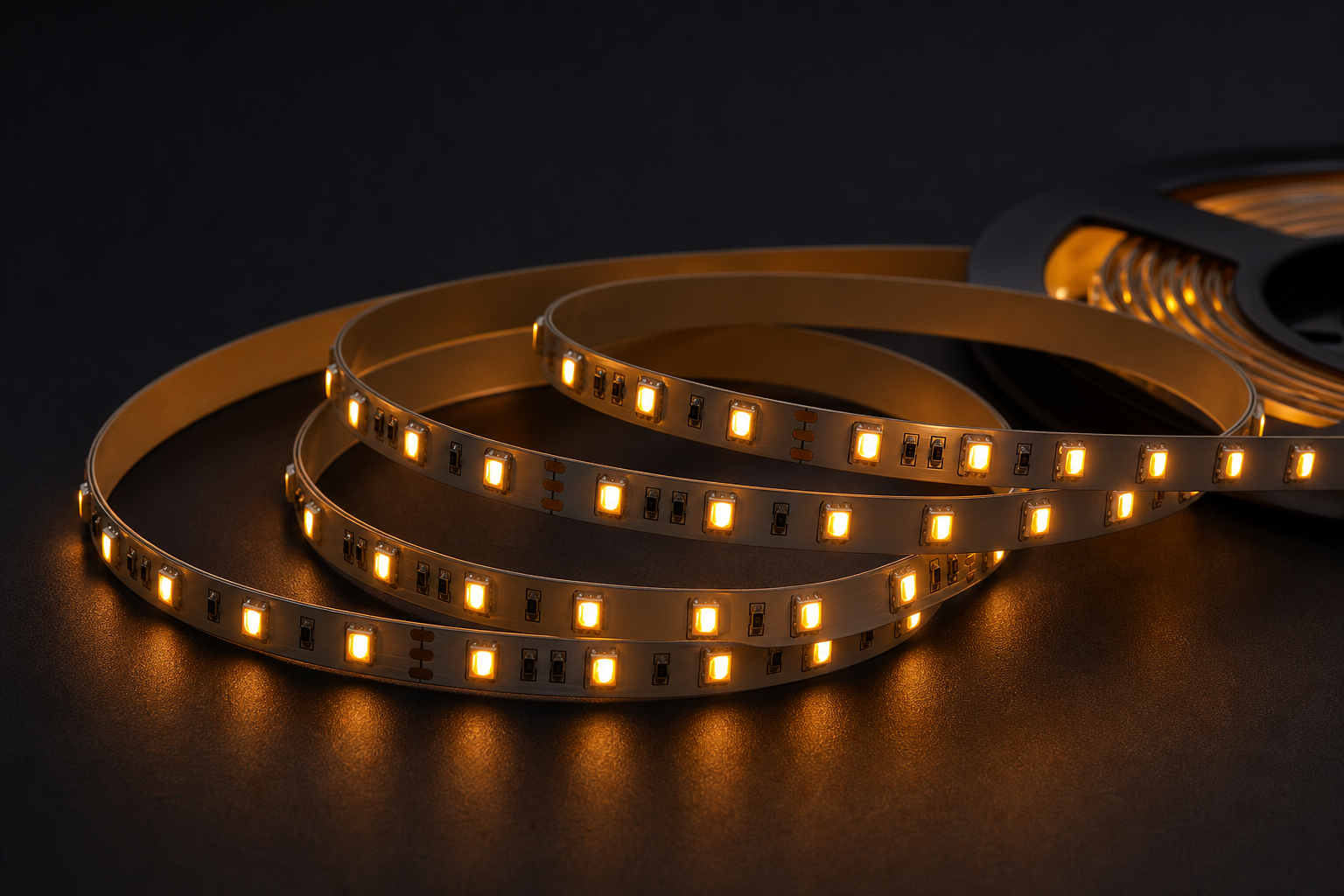
The four-digit codes on every LED datasheet decode to physical sizes — here is what each package delivers in power, flux and typical applications, strips included.
2026-09-10 · 6 min read · Reference guide
The code on an SMD LED is simply its footprint in millimetres: a 2835 measures 2.8 x 3.5 mm, a 5050 measures 5.0 x 5.0 mm, a 5730 measures 5.7 x 3.0 mm. The number tells you the size, not the quality — which is exactly why the same "2835" can mean a 22 lm budget chip or a 100 lm premium one. Use the chart below to decode quotations and datasheets: it lists the packages that dominate export product lines, what they typically deliver per LED, and where each one earns its place. Values are typical industry figures at standard drive currents; specific brands vary, and the datasheet — not the code — is the contract.
| Package | Size (mm) | Typical power per LED | Typical flux per LED | Typical current | Where you see it |
|---|---|---|---|---|---|
| 3528 | 3.5 x 2.8 | 0.06-0.08 W | 5-8 lm | 20 mA | Older strips; superseded by 2835 |
| 2835 | 2.8 x 3.5 | 0.2-1.0 W | 22-100 lm | 60-240 mA | Strips, panels, battens — today's volume workhorse |
| 5050 | 5.0 x 5.0 | 0.2-0.24 W per die, 3 dies | 16-24 lm (white); RGB colour | 60 mA | RGB and addressable strips, modules |
| 5630 | 5.6 x 3.0 | 0.5 W | 50-60 lm | 150 mA | Premium strips, tubes |
| 5730 | 5.7 x 3.0 | 0.5 W | 45-55 lm | 150 mA | Panels, battens, tubes, mass-market strips |
| 3030 | 3.0 x 3.0 | 0.2-1.0 W | 25-110 lm | 65-350 mA | Street lights, outdoor optics, high-density arrays |
| 7070 | 7.0 x 7.0 | 1-2 W | 100-220 lm | 240-480 mA | High bays, floods, high-output lanterns |
| COB array | Various | 5-100 W+ | Scales with area | Per array | Track spots, downlights, COB strip |
Typical ranges at standard drive currents across major brands; premium or degraded versions of the same code exist on both sides. Flux at fixture level is always lower after optics and thermal losses — see the lumens to watts chart for the conversion.
Strip listings combine package and density, so decode both before comparing prices.
| Strip configuration | Power per metre | Typical flux per metre | Typical use |
|---|---|---|---|
| 2835, 60 LEDs/m | 10-12 W/m | 1,100-1,400 lm | Coves, under-cabinet, general accents |
| 2835, 120 LEDs/m | 18-24 W/m | 2,000-2,800 lm | Task and main lighting from strip |
| 2835, 240 LEDs/m | 28-38 W/m | 3,000-4,500 lm | High-output lines, COB alternative |
| 5050 RGB, 60 LEDs/m | 12-14.4 W/m | Colour (no white flux rating) | Colour effects, facades, entertainment |
| COB strip, 320-528 LEDs/m | 8-15 W/m | 400-1,100 lm | Dotless continuous line, exposed profiles |
Illustrative figures for 24V strips at standard CRI; CRI 90 and ultra-warm bins run lower flux for the same power.
For buyers building ranges: strips and cove systems in the decorative lighting programme specify 2835 in 60-240 LEDs/m densities plus COB for exposed profiles; panels, battens and tubes across the commercial lighting range run 2835 and 5730-class packages; outdoor optics — where the package must feed a lens rather than a diffuser — move to 3030 and 7070 classes. Name the package, drive current and bin on the inquiry and every quotation arrives comparable; the sourcing context for chip tiers across factories is in the Guzhen sourcing guide.
Which package fits your product line — beams, thermal paths and failure modes.
Chip-on-board packaging explained — the single-surface source behind modern spots.
Convert lumen packages to expected wattage at real LED efficiencies.
How professional buyers work the lighting capital — districts, audits and export routes.
Send the package, density and bin you need — matched-bin production with lit-sample approval, quoted FOB within 24 hours.