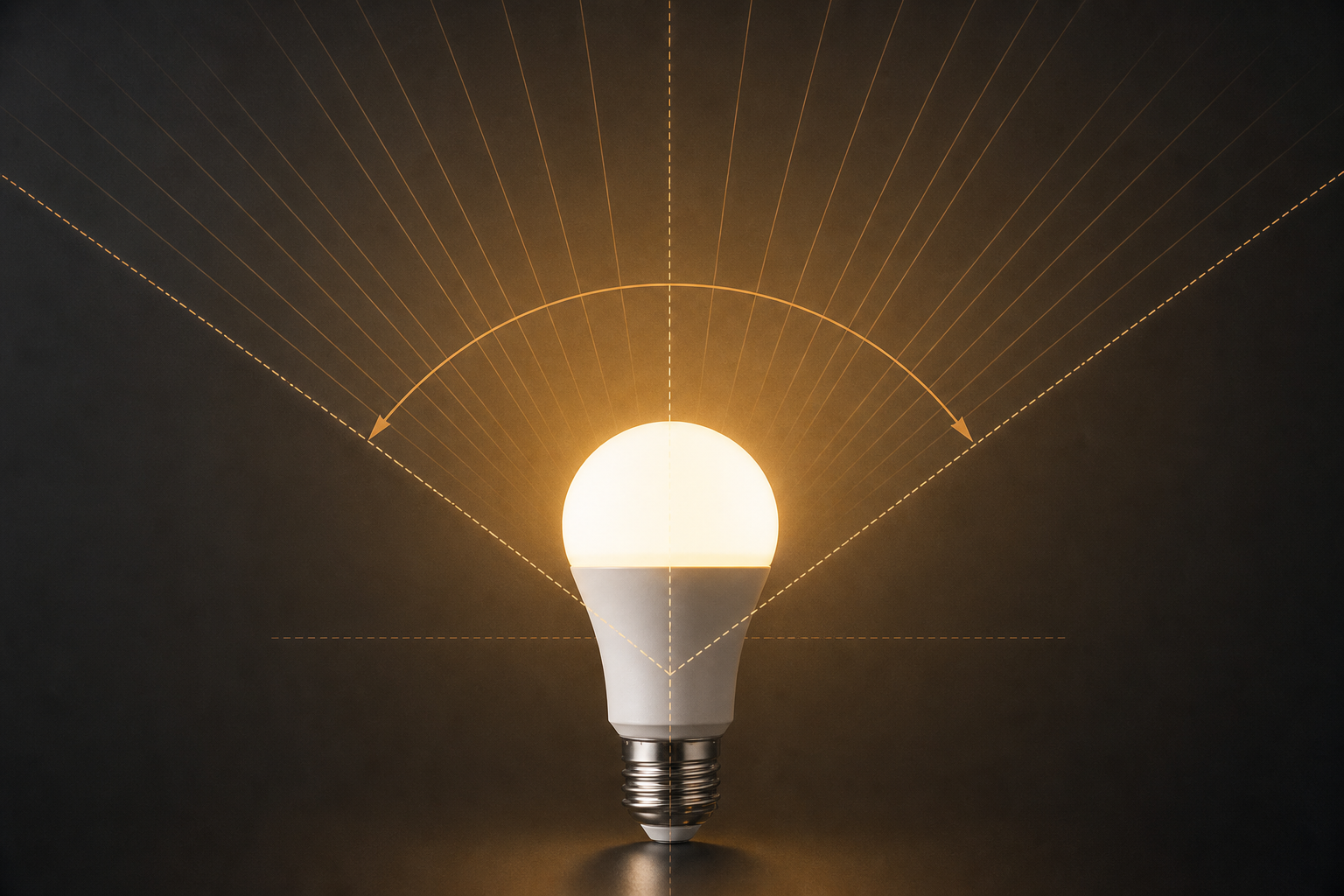
Watts no longer tell you how bright a light is. This chart converts the lumen packages buyers actually order into the wattage they should expect at honest LED efficiencies.
2026-09-10 · 6 min read · Reference guide
Use this chart when a specification says "replace the 250W metal halide" or "I need the 100-watt equivalent" and you need to translate it into an LED wattage you can quote. The rule is simple: lumens measure light, watts measure electricity, and the link between them is efficacy (lm/W). Because LED products range from 70 to 180 lm/W, the same brightness can carry wildly different wattage claims — which is exactly why wattage-only quotations from suppliers deserve suspicion. The table below converts the most common lumen packages at three benchmark efficiencies: 100 lm/W (ordinary budget LED), 130 lm/W (mainstream commercial, the most common real-world figure) and 150 lm/W (premium commercial and industrial class).
| Lumen package | Incandescent equiv. | W at 100 lm/W | W at 130 lm/W | W at 150 lm/W | Typical fixture |
|---|---|---|---|---|---|
| 450 lm | 40W bulb | 4.5 W | 3.5 W | 3 W | A60 lamp, mini pendant |
| 800 lm | 60W bulb | 8 W | 6 W | 5.3 W | A60 lamp, 4" downlight |
| 1,100 lm | 75W bulb | 11 W | 8.5 W | 7.3 W | 4" downlight, spot lamp |
| 1,600 lm | 100W bulb | 16 W | 12 W | 10.7 W | 6" downlight, PAR38 |
| 2,500 lm | 150W bulb | 25 W | 19 W | 16.7 W | Ceiling light, wall pack |
| 4,000 lm | 4 x 60W bulbs | 40 W | 31 W | 26.7 W | 600x600 panel, troffer |
| 6,000 lm | 250W halogen | 60 W | 46 W | 40 W | Linear batten, small flood |
| 10,000 lm | 400W metal halide | 100 W | 77 W | 67 W | 100W-class UFO high bay |
| 16,000 lm | 700W metal halide | 160 W | 123 W | 107 W | 150W high bay, street light |
| 25,000 lm | 1,000W metal halide | 250 W | 192 W | 167 W | 200W flood, major road lantern |
| 40,000 lm | 2 x 1,000W MH | 400 W | 308 W | 267 W | 300W-class area flood |
Illustrative planning values. Fixture-level efficacy is always lower than bare-chip efficacy because of driver losses, optics and thermal derating — that is why the system figures above stop at 150 lm/W.
| Fixture class | Typical system efficacy | What moves the number |
|---|---|---|
| Decorative lamps and pendants | 70-90 lm/W | Diffusers, shade losses and dimming electronics |
| Residential downlights | 80-100 lm/W | Recess depth, reflector efficiency, driver grade |
| Office panels and troffers | 100-130 lm/W | Diffuser transmission, UGR optics, controls standby |
| UFO and linear high bays | 130-160 lm/W | Heatsink sizing, driver brand, SDCM binning |
| Street and area lights | 140-170 lm/W | Beam optics, thermal design, surge protection overhead |
| Solar street lights | 160-200 lm/W effective | Aggressive dimming schedules inflate the effective figure |
Retrofit economics live or die on this conversion. A warehouse swapping 400W metal halide high bays for 150W LED units (roughly 20,000 lm at 135 lm/W) cuts lighting load by more than 60% — the arithmetic we walk through in the factory retrofit payback guide. Panels, battens and downlights across the commercial lighting range sit in the 100-130 lm/W band, while the high bay and flood families under industrial lighting and outdoor and solar lighting push 140 lm/W and above. Quote lumen packages, not wattages, and the comparison across suppliers becomes honest.
What each fixture type delivers in lumens and CCT, one quick table.
Recommended maintained illuminance by application per EN 12464-1 practice.
The payback arithmetic buyers check first before approving an LED retrofit.
CE, UKCA, SAA and SASO: which marks your market needs and how to verify them.
Tell us what you replace and the target lux — we return the lumen package, fixture schedule and FOB pricing within 24 hours.