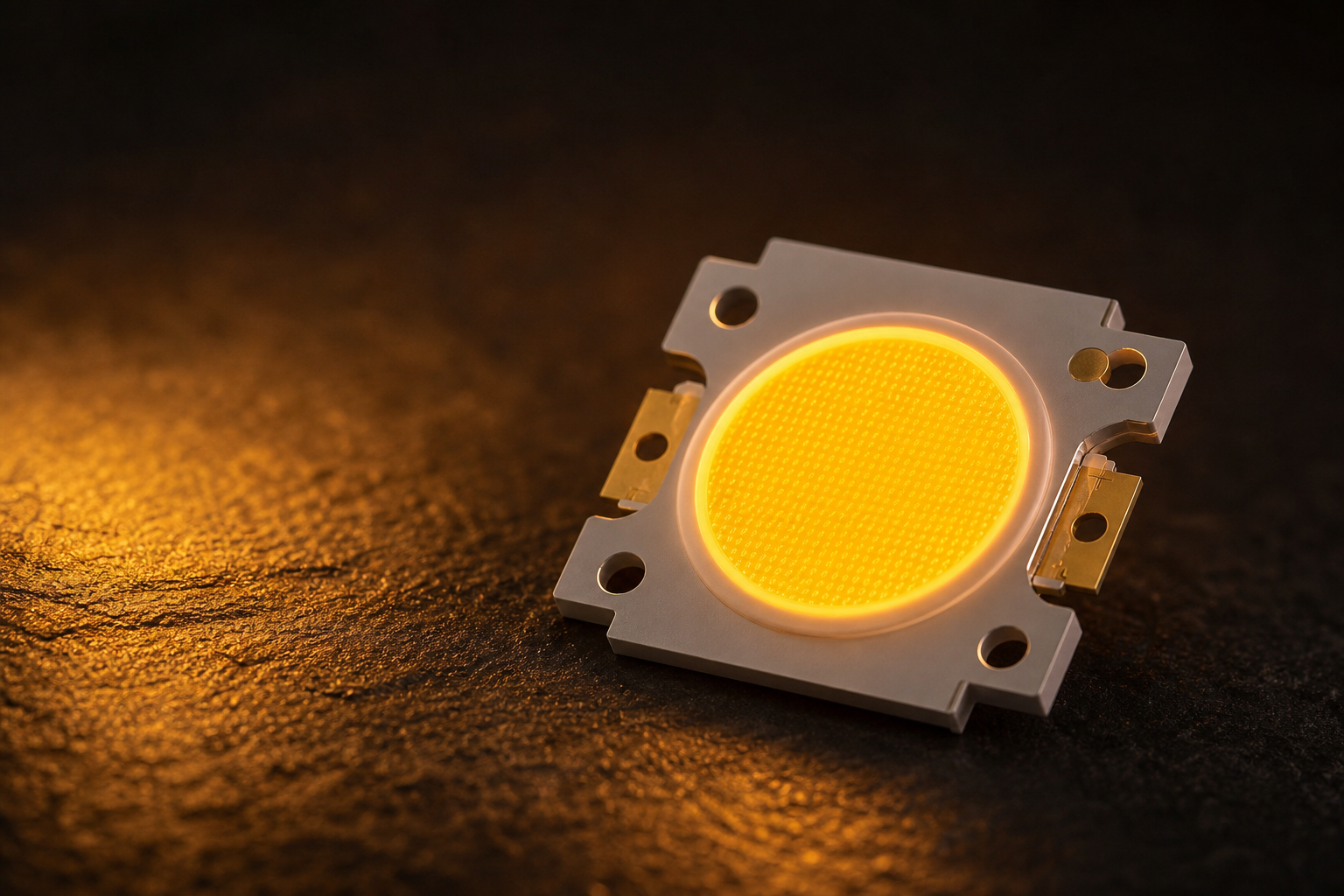
COB — chip-on-board — is an LED packaging approach in which many bare semiconductor dies are mounted directly onto a substrate, wired in series and parallel arrays, and covered by a single phosphor layer. The result is one continuous light-emitting surface rather than a grid of separate packaged LEDs. Where an SMD spotlight shows a cluster of bright points behind its lens, a COB shows a single, even disc — closer to the filament-downlighting tradition it replaced than to other LED formats.
The packaging hierarchy helps to keep the terms straight. At the bottom sits the bare die. In conventional SMD (surface-mount device) packaging, each die is individually housed — chip, bond wires, phosphor, lens — into a small self-contained component that is then reflowed onto a board in numbers. COB skips that individual housing: dies go onto the board first, and phosphor and encapsulation are applied over the whole array at once. Fewer components, fewer solder joints, one optical surface. Our COB vs SMD comparison puts the two approaches side by side for product-line decisions.
COB earned its place in catalogs by answering a specific complaint. Early LED spotlights replaced 50 W halogen MR16 lamps with a board of visible LED points: every highlight carried four shadows, every reflector produced ringed artifacts, and customers read the effect as "cheap". Packaging many dies into one surface recreated the halogen's single-source geometry — and with it, the clean shadow and tight beam that accent lighting had been built around. That history still explains where COB concentrates today: anywhere the beam itself is the product.
The single large emitting surface pays off in three ways. Optics: reflectors and lenses designed for a compact source produce cleaner beams with smoother centers and sharper cut-offs — which is why COB dominates narrow-beam track heads and accent downlights where a crisp spot is the product. Glare management: a uniform surface tolerates deeper recessing and snoots without visible multi-shadow artifacts. Color quality: one phosphor layer over one array bins as one source, which simplifies hitting tight color targets.
The costs are thermal and systemic. A COB concentrates substantial power into a small footprint, so the substrate, the heat sink and the interface between them decide the fixture's life — a COB running hot loses efficacy, shifts color and ages toward L70 faster than its datasheet suggests. And because the array is one component, a localized failure can take out the whole emitter; SMD designs degrade more gracefully. These traits are mechanical facts, not quality grades — which leads to the most persistent misconception in the category.
| Characteristic | COB | SMD array | Practical consequence |
|---|---|---|---|
| Emitting surface | One continuous disc | Grid of points | COB gives cleaner narrow beams and single shadows |
| Thermal path | Concentrated on one substrate | Spread across board | COB fixtures live or die by heat sink design |
| Failure mode | Whole array at risk | Local, gradual | SMD degrades gracefully; COB needs more margin |
| Typical homes | Track spots, accent downlights, COB strips | Panels, battens, general battens | Format follows beam and maintenance needs |
Characteristics are typical of current-generation product; specific designs vary. COB tape light, for example, deliberately trades the point-source look for a continuous line of light in coves and profiles.
Accent and retail product lines lean COB hardest: narrow-beam track heads, gimbal downlights and display lighting, where beam quality is the selling point — the patterns behind this are covered in our retail lighting solution. Decorative fixtures use COB sources behind diffusers and stone shades precisely because the single surface avoids point-source shadows — a construction visible across pendant and table families in our decorative lighting line. And the newest mass application is COB strip light: phosphor over an unbroken chip line produces a continuous "neon-like" glow without visible dots, a line we place against conventional strip in the strip vs neon flex comparison. General-area products — panels, battens, high bays — remain mostly SMD or discrete mid-power arrays, where the optics gain of COB buys little.
For product managers planning a line, COB also simplifies the brand story in one specific way: a single large source makes consistency visible. Because the whole array bins as one unit, a showroom can display a family of spotlights side by side and the color match is immediately checkable — a selling conversation that SMD grids, where each point bins separately, make harder to stage. The flip side is concentration of risk at ordering time: commit a program to one COB array and the line's beam character, efficacy and service story all ride on that single component, which argues for qualifying a second source before volume rather than after a failure.
Two COB arrays of the same wattage can differ enormously in what they deliver. The phosphor blend decides both color quality and stability — a well-formulated phosphor holds its CCT across the array's lifetime, while a cheap one drifts green or pink as it ages; this is the chemistry behind the binning discipline below. The substrate and die layout decide how evenly heat spreads: ceramic substrates and denser, better-matched die arrays run cooler and more uniformly than budget aluminum boards. And the drive design matters — arrays wired in long series strings fail wholesale if one junction opens, so reputable designs segment the strings. None of this is visible in a lit sample on a showroom shelf; all of it shows up in year two of a retail rollout, which is why fixture-level thermal data and bin commitments carry more weight than the chip's marketing tier.
Because the emitter is one component, procurement checks concentrate on three documents. Thermal evidence: the fixture's tested case temperature and the COB's rated temperature, not just the LED's nominal lifespan — L70 claims mean nothing at a heat sink that cannot shed the load. Binning: the color bin and SDCM window stated per batch, since a repeat order that drifts a bin will be visible across a mixed installation; our color temperature guide explains binning discipline. CRI claims: R9 (deep red) stated explicitly, because CRI averages R1-R8 and hides weak red rendering behind a decent Ra — see the CRI guide. Driver brand should be named on the BOM as with any commercial fixture.
Illustrative commercial terms: samples of 1-5 pcs ship in 7-14 days; trial orders 100-200 pcs per SKU; bulk 25-40 days after deposit; pricing quoted per project. Certification (CE, UKCA, SAA, SASO) via certified partner factories, verified by number and database link. Pre-shipment inspection should include lit-color comparison against the approved golden sample — the fastest way to catch bin drift before loading.
Which package fits your product line — beams, thermal paths and failure modes compared.
2835, 5050, 5730 explained — the SMD codes buyers see on every datasheet.
Which line to stock — including where COB tape blurs the old boundary.
How professional buyers work the lighting capital — districts, audits and export routes.
Beam angle, CRI and binning window — sample and FOB quotation within 24 hours.