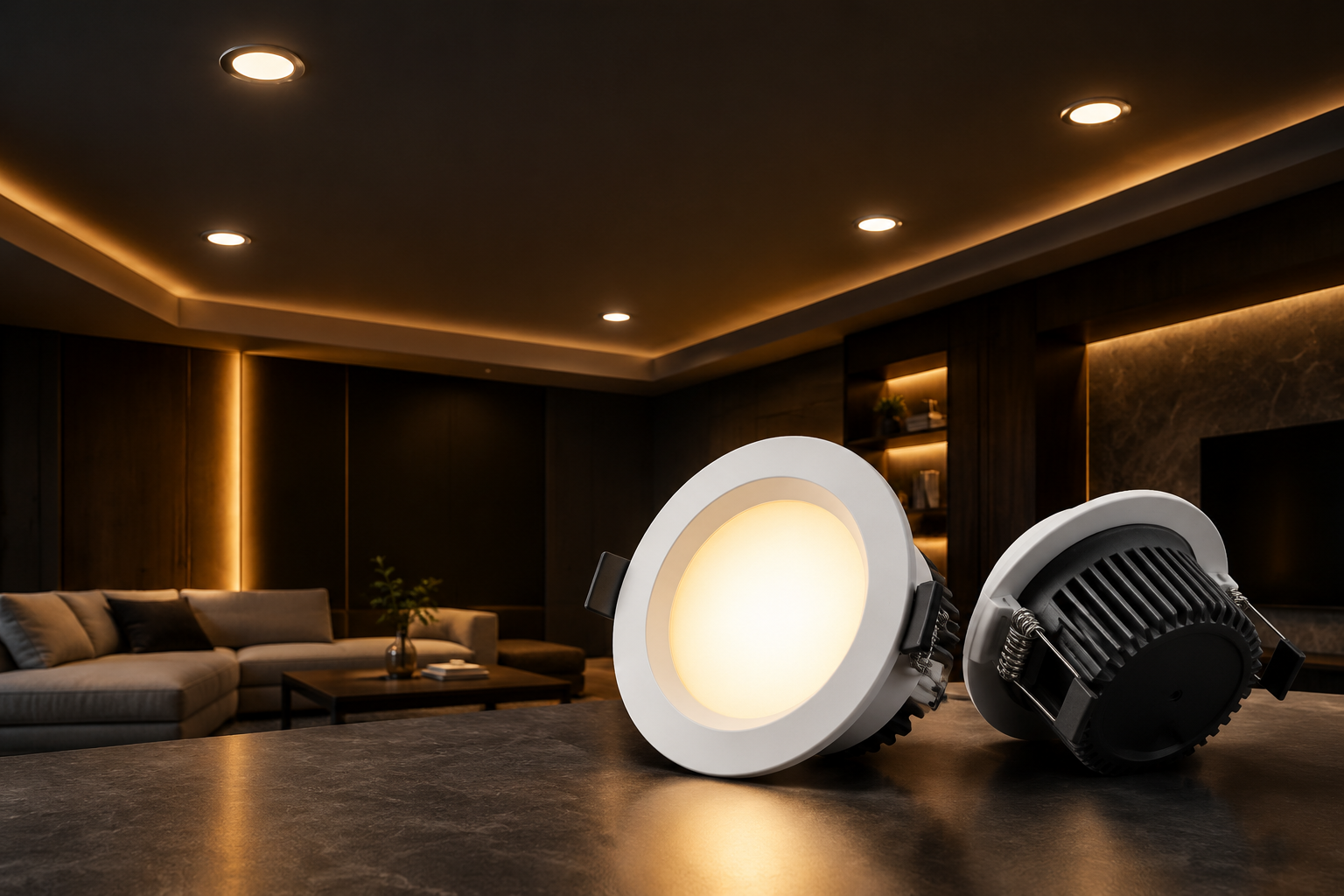
Smart lighting is lighting that can be addressed, automated and observed: individual fixtures or groups controllable from apps, voice assistants, wall panels, sensors and schedules, rather than switched as one circuit. Under that definition sits a genuine engineering stack — a light source, a driver that can be commanded, a radio or bus that carries the commands, and software that turns commands into scenes and rules. The category has moved from novelty to expectation in under a decade: residential buyers now ask "does it work with my phone" at the counter, and in commercial construction, controls have shifted from optional extra to code-driven requirement in a growing list of markets.
For distributors and contractors, smart lighting is where fixture sourcing meets electronics sourcing. The radio module, the firmware, the app ecosystem and the certification of the radio are all part of the product, and a smart line bought without understanding that stack produces the two worst trade outcomes: stock that cannot be sold because its ecosystem died, and projects that fail commissioning. This guide separates the layers, compares the protocols honestly, and lists what to verify.
What makes a lighting system smart
Four layers make the difference between a lamp and a node. The dimmable, addressable driver is the foundation — it must respond to control signals, not just mains switching. The communication layer carries those signals: wireless radio or wired bus, depending on the protocol. The control logic lives in hubs, gateways, panels or apps — scheduling, grouping, scenes, sensor binding. And the data layer, increasingly the point for commercial estates, reports energy use, run hours and lamp failure back to the operator. Remove any layer and the "smart" reduces to a remote-controlled lamp.
The benefit case, in the order that actually moves purchases: energy — sensor and daylight control routinely cut lighting energy by double-digit percentages in commercial spaces, which is precisely why energy codes now push controls; comfort — scenes, tunable white and automation tuned to occupancy; maintenance insight — a fixture that reports its own failure shortens fault-finding on large sites; and security presence — occupancy simulation and integration with alarm states.
The protocols, compared without the marketing
Every protocol argument is really an argument about four properties: whether a hub is required, how many devices a network carries, how well it scales, and who governs the standard. The table is the short version; the paragraphs after it are the part salespeople skip.
| Protocol | Hub needed | Scale profile | Typical territory | Buyer note |
|---|---|---|---|---|
| Zigbee | Yes — coordinator | Large mesh networks | Consumer ecosystems, smart homes, hotels | Mature, interoperable by profile; ecosystem choice matters |
| Bluetooth mesh | No — phone direct | Mid-size networks | Residential and light commercial retrofits | Simplest entry; app-bound control model |
| Wi-Fi | Router | Home-scale | Retrofit consumer SKUs | No hub but crowds the router; per-device setup |
| Thread / Matter | Border router | Growing home-scale | Premium consumer, multi-ecosystem | The interoperability bet; ecosystem support still maturing |
| DALI-2 | Wired controller | Building-scale, deterministic | Commercial, hospitality, code-driven projects | Standards-backed addressing; the professional default |
Protocol positioning summarized at category level — project specifics are confirmed per tender. Deeper comparisons: Matter vs Zigbee and Zigbee vs Bluetooth mesh.
Two structural facts deserve emphasis. First, wired versus wireless is a project-class decision more than a technology preference: hotels, offices and any building with a code-driven controls requirement specify DALI-2 or equivalent wired systems for determinism — an addressable, standards-governed bus where every device is testable — while wireless owns the retrofit and consumer space where pulling cable is the cost nobody accepts. Second, the ecosystems are commercial as much as technical: a Zigbee fixture is only "compatible" in the ways its profile and the target ecosystem allow, which is why serious buyers test fixtures against the target hub and app before container quantities, not after. Our smart lighting line is structured exactly this way — fixtures matched to declared target ecosystems, with the pairing behavior documented per SKU.
A third pattern worth naming is hybrid architecture. Larger projects increasingly combine the lanes: DALI-2 as the deterministic backbone for the fixture layer, gateways bridging the bus to wireless ecosystems for guest interaction, and sensor data flowing upward into building management systems. For distributors this hybrid reality defines the modern smart SKU list — fixtures that speak a wired protocol, and bridge modules that connect it to the wireless world — and it rewards ranges documented at the gateway level rather than fixture by fixture. When quoting mixed projects, price the bridge and the commissioning as visible line items; both are real work, and hiding them inside fixture pricing is how smart programs lose money without anything appearing to go wrong.
Where the demand is coming from
Two currents explain why smart lines earn shelf space now. On the residential and hospitality side, guest expectation has simply moved: tunable evening light, app control and voice integration have crossed from feature to assumption in premium segments, and hotel operators increasingly standardize guestroom control on addressable systems for both comfort and housekeeping insight — the guestroom layer of this is walked through in our guestroom lighting guide. On the commercial side, regulation is the engine: European building-efficiency rules and their controls requirements — tracked in our EPBD and smart lighting briefing — plus comparable energy codes elsewhere, are writing presence detection, daylight response and zoning into what projects must have, which converts controls from a sales pitch into a compliance item with a budget line.
Sourcing smart lighting: the extra checklist
Everything in normal fixture sourcing applies — drivers, BOM transparency, destination certification via certified partner factories verified per order — plus the radio-specific items that non-connected products never need:
- Radio compliance. Wireless products need the radio directive cleared for their destination (RED in the EU, with its RF and spectrum testing) alongside the usual LVD/EMC/RoHS — a second certificate layer many first-time smart importers miss.
- Ecosystem verification. Fixture behavior proven against the declared hubs and apps, with the firmware version noted; "compatible" claims tested, not assumed.
- Firmware lifecycle. Who patches, how updates ship, and what happens when the module vendor ends support. A smart SKU without a firmware answer is inventory with an expiry date.
- Data and privacy posture. Which data leaves the building, where it is processed — a question hospitality and commercial clients now ask in writing.
- Interoperability of spares. Mixed-batch estates break when replacement fixtures ship with newer firmware; order spares from the matched batch.
- Lead time. Illustrative export reference: standard smart fixture volumes run roughly 35-50 days — longer than non-connected equivalents because radio certification and firmware verification sit inside the cycle; FOB quotation within 24 hours of the item list.
Common mistakes when buying smart lighting
- Stocking an ecosystem, not a protocol. A line tied to one app's survival is fragile; verify portability across hubs before volume orders.
- Skipping radio certification. A fixture that clears EMC but not the radio directive cannot legally ship to the EU. The two certificates are separate documents.
- Assuming one protocol fits every project. Wireless in a code-driven commercial tender fails review; DALI in a no-cable retrofit fails budget. Sell the right lane.
- Ignoring commissioning cost. Addressable systems are commissioned, not just installed; projects that budget fixtures but not commissioning blame the fixtures.
- Mixed firmware batches on one site. Replacement units behave differently from their neighbors. Match batches for estates.
- Demoing on a crowded radio band. Showroom Wi-Fi congestion makes good systems look bad. Demo in controlled RF conditions.
Smart lighting is best bought the way the industry buys any system product: name the ecosystem, verify the stack, and hold the supplier to the behavior you tested. Done that way, a smart line is one of the few categories where the trade can genuinely differentiate on function rather than price alone — the structure of our own smart lighting range, from retrofit lamps to addressable commercial fixtures, follows exactly that logic.