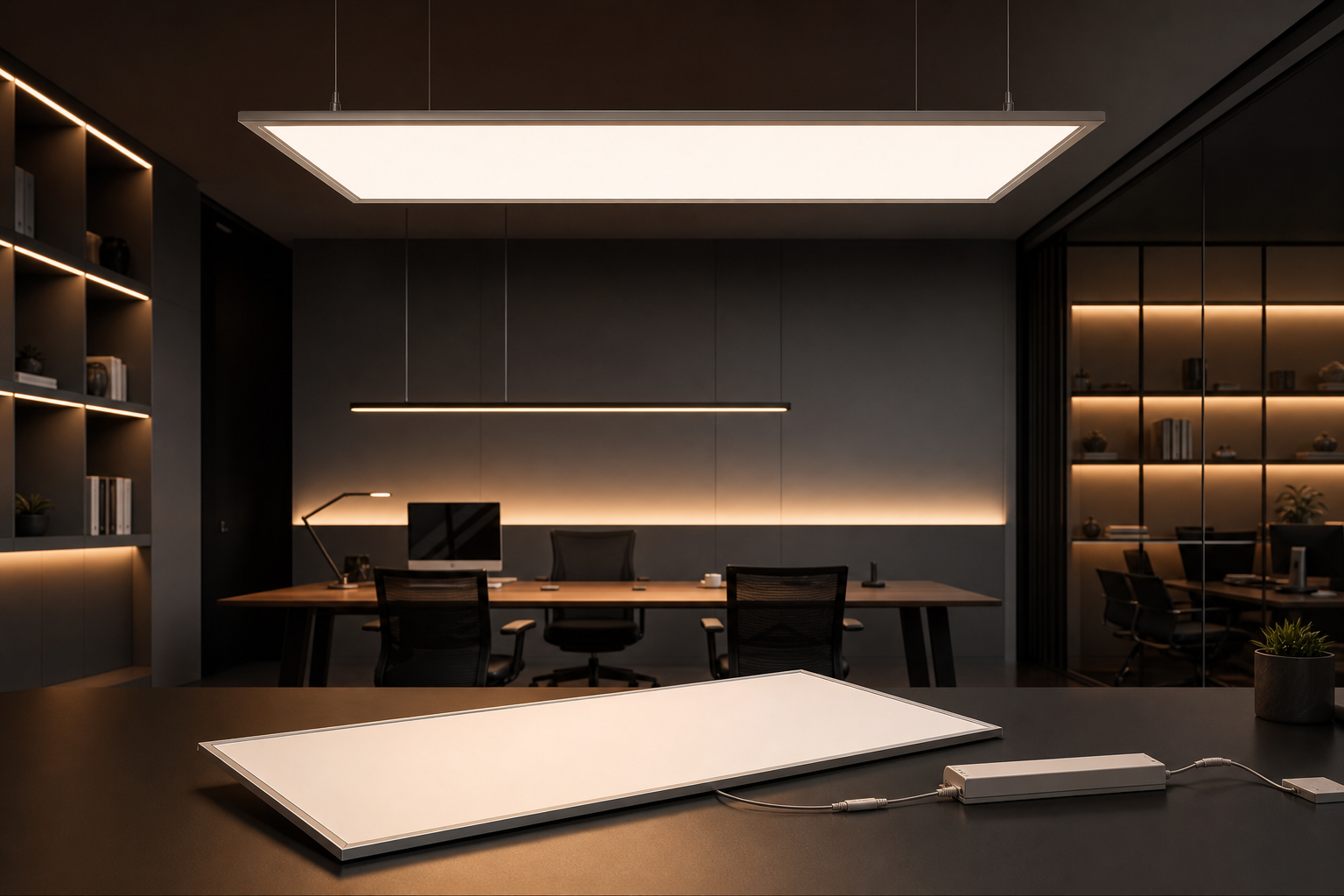
DALI — Digital Addressable Lighting Interface, standardized as IEC 62386 — is a two-wire protocol that lets a controller talk to each driver individually. The bus runs at low voltage, and the two control wires are polarity-free, so installers cannot wire them backwards. Up to 64 addresses sit on one DALI bus, each driver holding its own identity; the controller sends digital commands ("fade to 40 percent", "report your status") rather than an analog level, and the bus is bidirectional — drivers can answer with lamp failure, dim level and other feedback. That return channel is the quiet advantage: faults report themselves instead of waiting for a tenant complaint.
The practical consequence of addressing is flexibility after installation. Regroup a floor from four zones into six, change which switch controls which scene, add daylight control to one row of desks — all of it is configuration, not rewiring. Groups and scenes ride on top of addresses: any driver can belong to multiple groups, and a scene command tells every member to move to its stored level. This is the machinery behind the scene-setting that hotel and office clients describe when they say "the lighting should work like a system" — the thinking in our hotel lighting program assumes exactly this layer.
DALI-2 is not a new wire; it is the same bus with the standard rebuilt for interoperability. Original DALI certified driver behavior but left large parts of the system unspecified, so mixing brands worked unevenly. DALI-2 (IEC 62386 in its current editions) added control gear device types — most visibly DT6 LED drivers and DT8 tunable-white drivers that shift color temperature over the bus — extended the standard to input devices such as sensors and push-button couplers, defined application controllers, and introduced a certification and logo regime that requires multi-vendor testing. The practical reading for buyers: a DALI-2 logo on a driver is a much stronger interoperability claim than the DALI mark ever was, and a DALI-2 project can mix sensors, panels and drivers across brands with a real expectation they will cooperate. The finer-grained version history is in our DALI vs DALI-2 comparison.
| Control method | Addressing | Feedback | Typical cost posture | Best suited to |
|---|---|---|---|---|
| TRIAC phase-cut | None | None | Lowest | Decorative retrofit, simple rooms |
| 0-10V / 1-10V | None, per-channel analog | None | Low-mid | Small commercial, warehouse banks |
| DALI | 64 addresses, groups, scenes | Status reporting | Mid | Established commercial projects |
| DALI-2 | 64 addresses + sensors, controllers | Status reporting, certified mix | Mid-high | Offices, hotels, education, healthcare |
Cost posture is illustrative and relative; actual premiums depend on driver brand, sensor count and controller software.
The honest rule: DALI earns its premium wherever the lighting must change after handover or must report on itself. Offices with daylight harvesting and occupancy logic, hotels with per-room scene control tied to a guestroom management system, classrooms with teaching scenes, healthcare corridors with night-wash levels — all of these reconfigure constantly, and analog 0-10V makes every change a rewire. DALI also carries the emergency layer: self-contained emergency drivers on the bus (the IEC 62386 emergency part) run periodic testing and report results centrally, replacing the ladder-and-clipboard audit. For plain warehouses with two switching groups, 0-10V remains the rational choice; protocol religion has no place in a schedule — the scene logic in our office and education page applies DALI where it pays, not everywhere.
Worth singling out because it alone justifies DALI in many tenders: self-contained emergency drivers that live on the bus run their own discharge tests on schedule, log the results, and report failures back to the controller — replacing the manual key-switch audit of every luminaire with a printed report. Addressable emergency also identifies which unit failed, so the repair visit carries the right spare. The specification language to look for is the DALI emergency device part alongside DT6; mixing standard and emergency drivers on one bus is normal practice, and it is the reason facilities teams, not just designers, end up asking for DALI by name.
The labor line buyers underestimate is commissioning — the on-site work that turns wired hardware into a working system. A technician scans the bus, assigns each driver an address (manually or by ordering method), sorts drivers into groups matching the floor plan, stores the scene levels the operator wants, and sets fade times and system defaults. On a disciplined project this is hours per floor; on an improvised one it is days, because none of it can start until addressing is possible and none of it is visible in the fit-out photographs. The procurement consequence is concrete: purchase orders should include commissioning scope and responsibility explicitly — supplier-side commissioning support, contractor-side addressing labor, or a named controls specialist — because this line is where DALI projects quietly overrun.
DALI's physical generosity is a genuine site advantage. The two-core control cable may be run as loop, spine or spur — no termination, no topology rules, polarity-free — and it can share a trunk with mains wiring, so it drops into conventional installation practice without special conduit. Bus power (a small current that feeds the drivers' communication electronics) comes from a dedicated DALI power supply or from the application controller; sizing that supply against the number of devices is one of the few real design rules. Segmentation follows the 64-address limit: each bus is planned in the drawing, with routers or gateways linking buses so a floor grows in blocks rather than in one heroic line.
Dimmer-and-driver mismatch is the largest source of controls complaints in export projects, so the sample stage is where DALI orders are won or lost. State the protocol per fixture on the schedule (DALI-2, DT6 or DT8 where relevant, plus 0-10V or phase-cut for any mixed areas), name the controllers and sensors on site, and require the supplier to function-test a sample head or driver with the requested control brand before volume production — a five-minute test that has saved entire fit-outs. Ask for DALI-2 certification evidence via certified partner factories, verified by number and database link; the wider compliance matrix sits in our certification guide. Plan commissioning explicitly: addresses, groups and scenes are assigned on site, and the labor line is real — typically a day or two per floor for a commissioning technician, illustrative of course.
Illustrative commercial terms: samples of 1-5 pcs ship in 7-14 days including the DALI function test; trial orders run 100-200 pcs per SKU; bulk production 25-40 days after deposit; pricing quoted per project, with the driver line itemized since DALI-2 drivers, not the luminaire, carry most of the premium. For the smart-lighting context DALI sits inside, see our smart lighting line and the protocol comparison in Matter vs Zigbee — bus-based and wireless layers are complements, not rivals.
What changes for your lighting project — device types, certification and mixing rules.
Meeting EN 12464-1 without overlighting — the scene where DALI logic pays for itself.
Systems, protocols and benefits — where the DALI bus fits beside wireless layers.
CE, UKCA, SAA, SASO and DLC by destination market — what your order actually requires.
Protocol per fixture, controller brands and driver schedule — function-tested samples and FOB quotation within 24 hours.