2026-09-10 · 8 min read · Comparison
TL;DR — the short answer
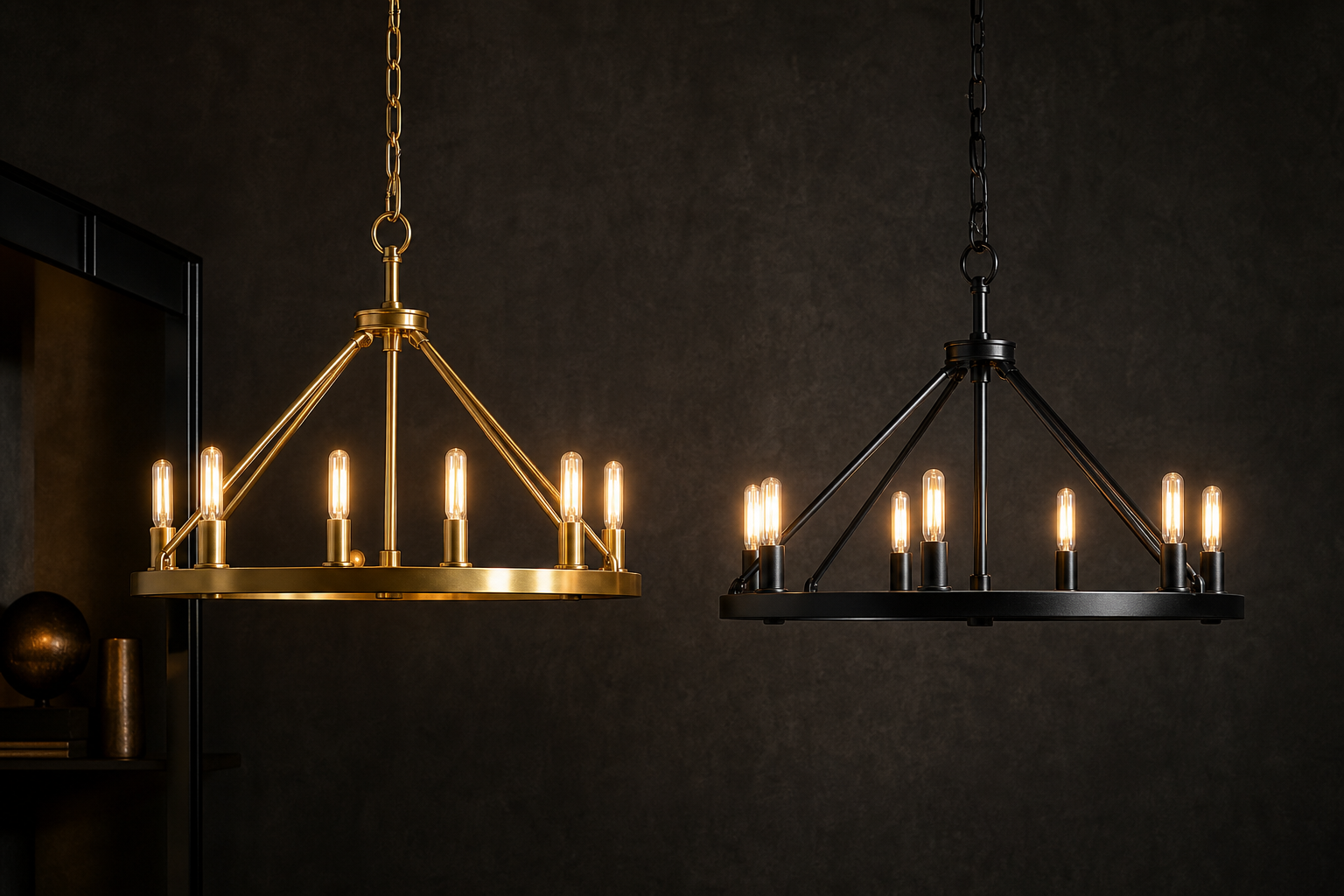
Choose brass when the interior story is warmth, heritage or quiet luxury — brass reads golden under 2700-3000K light, pairs with marble, walnut and textiles, and develops a patina some hotel brands deliberately embrace. Choose black when the story is contemporary, graphic or architectural — matte black frames disappear against dark ceilings, flatter sculptural glass and stone, and photograph cleanly in modern lobbies. The deeper decision, and the one that determines whether the choice survives five years of housekeeping, is the finish process behind the color: solid brass versus plated steel, electroplating versus coating versus PVD, lacquered versus living finish. Approve samples against that process data, not against the render.
Two finishes, two design languages
Brass is a warm metal that interacts with light sources. Under the warm-white temperatures that dominate hospitality lighting, a brushed or antiqued brass chandelier glows — the fixture itself becomes part of the light. It anchors classic and transitional lobbies, ballrooms and heritage conversions, and it has ridden the "quiet luxury" wave into contemporary interiors as well, usually in brushed or satin rather than polished forms. Its risk profile: brass shows fingerprints and water spots when polished, drifts visually if one batch lacquers and another does not, and can dominate a room if the designer wanted the chandelier quiet.
Black is the disciplinarian. A matte black chandelier asserts silhouette rather than material — arms, rings and shades read as drawn lines against the ceiling. It suits contemporary lobbies, rooftop restaurants and guestrooms with a design-forward brief, and it hides small surface imperfections better than any metal tone. Its risks run the other way: matte black surfaces collect visible dust in high spaces (housekeeping either plans the high-dusting cycle or the fixture looks tired within months), cheap black coatings can chalk or grey under UV near windows, and scratches on black-over-steel expose bright metal at the wound.
How each finish is made — and why it sets price and durability
The word "brass" on a quotation can mean three different products. Solid brass (the body is brass stock) is the premium: heavy, satisfyingly dense, machines beautifully, and the only option that ages honestly into a patina. Brass-plated steel or iron is the volume standard: the structure is steel for strength and cost, with an electroplated brass layer and usually a clear lacquer over it. A sprayed "brass-tone" coating is the budget tier — visually plausible in photos, mechanically the weakest, and the first to fail at joints and high-touch points. A parallel ladder exists for black: powder coating is the respectable standard; thin spray coatings are the budget tier; and PVD (physical vapor deposition) sits at the top for both colors, giving exceptional scratch and corrosion resistance — the specification of choice for coastal and high-humidity properties.
None of the tiers is automatically wrong; each fits a different budget and service life. What is wrong is opacity. A hotel FF&E submission should state, per line item: base material, finish process, plating or coating thickness where applicable, and lacquer or PVD specification. That single paragraph prevents the classic failure — approving a showroom sample in solid brass and receiving production in sprayed steel, which is indistinguishable in a photograph and nothing alike in year three.
Maintenance in hotel conditions
Hotel service reality decides the finish as much as the design board. Polished or lacquered brass needs a defined care regime — approved cleaning agents only; abrasive cleaners cut through lacquer and start uneven tarnishing. Living-finish brass (deliberately unlacquered) is the low-touch option: it darkens on its own schedule, which some brands specify precisely to escape maintenance debates — but it must be a brand decision, not an accident. Matte black needs scheduled high-dusting (a lift or pole access plan for tall lobbies) and touch-up paint stocked for chips. In coastal properties, salt air attacks plated finishes at microscopic pores and scratches; there, PVD or solid materials with protected hardware are the defensible specification, and electrical isolation of dissimilar metals should be checked in the drawing review.
Budget the maintenance plan at specification time, not discovery time: high-dusting frequency, approved cleaning agents, touch-up stock and lamp-access route all appear on hotel O&M audits, and a finish chosen without its care plan is a future change order in waiting.
A closing design note: the binary is dissolving in practice. Two-tone fixtures — black frames with brass interior reflectors, or the reverse — have become a signature of contemporary hospitality work, bouncing warm light off metal while keeping the architectural silhouette graphic. Where the brief hesitates between the two finishes, a two-tone hero fixture over neutral standard lines often resolves the debate without committing the whole program.
What the finish actually costs
Decode the price by walking the tier ladder. Base material moves the number most: solid brass stock weighs multiples of steel tube, and metal is priced by weight through the supply chain. Process follows: electroplating with adequate thickness costs more than spray; PVD commands a premium over both but repays it in scratch and corrosion resistance. Hardware finishes — chains, canopies, screws — must match or be specified deliberately, because a brass body with bright-steel hardware reads as a cost cut at two meters' distance. Custom sizes and customer-specified finishes add tooling and approval loops on top. None of this produces a fixed brass-versus-black premium: a PVD black fixture can outprice a plated brass one. Price is quoted per project, by weight, process and finish specification — which is why the finish process sheet from the earlier section doubles as the pricing sheet.
Side-by-side comparison
| Dimension | Brass chandelier | Black chandelier |
|---|---|---|
| Design language | Warmth, heritage, quiet luxury | Contemporary, graphic, architectural |
| Interaction with light | Glows under warm white; fixture reads as material | Silhouette-first; flatters sculptural shades and glass |
| Construction tiers | Solid brass / plated steel / sprayed tone | Powder coat / spray coat / PVD over steel |
| Aging behavior | Patina (valued or managed via lacquer) | Coating wear, chipping exposes substrate |
| Housekeeping load | Polished: care regime; living finish: near zero | Scheduled high-dusting; touch-up stock |
| Coastal suitability | Good if PVD or solid with protected hardware | Good if PVD; powder coat acceptable inland |
Finish-tier behavior reflects common manufacturing practice across the cluster; verify actual specifications per model and batch. Costs are quoted per project.
How to choose — three decision rules
- Warm materials and heritage brief: brass, with the tier chosen to the service model — lacquered for polish, living finish for low maintenance.
- Contemporary brief or dark ceilings: black, powder-coated as standard, PVD where humidity or salt air argues for it.
- Either way: approve a finish process sheet with the sample — base material, process, thickness — and hold production to it, batch by batch.
Advice for procurement teams and dealers
Sample discipline is everything in this category. View finish samples under the project's actual light sources and dimming levels — brass at full output and at 20% dim are two different materials — and in the project's own ceiling heights and backdrop colors. Run a batch-consistency check on the first production run: lacquer tone and plating depth drift between baths, and a lobby that mixes batches reads instantly wrong. For tall installations, include the high-dusting plan in the O&M handover; the finish that survives is the one the building team was briefed to keep.
For dealers and sourcing teams: the chandelier category rewards factories with in-house metal shops and controlled finishing lines — a sourcing audit should walk the plating or coating line, not just the assembly floor; our Guzhen sourcing guide covers the audit sequence. Catalog logic: a flagship chandelier platform offered in both brass and black finishes multiplies a decorative line without doubling tooling. Pricing is quoted per project and depends on base material (solid versus plated), finish process and hardware; treat any published brass-versus-black premium as illustrative until your schedule is priced.
Retain a golden sample per finish per program — sealed, labeled, dated — and require production batches to be compared against it at pre-shipment inspection, not against photographs. Two decades of decorative-export disputes trace to the missing golden sample: the factory matched the last batch, the last batch had drifted from the approval, and nobody could prove which approval was real.