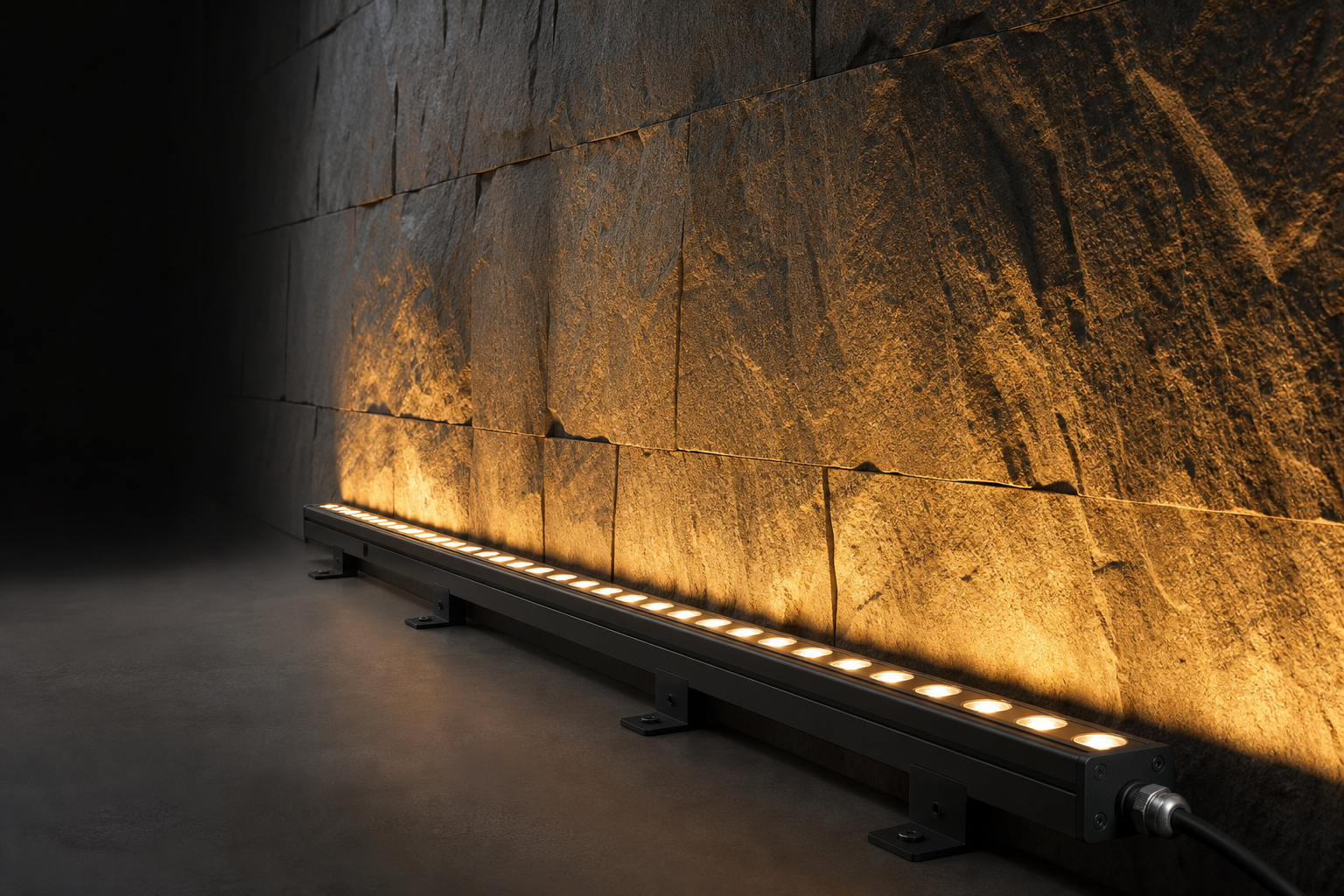
Wall washer lighting is the technique of lighting a vertical surface as a surface — not spotlighting an object on it, but laying light across the plane so the wall itself becomes the luminous element of the room or facade. Done well, it is the least visible kind of architectural lighting: the wall simply reads as calm and evenly bright, artwork hangs on an even field, and a building at night presents a clean silhouette instead of a scatter of bright points. The hardware that does it — linear wall washers, recessed perimeter slots, in-ground uplights, adjustable grazing units — is a core repeat-order category for hospitality, retail and facade contractors.
The category looks simpler from a catalog than it behaves on site. Most wall-washing failures are not product failures but technique failures: the wrong distance from the wall for the surface, spacing that produces scalloping, or a beam chosen for output numbers rather than for the wall. This guide separates the two fundamental techniques, the fixture types behind each, and the specification checks that keep a facade or cove-level wash uniform.
Washing versus grazing: the two techniques
Everything in this category starts with one decision — how far the fixture sits from the wall, because distance and beam angle together decide what the surface will show.
Wall washing places fixtures set back from the surface — roughly 0.6 to 1.2 meters for exterior facades, or at ceiling perimeter in interiors — and throws a wide, controlled beam across the plane. The goal is uniform luminance top to bottom: the wall reads as one smooth sheet. Washing suits flat, smooth surfaces: painted plaster, curtain wall, large-format cladding. It is also the technique for lighting large interior walls, boardroom feature walls and hotel ballroom perimeters, usually from recessed linear slots or adjustable ceiling units.
Wall grazing places fixtures close to the surface — 15 to 30 centimeters — and throws light down (or up) along it at a sharp angle. The near-parallel light catches every projection and recess, which exaggerates texture dramatically. Stone, brick, corrugated metal, fluted concrete and carved reliefs come alive under grazing; the same materials under washing look flat. Grazing is the signature hotel-lobby move behind a stone reception wall and the standard treatment for textured facades on premium commercial projects.
Choosing wrong is expensive to discover after installation: textured stone washed from a setback looks dull and featureless, and flat plaster grazed up close shows every trowel mark. Contractors evaluating a facade package can short-circuit the risk by requesting a photometric calculation or a sample wall mock-up before the order — both are routine requests in our landscape and facade solution workflow.
The fixture families
| Fixture type | Technique | Typical output class | Typical protection | Natural application |
|---|---|---|---|---|
| Linear wall washer (surface or recessed) | Washing or grazing by optics | 300-1,500 lm/m, illustrative | IP65-IP67 exterior | Facade bands, coves, interior feature walls |
| In-ground uplight, asymmetric optics | Washing from below | 1,000-4,600 lm class | IP67, drive-over ratings by model | Facade washing at grade, columns, monuments |
| Adjustable spotlight / projector | Washing at distance | Wide beam variants | IP65-IP66 | Set-back facades, tall plane coverage |
| Recessed perimeter slot system | Grazing close-set | Per module, interior grade | IP20-IP44 interior | Hotel lobbies, retail feature walls |
Category-typical ranges, illustrative only — actual schedules follow each project's photometric calculation.
Three specification variables dominate performance across all four families. Beam angle: wide (60-100 degrees) for washing a plane, narrow-to-medium for grazing tall texture, with asymmetric distributions engineered specifically to throw light up a wall from a floor-level fixture. Output and uniformity: for facades the metric that matters is luminance uniformity across the plane, which spacing and beam jointly control, not raw lumens alone. Color quality: vertical surfaces are seen at eye level and dominate the perception of a space, so CRI and color consistency between fixtures matter more here than in overhead general lighting — see our guide to CRI for lighting buyers for the vocabulary.
Spacing, uniformity and the details that decide the result
Uniform washing is a geometry problem. For a facade washed from a linear row, a practical starting rule is fixture spacing of one to one-and-a-half times the setback distance, tightened or widened by beam angle, with half-spacing at corners so the two walls meet without a dark seam. Grazing runs much tighter — linear grazing units commonly sit at 30 to 60 centimeter centers — because the effect depends on continuous shadow gradients along the texture. Scalloping, the series of bright arcs on the wall that instantly marks amateur work, is what happens when spacing outruns beam coverage; it is fixed by closer spacing or wider optics, not by more lumens.
Height coverage is the second constraint: a wide beam from a floor-level in-ground unit may wash four meters of facade beautifully and die at six, which is why tall elevations often combine an in-ground row with a mid-height linear band. On multi-fixture facades, color consistency between units matters as much as spacing — a wall seen at a raking angle will expose even small SDCM differences between fixtures. Professional specifiers write both a binning requirement and a spacing tolerance into the schedule, and treat the supplier's photometric files as part of the deliverable, not an optional extra. Our facade lighting design guide works through full elevation layouts, and the hotel and hospitality solution shows how interior grazing walls sit within a layered scheme.
Sourcing wall washers for export projects
- Exterior duty ratings. Facade units live with rain, wash-down and UV: IP65 as the entry expectation, IP67 for in-ground and drive-over positions, with IK ratings where vandalism or vehicle contact is possible.
- Thermal design for continuous dimming. Linear washers often run for full evenings at partial output; drivers and board layout must be rated for the housing's real sustained temperature, not just full-on bench conditions.
- Length and cut-point policy. Custom-length linear units cut to facade dimensions avoid joint darkness — but only if the factory states where cuts are allowed and reseals them. Confirm before ordering, not on site.
- Documentation per order. CE/UKCA via certified partner factories, verified with certificate numbers; photometric (IES/LDT) files delivered with the quote so the lighting designer can confirm uniformity before purchase.
- Packing for long lengths. Linear fixtures rack or carton by length; export-grade packing with rigid protection along the optic face prevents the transit scratches that show on every lit wall.
- Lead time realism. Illustrative export reference: standard-length production 25-40 days; custom cut-to-length programs add one to two weeks; FOB quotation within 24 hours of drawings.
Common mistakes in wall washer projects
- Grazing a flat wall or washing a textured one. The technique and the surface must match; no fixture spec repairs the wrong distance.
- Designing in lumens instead of uniformity. A brighter non-uniform wall is still a failed wall. Specified luminance uniformity plus photometric files is the professional package.
- Ignoring corner treatment. Full spacing run into a corner leaves a visible dark seam; corners need the half-spacing rule planned in advance.
- Under-rating the environment. An IP54 interior-grade linear unit on an exposed facade fails within its first winter. Match protection to position, including drive-over zones.
- Skipping color consistency requirements. On vertical planes the eye catches fixture-to-fixture differences that go unnoticed overhead. State binning (SDCM) in the schedule.
- Forgetting maintenance access. In-ground units need drainage and serviceability designed in; the best optics fail if the housing sits in standing water.
The category rewards buyers who specify technique first and hardware second: name the surface, the distance and the uniformity target, and the fixture choice largely writes itself. Our team quotes wall washer packages that way — facade drawings in, photometric files and a cut-length schedule out, FOB price inside 24 hours.