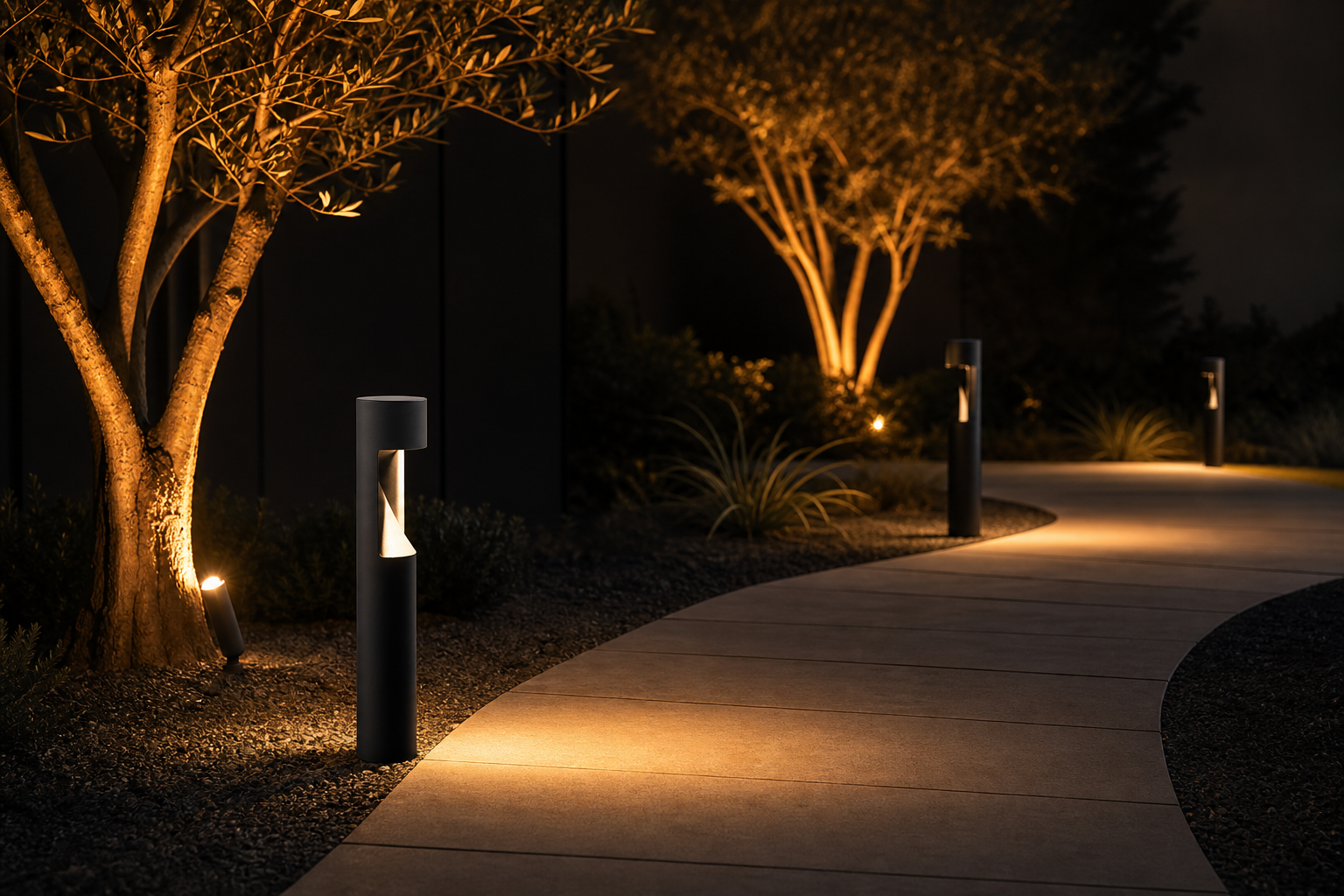
How to layer a garden or resort landscape after dark — the lux logic for safety, the techniques for trees and water, the IP and voltage details that decide survival, and the sourcing checks buyers forget.
2026-09-10 · 9 min read · Lighting guide
A landscape scheme is read in three layers, and the projects that fail are the ones that light only one of them. The safety layer covers paths, steps, level changes and driveways — modest, even, glare-free light where feet actually travel. The composition layer is the drama: specimen trees, sculpture, water, the facade beyond — selective light that gives the garden depth and a reason to be walked at night. The courtesy layer is small and often skipped: dim guidance at seating, a soft wash at the outdoor kitchen, a low pool of light at the gate. Hotels and resorts buy all three; private estates usually start with safety plus one hero composition.
The governing discipline is restraint. Outdoor light is seen against near-darkness, so every lumen counts several times more than indoors — and every visible source is a glare complaint waiting. Typical practice keeps path and area levels low, in the 5-20 lux band on walking surfaces (in the style of EN 13201 P-class practice), saves real output for the two or three features that anchor the composition, and hides almost every fixture. A garden where you can see the light but never the lamp is the brief in one sentence.
Different owners use the same three layers differently, and the brief should say which. A private estate wants arrival drama and a safe route to the car; a resort wants the garden usable as a venue until midnight, with paths that never pitch a guest into darkness; a public park wants P-class compliance, vandal resistance and a curfew. The fixture families overlap almost entirely — what changes is the control philosophy, the duty rating and who answers the phone at year five. Writing those three answers into the brief before quoting is what separates a scheme that installs cleanly from one that restarts twice.
Set targets by zone before choosing a single fixture. The table below is the working structure:
| Zone | Typical illuminance | Technique | Notes |
|---|---|---|---|
| Primary paths | 10-20 lux on the surface | Bollards or path lights, staggered | Shielded optics; spacing 2-3× fixture height as a start |
| Steps and level changes | 20-50 lux on treads | Step lights in risers, handrail lines | Every step lit; the single biggest liability zone |
| Specimen trees | 50-100 lux on the canopy | Uplighting, 2-3 fittings per tree | Beam follows height: 24°-36° for 4-6 m, 10°-15° for taller |
| Water features | 20-50 lux in the basin | Submersible IP68, aimed away from seating | Low-voltage supply mandatory; see sourcing section |
| Seating / dining terraces | 20-50 lux, dimmable | Wall lights, festoon, table lamps | Warm white 2700 K and below; light must not reach faces directly |
| Boundaries and gates | 10-30 lux | Graze on planting, marker at the gate | Check light trespass toward neighbors before aiming |
Values are illustrative starting points in the style of EN 13201 and common residential practice; resort and municipal projects should confirm the governing brief.
Fixture families follow the zones. Bollards (0.6-1.0 m, louvered) and path lights carry the walking network. Spike uplights give planting flexibility, while in-ground uplights (IP67, drive-over rated, with drainage gravel beds) lock the aim for architectural trees. Step lights and handrail integrations own the level changes, and submersible fittings (IP68, low-voltage) live in basins and rills. Two materials decisions dominate long-term satisfaction: marine-grade 316 stainless or solid copper/brass in coastal or pool districts, and powder-coated aluminum elsewhere — with any coated fitting installed before its finish gets scratched by site equipment.
Planting matures, and the lighting scheme that ignores growth rates dates itself within three seasons. Spike-mounted uplights and repositionable fittings exist precisely because shrubs swell and canopies close; in-ground units that graze a young tree will sit inside its trunk in a decade. Specify spare conduit and junction capacity on the main runs — the cheapest possible insurance against re-trenching — and schedule an annual aiming walk as the planting grows into its night role. Landscape lighting is the only discipline in the catalog where the display physically moves; the design should expect it.
Low-voltage architecture is the landscape default for good reason: 12 V supplies make in-ground and submersible installations safe, allow spike-mounted repositioning as planting matures, and keep transformer placement flexible. The engineering duty is voltage drop — on 12 V circuits, keep runs short, use adequate cable cross-section, and hold fixture loading to roughly 80 percent of transformer capacity; beyond about 15-20 meters per run, hub wiring or multiple transformers beat one long daisy chain, as a rule of thumb buyers can verify with any drop calculator. Our solar sizing guide covers the off-grid version of the same arithmetic where trenching is impossible.
Control is where a garden stops being a switch. Scene control on dimmed zones — arrival, dinner, late-night — multiplies the use of one installation, and astronomical timers trim hours automatically with the seasons. Presence sensing on service paths and gates adds security light only when it is wanted. Dark-sky practice ties it together: warm 2700 K or lower, full shielding, sharp cutoff, and a curfew scene that drops composition light to zero after the household or resort goes quiet. Our light pollution guide explains the terms a municipal reviewer will use, and the wider pole-and-path hierarchy sits with our landscape and facade solutions program.
Equipment siting is the unglamorous half of controls. Transformers, drivers and time clocks need ventilated, drainable enclosures sited where service access does not mean lifting deck boards or wading through planting beds — and every location should be marked on the as-built plan, because two seasons of growth will hide the unlabeled ones completely.
Landscape hardware lives a harder life than its price suggests, so the verification list is specific. Require: IP test reports per fixture family (IP65 bollards, IP67 in-ground, IP68 submersible), IK rating where drive-over or vandal exposure exists, photometric files for the uplight beams, driver or transformer efficiency data, and salt-spray certificates for coastal projects. Cable, glands and junction kits from the same factory avoid the mixed-material corrosion that voids warranties. Certification follows the destination market — CE for the EU, UKCA for the UK, SAA for Australia, SASO/SABER for the Gulf — issued via certified partner factories and verifiable by certificate number; the matrix is summarized in our certification guide.
Commercially, landscape programs are mixed-SKU by nature — bollards, uplights, step lights and transformers shipping as one kit — so packaging and labeling deserve a line in the purchase order: room-by-room or zone-by-zone carton labeling cuts installation days measurably, and fragile shades and glass lenses need drop-tested cartons. Typical terms run samples in 7-14 days, trial orders from 100-200 pcs across the mix, bulk production 25-40 days after deposit — illustrative, confirmed per order. Fixture families consolidate naturally with our outdoor and solar program for unpowered zones, and estate-scale schemes pair with the outdoor area lighting guide for the pole-mounted side of the site. Close the spares note at order stage: two or three complete units of each fixture family, held on site, covers breakage during landscaping works — the phase when most garden fixtures actually die.
Grazing, washing and silhouetting buildings — the vertical half of an exterior scheme.
Parks, plazas and campus walkways — pole schedules, P-classes and dark-sky practice.
Dark-sky friendly lighting for export projects — the terms municipal reviewers use.
CE, UKCA, SAA, SASO and DLC by destination market — what your order actually requires.
Zone-by-zone layout, fixture schedule and a per-project quotation — first response within 24 hours.