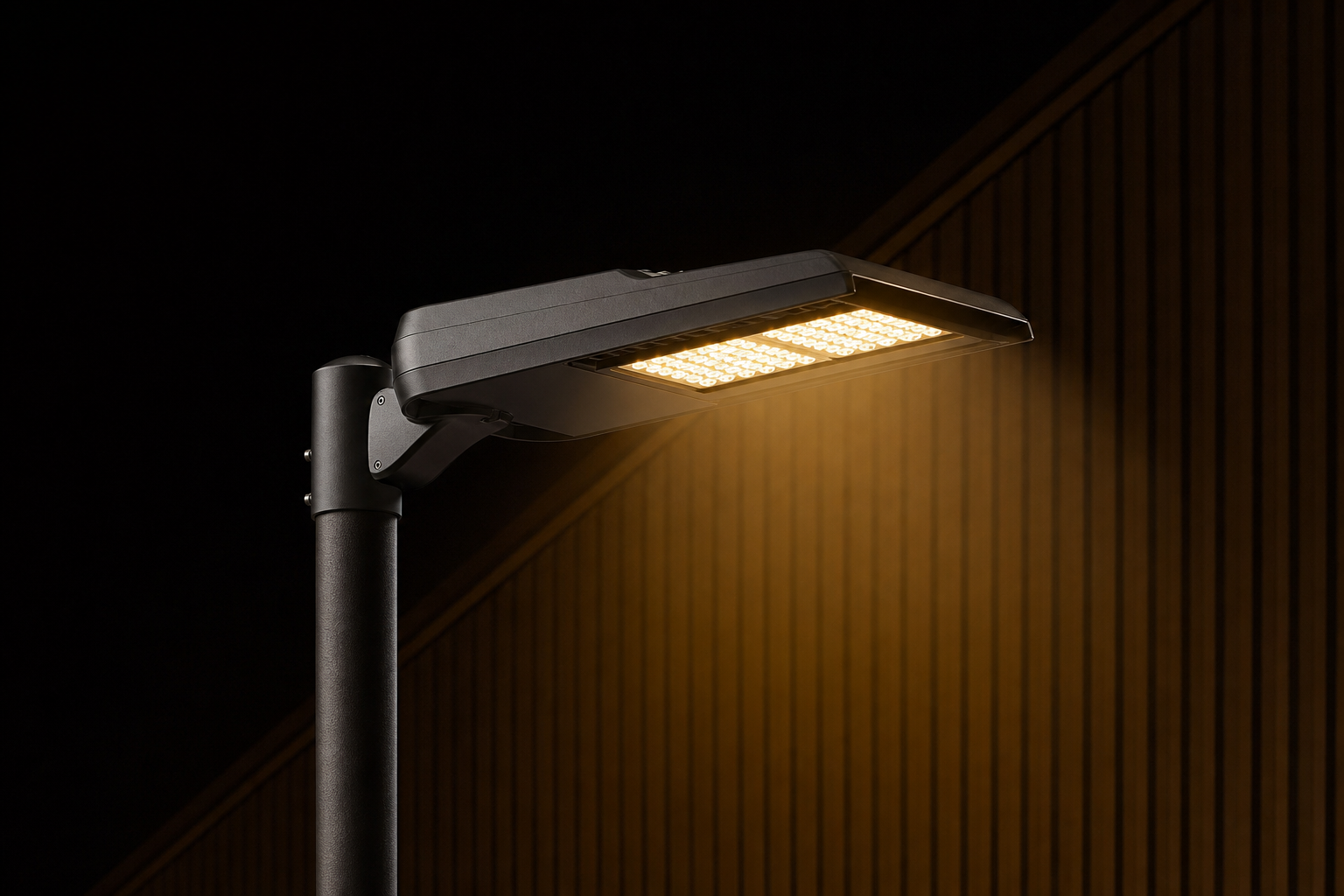
Light pollution is artificial light emitted where, when or in the direction it is not needed — the glow over cities that hides the Milky Way, the floodlight that shines into a bedroom window, the shopfront lit at 3 a.m. for no one. It is a byproduct of outdoor lighting done carelessly rather than a property of lighting itself, which is precisely why it has become a procurement topic: the fixtures a distributor stocks and the layouts a contractor installs decide how much of it a project creates.
For the export trade the commercial signal is unambiguous. Municipal tenders in Europe, Australia and a growing list of North American jurisdictions now carry obtrusive-light clauses — maximum upward light ratios, color temperature caps, curfew dimming — and dark-sky requirements have moved from astronomy advocacy into building codes and energy regulations. Suppliers who can evidence shielded optics and warm CCT with photometric files are eligible for programs others quietly are not.
The four forms of light pollution
The term bundles four distinct problems, each with its own cause and its own fixture-level remedy.
- Skyglow. The dome of scattered light over settlements that washes out the night sky. It is driven disproportionately by light emitted upward or horizontally from fixtures — which is why full shielding is the single most effective measure — and by blue-rich spectra, which scatter more strongly in the atmosphere.
- Glare. Direct, uncomfortable brightness in the eye from unshielded or over-bright sources. Glare is a safety issue as much as an amenity one: an aging driver facing a bare 4000K array on a pole experiences measurably worse visibility. Shielding, lower luminance optics and warmer spectra reduce it.
- Light trespass. Light falling where it is not wanted — into windows, onto neighboring property, into protected habitats. Trespass is controlled by aiming, shielding accessories, output discipline and setback-aware layout.
- Clutter. The visual noise of excessive, poorly grouped bright points along commercial strips. Curfews, uniform design language and dimming schedules address it at the district level.
Alongside the visual effects sit ecological and human-health impacts: disorientation of nocturnal insects, birds and sea turtle hatchlings; disrupted circadian rhythms in humans exposed to blue-rich light at night. Those impacts are what elevated the topic from aesthetics to regulation.
The metrics buyers will be asked about
Obtrusive light is measured, not vibes-assessed, and three measurement frameworks dominate tender language. Upward light metrics express what share of a fixture's lumens leave above horizontal — the ratio most schemes cap, with the strictest targets requiring effectively zero upward output. The BUG system, used in North America, rates a fixture separately on Backlight, Uplight and Glare in ranked zones, letting a tender set maximum ratings per lighting zone rather than arguing about fixture aesthetics. And lighting-zone frameworks classify environments from high-brightness urban cores to protected dark landscapes, with permitted illuminance, luminance and curfew rules scaled to each zone.
| Requirement appearing in tenders | What it measures | Typical specification form | Fixture-side implication |
|---|---|---|---|
| Upward light ratio cap | Share of flux above horizontal | Zero or near-zero upward output required | Fully shielded optics; no exposed lenses or domes |
| BUG rating limits | Backlight / uplight / glare by zone | Maximum B-U-G values per lighting zone | Directional optics, internal baffles, controlled distributions |
| CCT ceiling | Color temperature of outdoor light | 3000K cap common; 2700K or lower in sensitive zones | Warm LED packages for outdoor families |
| Curfew dimming | Output after a set hour | Dims to a set level or off overnight | Dimmable drivers, photocell and schedule control |
Specification forms summarized at tender-practice level, illustrative — exact limits follow each jurisdiction's obtrusive-light rules.
Lighting-zone frameworks deserve a note because they change what a supplier is asked for. Under the most widely used scheme, environments are classed from high-brightness urban cores down to protected dark landscapes, and each class carries its own allowances for illuminance, luminance, upward output and curfew timing. A single fixture model may be compliant in a city center and non-compliant in a coastal reserve — same hardware, different context. This is why municipal requests increasingly arrive as a zone code plus a fixture schedule rather than a product name, and why suppliers who can produce zone-specific photometric summaries win the technical review. For export distributors the practical step is simple: ask which lighting zone a program falls under before quoting, and attach the relevant numbers to the offer.
What dark-sky friendly fixtures look like
The good news for buyers: dark-sky compliance is mostly ordinary good engineering, not a premium product universe. The fixture properties that satisfy the clauses above are now standard options across street, area and architectural outdoor families:
- Full shielding. The lens plane sits at or above horizontal; nothing glows sideways or up. On street lights this is now the mainstream design; on architectural and landscape fixtures it distinguishes a shielded up/down wall unit from a bare globe.
- Warm color temperature. 2700K-3000K packages for outdoor areas as the compliant default, with amber options in ecologically sensitive coastal and habitat programs.
- Right-sized output. Over-lighting is its own pollution; layouts calculated to target illuminance — as in our street light spacing guide — reduce both energy and skyglow simultaneously.
- Controls and curfew. Photocell, schedule and DALI-compatible drivers so districts can dim after hours without re-fit.
Solar street lights interact with these goals favorably in off-grid programs — modern units are specified with the same shielded optics and warm CCT as grid luminaires, and their motion-dimming profiles are inherently curfew-like. The selection logic carries over directly from our all-in-one solar street light guide, and the full outdoor range structure appears in the street and municipal solution.
Sourcing for dark-sky compliant programs
- Photometric evidence per fixture. Upward light ratio and BUG data from the manufacturer's IES/LDT files — the documents tenders actually check. We supply these with quotations as standard practice.
- Warm outdoor optics in stock families. 3000K street and area lines as the default SKU, 2700K and amber variants quoted for sensitive zones; certifying these follows the usual destination path via certified partner factories, verified per order.
- Shielded architectural lines. Facade, bollard and landscape families offered with full-cutoff variants so municipal-adjacent private projects comply too — the fastest-growing compliance segment after street lighting.
- Controls readiness. Dimmable drivers and photocell interfaces standard, so curfew rules are a configuration matter rather than a hardware change.
- Lead time. Illustrative export reference: FOB quotation within 24 hours of the item list; production of standard shielded street and area volumes roughly 30-45 days, with photometric documentation prepared alongside the quotation.
Common mistakes around light pollution
- Assuming compliance means less light. Well-designed shielded layouts meet task illuminance targets; the goal is where the light goes, not whether the task is lit.
- Over-lighting by habit. Legacy metal-halide illuminance targets carried into LED layouts double the pollution and the energy bill together.
- Cool CCT out of inertia. 4000K outdoor stock wins nothing at tender stage in markets with caps, and reads harsher to residents.
- Decorative exceptions that undo the program. One exposed-globe facade line on a compliant street project still generates the complaint calls.
- No curfew capability. Retrofitting controls after a curfew rule arrives costs multiples of specifying dimmable drivers at purchase.
Light pollution is the rare compliance topic where the compliant product is also the better-lit one: shielded, warm, right-sized and controlled. Buyers who move their outdoor stock toward those four properties are preparing for tenders that already exist — and selling after dark, ironically, in the markets that still let residents see it. The engineering context sits in our street lighting design guide, and the certification mapping per destination in the lighting certification guide.