2026-09-10 · 8 min read · Comparison
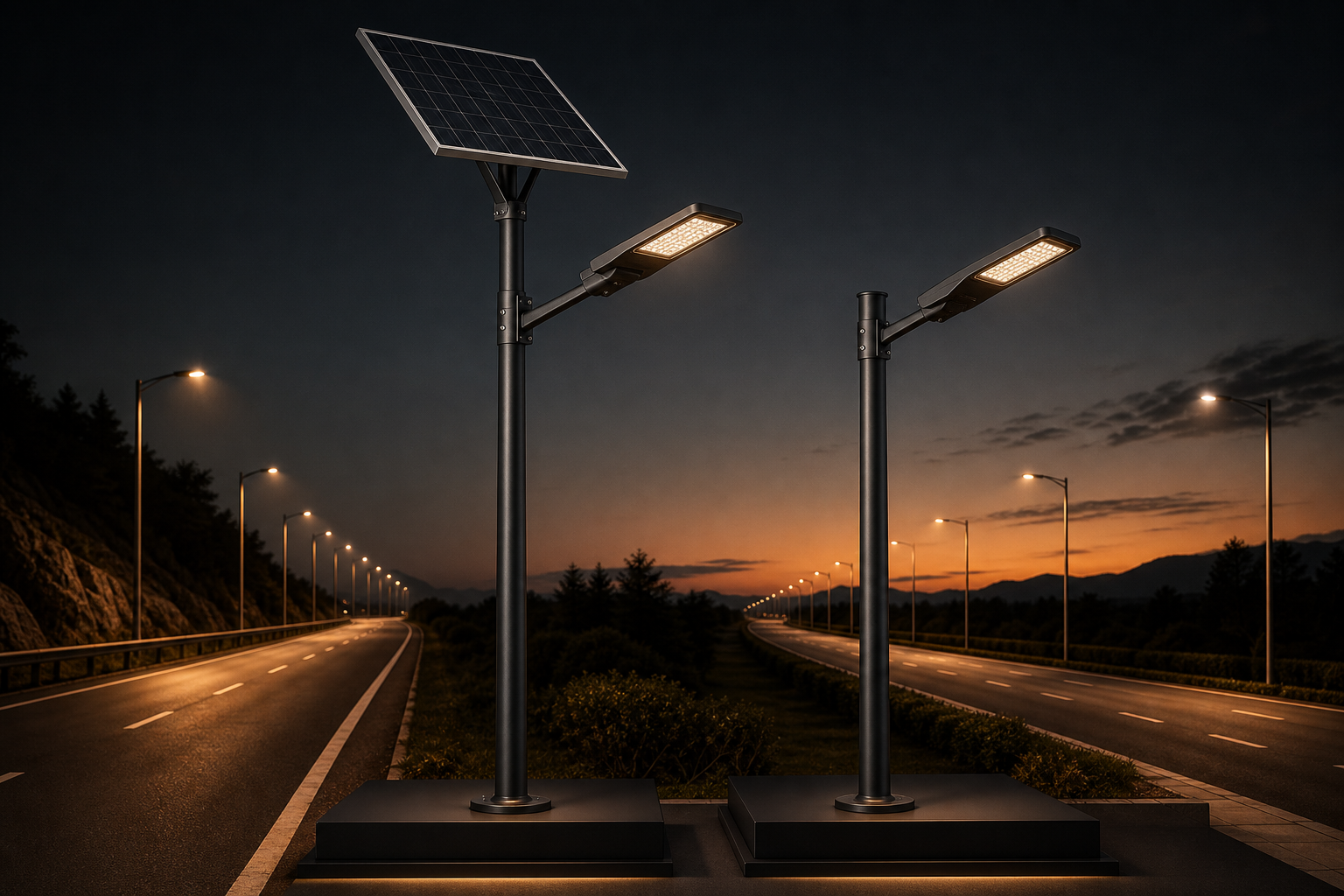
TL;DR — the short answer
Mains-fed LED street lights win on upfront cost wherever the grid is present and trenching is reasonable — their ten-year cost is dominated by energy bills and routine maintenance, and their light output never degrades with the weather. Solar street lights win wherever bringing the grid is the expensive part: long greenfield runs, dispersed villages, parks and car parks where trenching per pole costs more than several luminaires, and regions with unreliable grids or expensive diesel generation. The battery is the solar option's structural weakness: it is the one component that will be replaced at least once in a ten-year horizon. Municipal buyers should therefore compare on ten-year TCO per pole — and treat sunlight-hour assumptions, battery cycle life and theft risk as tender-critical data, not brochure lines.
The cost structures are different from the first meter
A mains street light's capital cost is deceptively small: pole, luminaire, control gear, and a connection. The real capital hides in the civil works — trenching, cabling, distribution boards and transformers — which scales with distance and with how much paving the route crosses. In built-up roads, those costs are sunk anyway; in greenfield or landscape projects, civil works can rival or exceed the lighting hardware itself. All cost examples in this article are illustrative for structure only; actual trenching rates move by an order of magnitude between soil and paving types.
A solar street light inverts the structure: the capital is front-loaded into the complete system — larger photovoltaic panel, battery (LiFePO4 is today's working standard), charge controller and luminaire engineered as one energy budget — while operating cost approaches zero. No cable runs, no energy bill, near-immunity to grid outages. The lifecycle expense arrives on a schedule instead: battery replacement, typically once within a ten-year frame depending on depth-of-discharge design and climate, plus panel cleaning in dusty regions. A well-dimensioned system sizes the battery bank for autonomy — three to five nights of overcast operation is a common tender requirement — which directly raises capex; under-dimensioned systems fail their first monsoon season. This is the design tension a serious evaluation must test.
Hidden cost lines deserve explicit treatment in both columns. Mains: excavation reinstatement (asphalt and paving make-good is often quoted separately by civil contractors), night-work premiums on live roads, and the distribution board's capacity headroom. Solar: anti-theft hardware, periodic panel cleaning in dusty regions, and the disposal or recycling path for batteries at end of life — a line that European-funded programs increasingly require bidders to state. Two-year post-installation light-level checks, recommended for both options, close the loop between the tender's promised lux and the road's delivered lux.
A ten-year TCO frame (illustrative)
Set the comparison up as a table of cost events over ten years per pole, then run it for your actual site. The illustration below shows the shape of the answer, not a quote.
| Cost event (10 years, per pole) | Mains LED street light | Solar street light |
|---|---|---|
| Fixture + pole capex | Lower | Higher (panel, battery, controller included) |
| Civil works | Trenching + cabling + board; dominant on greenfield runs | Foundation only; near zero beyond the pole base |
| Energy over 10 years | Continuous bill, exposed to tariff escalation | Zero |
| Component replacement | Driver sometime within decade; LED source generally outlives frame | Battery once, often twice in hot climates (illustrative) |
| Failure exposure | Cable theft, outages, excavation damage | Panel/battery theft, panel soiling, insufficient autonomy |
| Output consistency | Constant, weather-independent | Managed by adaptive dimming through bad-weather periods |
All values are illustrative patterns for comparison structure. Per-site TCO depends on trenching distance, tariff, insolation, climate and theft incidence — request a site-specific calculation.
Two sensitivities decide most real evaluations. The first is trenching distance: solar's capex premium is repaid quickly as cable meters accumulate, which is why dispersed and landscape sites flip decisively to solar. The second is insolation and climate: the same solar pole that performs excellently at high irradiance in the Gulf needs a different panel-and-battery budget in monsoon-prone South Asia. Any tender that fixes one solar spec for all sites has misunderstood the product.
Reliability, theft and the questions auditors ask
Mains systems fail in familiar ways: cable theft in high-theft districts, driver failures, excavation damage. Their advantage is predictability — a grid-fed luminaire performs identically in December and June. Solar systems fail differently: batteries age faster in heat, panels gather dust, and a single undersized component — panel, battery or controller — unbalances the whole energy budget. Component-level specification is the audit trail: named battery chemistry and cycle-life data, panel brand and flash-test reports, controller logic for adaptive dimming, and autonomy verified by calculation rather than assertion.
Theft risk reallocates rather than disappears: solar removes attractive copper runs but puts high-value panels and batteries on accessible poles. Anti-theft mounting, component marking and community placement policy belong in the tender documents alongside the lux tables.
Hybrid options and transition paths
The binary hides useful middle ground. Where the grid exists but tariffs bite, mains luminaires on adaptive dimming schedules cut energy meaningfully — figures in the 30-60% range are commonly cited and entirely profile-dependent (illustrative). Where the grid is unreliable rather than absent, mains luminaires with local battery backup keep lights through short outages at a fraction of a full solar system's cost. And on larger periphery programs, a centralized solar array feeding several poles through low-voltage distribution splits the difference: grid-style constant output, solar-style energy sourcing, batteries maintained in one supervised location instead of dozens of poles. None of these replaces the honest site comparison; they widen the option set that comparison should draw from.
How to choose — three decision rules
- Grid at the roadside, urban or suburban road: mains LED, full-output all night, lowest lifecycle cost in most cases.
- Long cable runs, dispersed sites, weak or absent grid: solar, dimensioned for site-specific autonomy — never from a generic spec sheet.
- Either way: evaluate on ten-year TCO per pole with named components and verified photometry, not unit price per luminaire.
Advice for procurement teams and dealers
Structure the tender to make claims checkable. Require: per-site insolation data and the autonomy calculation derived from it; battery chemistry, capacity and cycle-life figures at the stated depth of discharge; panel flash-test reports; and photometric compliance to the road class (for European-style tenders, EN 13201 M-class targets) for both options. Ask bidders to submit the TCO table itself, so evaluation compares assumptions openly instead of unit prices silently. Certificates for the complete assembly are provided via certified partner factories and verified against official databases per destination — for Gulf programs, the SASO/SABER route in particular should be mapped before award, not after.
Warranty structure deserves equal line-item attention: fixture, driver and battery age on different clocks, so a single "five-year warranty" claim should be decomposed — who replaces the battery at year four, who pays freight, and whether the replacement part is the same model still in production. Municipal auditors increasingly ask exactly that question before award, and the bidder with written answers wins the credibility gap.
For dealers serving municipal accounts: carrying both lines is the durable position. The mains-led program serves town and city roads; the solar program captures greenfield, park and periphery projects — with the sizing discipline of our solar street light sizing guide as your quotation backbone. Where a client asks for one pole price covering both options, answer with the TCO frame above; per-pole and per-project pricing for either configuration is quoted per project, and any cross-market price comparison you encounter is illustrative until run on your site's numbers.
Operationally, the two lines share more than catalogs suggest: the same pole and bracket suppliers, the same installation crews, the same photometric software. A dealer who trains estimators to run the sizing and TCO calculations in-house converts the solar line from a commodity resell into a consulting service — which is where the margin, and the municipal relationships, actually live.