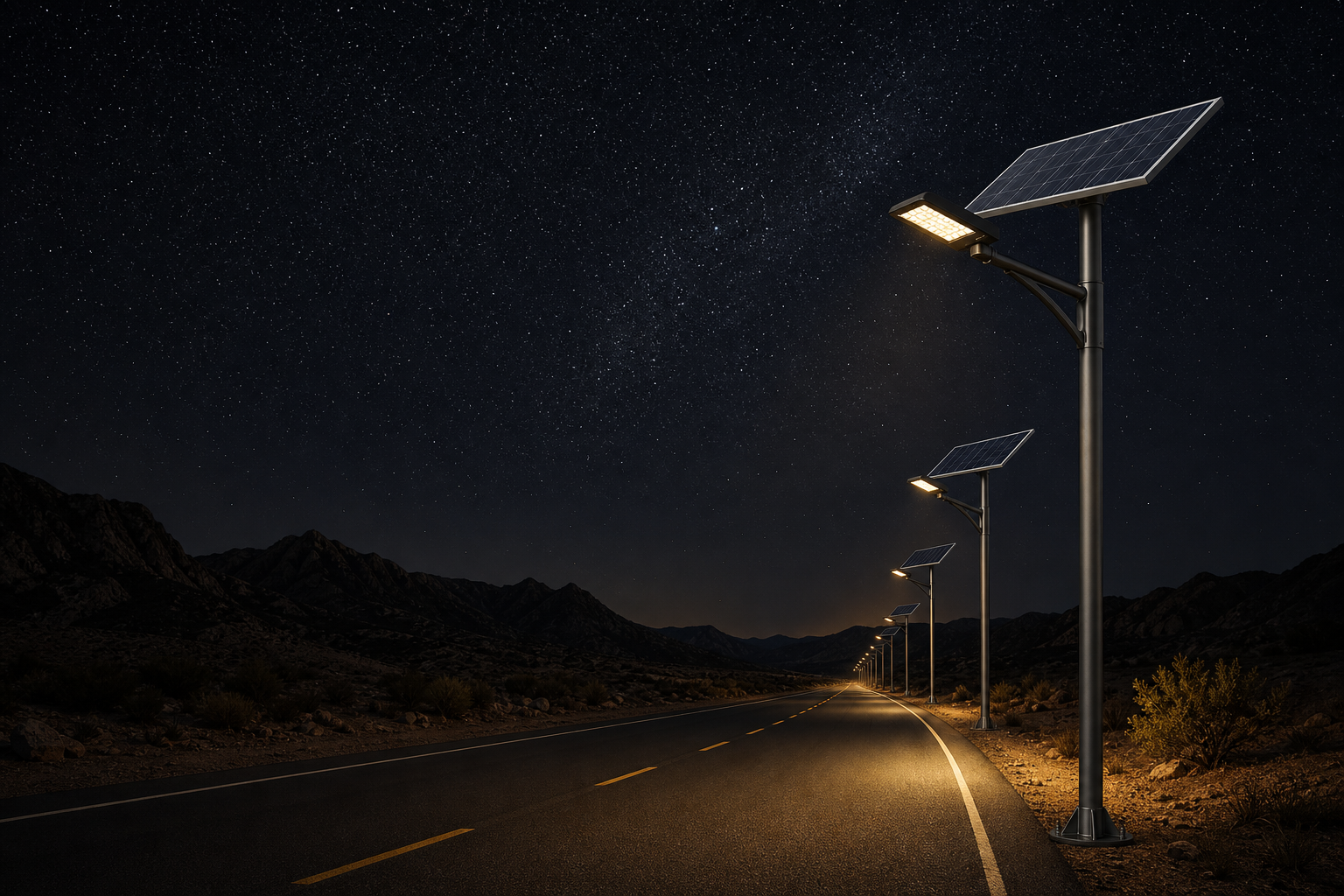
A solar street light is four products in one housing — panel, battery, controller, luminaire — so the shortlist question is which component chain each supplier actually controls.
2026-09-10 · 8 min read · Sourcing guide
Two solar street lights with identical dimensions and identical "100 W" labels can differ by a factor of three in delivered light and by five years in service life. The difference hides in four components the buyer rarely sees: the photovoltaic cell grade inside the panel, the battery chemistry and its cycle rating, the charge controller's logic, and the luminaire's real wattage. A manufacturer ranking by company name tells you none of this — two nominally competing suppliers may buy the same cells and the same controllers, while a third assembles premium parts into a housing its own factory never engineered.
So this guide does what a ranking cannot: it gives you the component-level verification framework we use when organizing solar sourcing for AURELUX clients — AURELUX being a cluster sourcing partner, quoting via a network of evaluated partner factories, never claiming factory ownership. All commercial figures are illustrative and confirmed per order.
| # | Check | What to verify | Red flag |
|---|---|---|---|
| 1 | Panel cell grade | Grade-A mono cells declared; actual panel wattage measured on a solar simulator, not just labeled. | "High efficiency" with no cell grade; wattage that cannot be tested. |
| 2 | Battery chemistry | LiFePO4 preferred for cycle life; capacity in Ah at stated depth of discharge; cycle count at 80% capacity. | Unnamed "lithium"; ternary cells in hot climates; Ah figures without DoD. |
| 3 | Charge controller | MPPT vs PWM declared per model; MPPT recovers meaningful energy in low-sun seasons; temperature-compensated charging. | Controller type unlisted; PWM sold as MPPT in photos. |
| 4 | Autonomy design | Nights of backup at stated DoD for your region's peak dark season; rainy-day design stated in writing. | "3-5 rainy days" applied to every market from one template. |
| 5 | Luminaire truth | Real LED wattage and delivered lumens; photometric file for the optical distribution claimed. | "500 W" all-in-one units — a marketing number no driver supports. |
| 6 | Ingress & mounting | IP65/IP66 on the electronics compartment; pole bracket corrosion class; wind-load note for the pole height. | One IP claim covering panel, battery and luminaire indiscriminately. |
| 7 | Smart controls | Motion-dimming profiles, timer modes, remote monitoring options — declared per model with app or gateway specifics. | "Smart" that means only a light sensor. |
| 8 | Certification per market | CE for export baseline; SASO via certified partner factories for Saudi; IP and IEC test reports referenced by number. | Certificate images with numbers that fail database verification. |
| 9 | Warranty split | Warranty stated per component: panel, battery, controller, luminaire — batteries are the wear item and should be priced accordingly. | One blanket "5 years" with no component split. |
| 10 | Tender documentation | IES/LDT files, battery datasheets, controller manuals, packing details — issued as a coherent tender pack. | Flyer-grade PDFs when the buyer asks for tender documents. |
Solar street light assembly concentrates in the Pearl River Delta — Zhongshan, Jiangmen and Shenzhen — where panel processing, battery pack assembly and LED luminaire manufacturing sit in one supply region. Zhongshan's broader lighting cluster gives the category its export infrastructure: an ecosystem exporting to 180+ countries and regions, with the market-procurement trade pilot (customs code 1039) enabling compliant small-order export for pilot sites and distributor trial orders (Zhongshan municipal sources, 2024-25).
The cluster's structure also explains a sourcing truth: many "manufacturers" are integrators who buy panels from one plant, batteries from another and housings from a third. Integrators are not automatically worse — the good ones engineer the system honestly — but your verification must target the components, because that is where the supplier's own leverage over quality actually lives.
| Archetype | Profile | Best for | Watch for |
|---|---|---|---|
| Integrated assembly house | Assembles complete all-in-one units; tests system behavior as a whole; strongest on consistency. | Distributor stock lines and repeatable estate or campus programs. | Component substitution between batches; lock the BOM per order. |
| System integrator | Engineers panel-battery-LED combinations to site conditions; buys best-in-class parts. | Tenders with autonomy requirements in difficult sun regions. | Longer lead time; verify every component claim independently. |
| Tender-grade supplier | Full documentation culture: photometry, battery reports, third-party tests, spares planning. | Municipal and institutional procurement with scored compliance. | Higher unit cost — budget it against dispute risk. |
Three checks catch most disappointment before shipment. First, derate everything: a panel in a dusty, hot installation delivers well below its lab wattage, so autonomy calculations must use derated input, not nameplate. Second, test the battery claim: capacity in amp-hours at a stated depth of discharge and temperature, with cycle life at 80% retention — a battery sold only in "mAh" or unqualified Ah is a priced-to-fail component. Third, measure the light: request an illuminance measurement at defined distance for the exact model, or an IES file you can run in Dialux; a "100 W" LED that delivers fewer lumens than a competitor's 60 W is the market's oldest trick.
Sample policy follows the cluster norm: samples in 7-14 days courier-tracked, trial orders from 100-200 pcs before bulk, production 25-40 days after deposit (illustrative terms). Require a pre-shipment inspection that includes a powered discharge test per sampled unit.
For the underlying engineering, see what an all-in-one solar street light is, the sizing method in our solar street light sizing guide, and the trade-off analysis in solar vs mains street lights. Program-level context lives on our outdoor and solar lighting catalog and street and municipal lighting solution pages.
Solar street light purchasing rewards total-cost thinking because the components age at different speeds and the installation carries no grid extension. The frame worth taking to management is cost per delivered lumen-year: unit price plus freight, poles and installation, divided by delivered lumens and the honest service years the component chain supports. On that arithmetic, a unit with genuine LiFePO4 capacity, an MPPT controller and a real LED load beats a cheaper all-in-one with fantasy wattage within a couple of years — and the difference compounds across a hundred poles. The frame also disciplines the warranty conversation: when the battery is the wear item, the program's service budget lives in year four or five, and a spares plan (batteries and controllers stocked at 1-3% of the fleet; illustrative) is cheaper than emergency replacements in the wet season.
For tender-grade buyers, documentation is the second cost lever. Municipal evaluation increasingly scores the pack — photometric files, battery datasheets with cycle curves, controller manuals, IP test reports, component-level warranty letters — and suppliers who maintain this documentation as a product asset win on evaluation even at higher unit prices. Ask each shortlisted supplier for their standard tender pack before asking for their best price; the quality of what arrives unsolicited predicts the quality of what ships. For the calculation methods behind autonomy and panel sizing, the sizing guide and the mono vs poly panel comparison cover the working math.
The anatomy of the category: panel, battery, controller and luminaire in one housing.
Total cost of ownership compared for municipal buyers, with the honest trade-offs.
Panels, batteries and autonomy — the sizing method that survives the dark season.
How professional buyers work the lighting capital — districts, audits and export routes.
Send the road class, pole height and sun region — a component-verified solar schedule with autonomy math and FOB quotation within 24 hours.