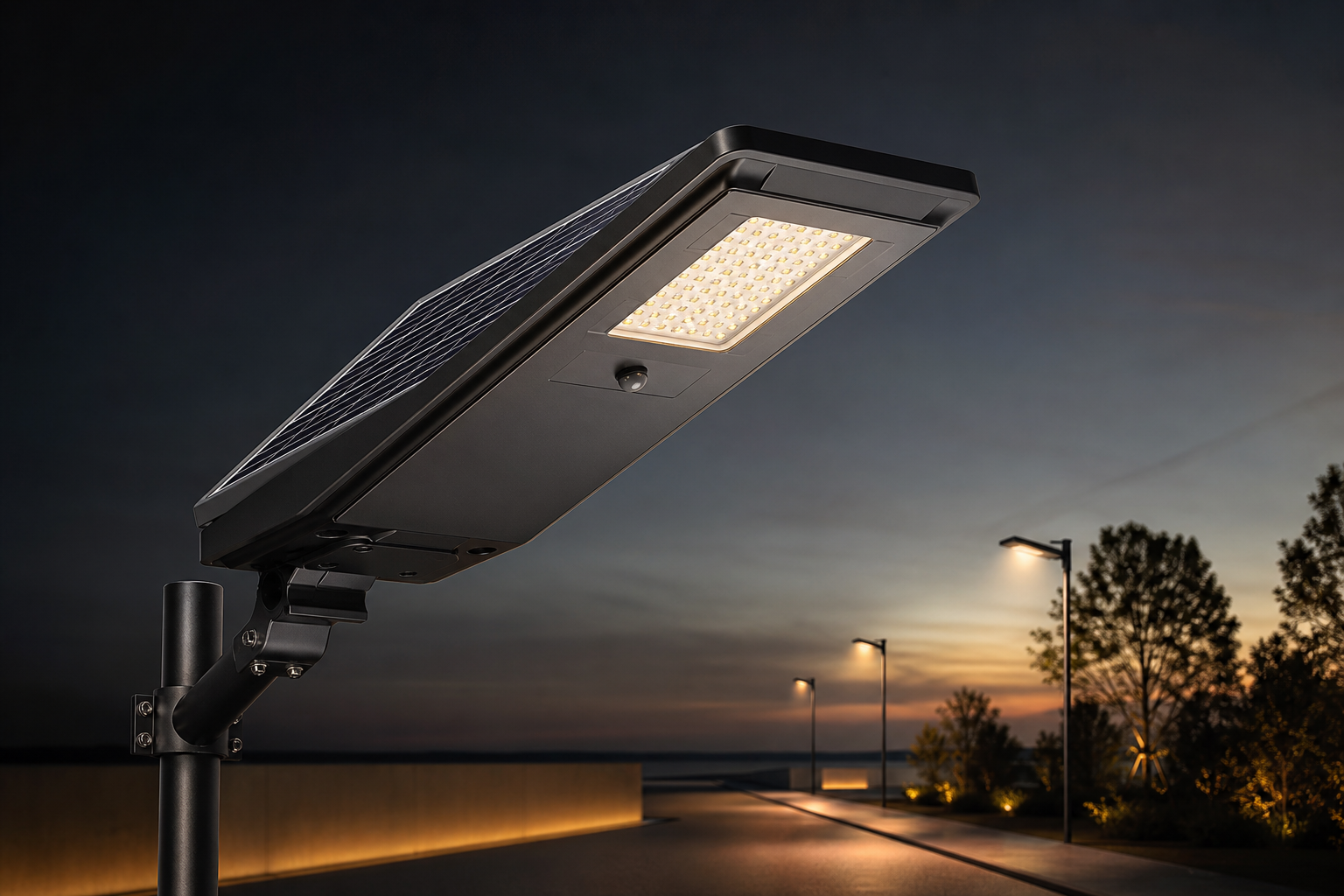
An all-in-one solar street light is a self-contained road or area luminaire in which the photovoltaic panel, lithium battery, charge controller, LED module and usually a motion or photocell sensor are integrated into a single fixture. There is no cable run to a grid connection, no separate battery box on the pole, and no panel mounted separately on a bracket. The fixture charges by day and lights by night, switching itself on at dusk and off at dawn. For distributors serving rural electrification programs, estate roads, parks and off-grid communities, it has become the default first quote: one SKU, one installation step, no trenching.
The category is also where lighting procurement meets battery procurement, which is why so many solar street light specifications fail in year two rather than on arrival. This guide explains how the integrated design actually works, how the three main solar form factors differ, how to size a unit against a real site, and what to check in a supplier quotation before the deposit leaves your account.
How an all-in-one unit works
By day, the monocrystalline or polycrystalline panel laminated into the top of the housing converts sunlight into DC power, and the charge controller — MPPT on better units, PWM on entry-level ones — regulates it into the battery pack. By night, the controller reverses the flow: it senses the drop in panel voltage at dusk, connects the battery to the LED array, and manages the discharge until dawn or until the programmed profile ends. No external switching is needed; the panel doubles as the photocell.
Four components determine whether the fixture performs for five years or disappoints in eighteen months:
- The panel. Integrated panels are small by geometry — the housing is only so wide — so cell efficiency matters more than on split systems. Monocrystalline cells convert a meaningfully larger share of incident light than polycrystalline at equal area, which is why export-grade all-in-one units have largely moved to mono.
- The battery. LiFePO4 (lithium iron phosphate) is the export standard for its cycle life and thermal stability, typically around 2,000 cycles to 80 percent depth-of-capacity retention. Cell grade — A-grade versus reclaimed cells — is invisible from the outside and is the single most common place a quotation is quietly degraded.
- The controller. Beyond charging, it runs the nightly profile: full output for the evening peak, dimmed through the midnight trough, boosted at dawn. A programmable profile is what makes a realistically-sized battery deliver dusk-to-dawn service.
- The LED and optics. The array is sized in lumens against the target road class, with a distribution (typically type II or III) matched to pole spacing. A motion sensor stretches runtime further by dropping output when the road is empty.
For a wider view of where these fixtures sit in the outdoor range, see the outdoor and solar lighting line and the dedicated solar lights fine line, which covers split systems and garden-scale products alongside.
All-in-one, split and solar garden: three different tools
The term solar street light covers three distinct form factors, and quoting the wrong one for a site is a classic tender mistake.
- All-in-one (integrated). Everything in the luminaire head. Fastest to install, lowest freight volume, best tamper resistance — and a panel area ceiling that limits top-end power. The natural fit for lanes, residential roads, compounds and parks up to roughly 6-meter poles.
- Split (two-in-one) systems. Panel, battery box and lamp are separate, connected by cable. The panel can be sized independent of the head, so higher power and longer autonomy become possible; the costs are more installation labor, more cable to protect, and more points for a maintenance crew to argue about.
- Solar garden and bollard lights. Small-format, 3 to 15 W class products for pathways and landscape, sometimes with replaceable NiMH packs. They are a different product family with different expectations — see the sizing notes in our solar garden line before mixing them into a road program.
A useful rule of thumb: the larger the road class and the longer the required autonomy, the more the economics shift toward split systems, because panel area — not LED wattage — is the binding constraint on integrated units.
How buyers should size a unit
Sizing starts from the site, not the catalog. Three inputs drive everything: the daily energy the load consumes (LED watts × operating hours after profile dimming), the daily energy the panel can harvest (panel watts × local peak sun hours), and the autonomy buffer the battery must hold for overcast weather. When consumption exceeds harvest, the fixture fails in the first cloudy week, whatever the brochure claims.
The table below shows typical export configuration classes. Treat every figure as illustrative — a real schedule is calculated from the installation address.
| Application | Typical LED power | Pole height | Typical nightly profile | Battery sizing logic |
|---|---|---|---|---|
| Residential lane, compound road | 20-30 W | 4-5 m | Dusk-to-dawn, dimmed after midnight | 1 overcast night buffer typical |
| Collector road, estate main street | 40-60 W | 6 m | Dusk-to-dawn with motion step-down | 2 overcast nights typical |
| Rural main road, municipal program | 60-90 W | 7-8 m | Dusk-to-dawn, scheduled profile | 2-3 overcast nights for tender compliance |
| Area / parking, high-activity sites | 90-120 W | 8-9 m | Evening full, sensor-controlled later | Usually shifts to split system economics |
Illustrative prototype figures for orientation only — final configuration is confirmed per site insolation data.
Two habits separate professional buyers from disappointed ones. First, always hand the supplier the project coordinates: peak sun hours in Norway and in Nigeria differ by a factor of three, and the same catalog SKU cannot serve both. Second, ask for the runtime calculation, not just the conclusion — a defensible schedule shows the energy budget line by line. Our solar street light sizing guide walks the arithmetic in full, and the street and municipal solution page shows how solar units sit alongside grid-fed luminaires in a mixed program.
Sourcing checklist: what to verify before ordering
Solar street lights combine three regulated product streams — luminaire, battery, radio (if app-connected) — so the documentation list is longer than for a mains fixture. Items we verify on every solar order:
- Destination certification. CE (LVD/EMC/RoHS) for the EU, SASO/SABER for Saudi Arabia, SAA for Australia and New Zealand — in our model held via certified partner factories and verified per order with certificate number and official database link.
- Battery transport compliance. Lithium cells ship under UN38.3 test summary and correct packing classification. Missing UN38.3 paperwork stops a shipment at the freight forwarder, not at the border.
- BOM transparency. Cell grade, controller type (MPPT/PWM), panel cell type and IP rating of the housing written into the proforma. If a supplier refuses to state the battery grade in writing, that refusal is the finding.
- Packing for pole-mounted units. Drop-test cartons and panel-face protection; integrated units concentrate weight in the head, and transit damage concentrates there too.
- Lead time realism. Configured-to-site production typically runs longer than stock SKUs. Illustrative export reference: trial orders of 100-200 pieces at roughly 30-45 days after configuration sign-off, with FOB quotation inside 24 hours of the item list.
Common mistakes that surface in year two
- Buying watts instead of lumens. Two 60 W units can differ by 30 percent in delivered light. Spec luminous flux and distribution, and compare test reports rather than front-of-catalog numbers.
- Accepting catalog autonomy. Autonomy quoted without a location assumes generous sun. Programs sized this way fail during the first week of monsoon or harmattan cloud.
- Unstated battery grade. Reclaimed or B-grade cells pass handover testing and fade within two seasons. Insist on cell grade on the BOM and a pack-level warranty line.
- No temperature compensation. Charging profiles shift with ambient temperature; controllers without compensation overcharge in heat and undercharge in cold, both of which shorten pack life.
- Ignoring mounting geometry. An integrated panel tilted the wrong way for the hemisphere, or shaded by an adjacent building line, loses a third of its harvest. The site survey is part of the specification, not an installation detail.
Handled this way, an all-in-one solar street light is a dependable infrastructure product rather than a compromise — and for many off-grid programs it is the only rational one. Send the site, ask for the calculation, and hold the BOM to what was agreed.