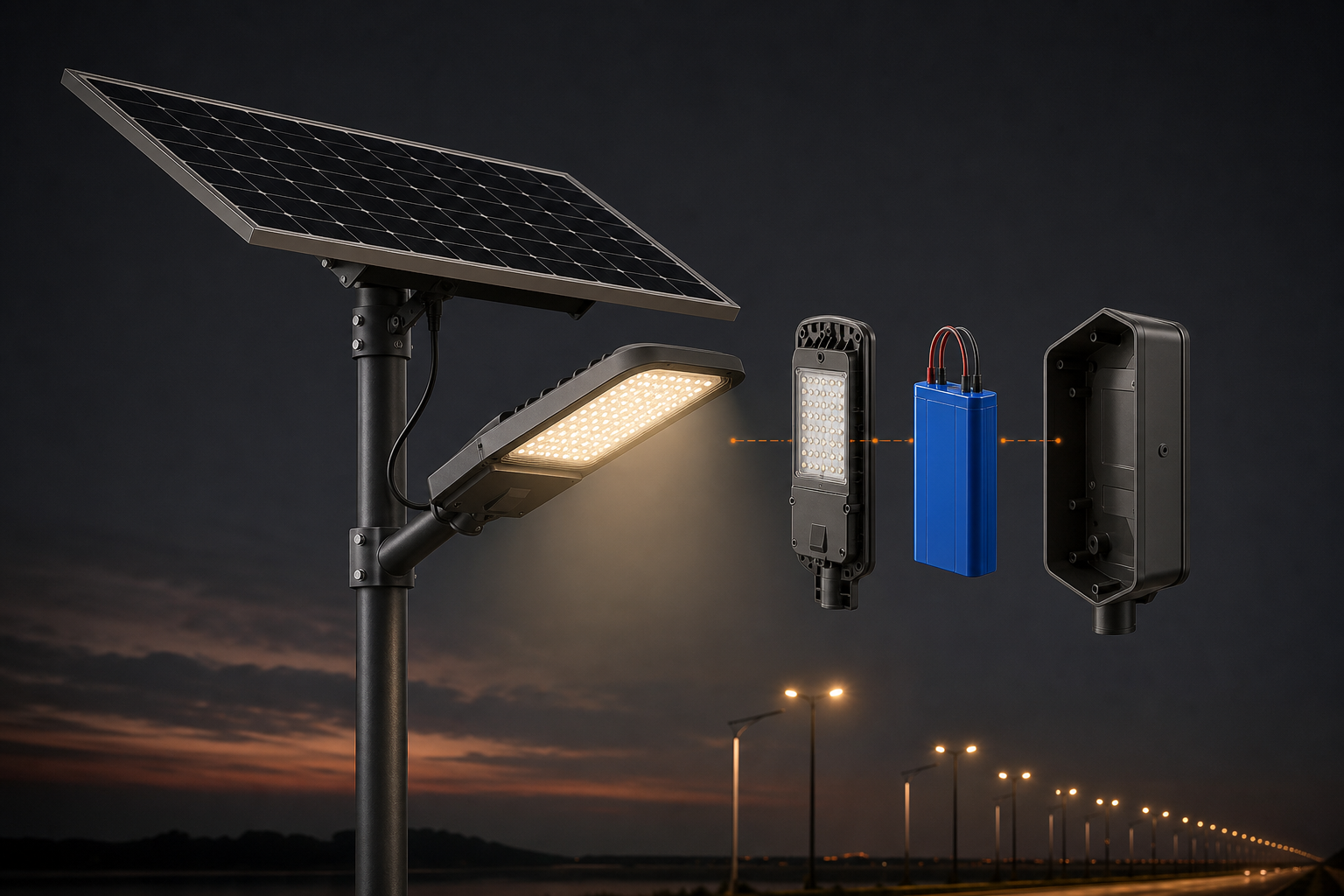
The three-formula method behind a solar light that survives winter — LED load, panel wattage and battery autonomy — plus a configuration table by pole height.
2026-09-10 · 6 min read · Reference guide
Solar street light quotations are easy to fake and hard to audit — which is exactly why buyers who can size a system themselves get better hardware at lower prices. The whole discipline is three numbers derived in order: the daily energy the LED consumes, the panel wattage that must replace it from the local sun, and the battery capacity that must carry it through the nights you promise. Get those three honest and everything else in the quotation (controller, housing, optics) is normal engineering; get them padded and the light works in July and dies in November. The method below assumes an all-in-one or split system with LiFePO4 storage; every figure is illustrative until your site's sun-hours data goes in.
Step 1 — daily energy. Daily Wh = LED watts x effective runtime hours. With a dimming profile (100% for the first hours, 50% after midnight, motion-step to 30%), weight each period: a 30W lantern running 6 h at full, 5 h at 50% and 1 h at 30% consumes 30 x (6 + 2.5 + 0.3) = 264 Wh per night.
Step 2 — panel wattage. Panel Wp = daily Wh / (peak sun hours x 0.75). The 0.75 factor covers soiling, temperature, charge losses and winter angles. For 264 Wh at 5 peak sun hours: 264 / (5 x 0.75) = 70W of panel minimum — round up, never down.
Step 3 — battery capacity. Battery Wh = daily Wh x autonomy nights / (DoD x temperature factor). With LiFePO4 at 80% depth of discharge and a 0.9 low-temperature allowance, 3 nights of autonomy needs 264 x 3 / (0.8 x 0.9) = 1,100 Wh — about 86 Ah at 12.8V. Gel batteries need deeper derating; our solar vs mains comparison shows what that does to lifetime cost.
| Application | Pole | LED load | Typical output | Runtime profile | Panel (at 5 PSH) | Battery (LiFePO4) |
|---|---|---|---|---|---|---|
| Garden, pathway | 3 m | 5-10 W | 800-1,500 lm | 10-12 h, dusk-dimmed | 25-40 W | 15-25 Ah / 12.8V |
| Estates, campuses | 4-5 m | 15-20 W | 2,500-3,000 lm | 11-12 h with motion dimming | 50-70 W | 30-40 Ah / 12.8V |
| Residential roads | 6 m | 25-30 W | 4,000-5,000 lm | 11-12 h, step-dimmed | 80-100 W | 40-60 Ah / 12.8V |
| Urban collector roads | 8 m | 40-50 W | 7,000-9,000 lm | 11-12 h, step-dimmed | 120-160 W | 60-80 Ah / 12.8V |
| Highways, wide roads | 10-12 m | 60-80 W | 11,000-15,000 lm | 11-12 h, step-dimmed | 180-240 W | 100-150 Ah / 12.8V or 25.6V |
Illustrative configurations for 3 autonomy nights, 5 peak sun hours and LiFePO4 chemistry. At 4 PSH panel wattage rises roughly 25%; at 6 PSH it falls; a site survey settles it. Pole and spacing context sits in our street light spacing guide.
A comparable solar specification states: LED load in watts, rated lumens, the dimming schedule with hours per step, panel wattage and cell type (mono dominates today — the trade-offs sit in our mono vs poly guide), battery chemistry, capacity in Ah at stated voltage, autonomy nights, DoD and cycle-life rating, controller type with low-temperature charge protection, and IP/IK ratings for head and battery box. That single paragraph turns a brochure into an auditable bill of materials. The product families behind it sit under solar lights and street lights, with full off-grid ranges under outdoor and solar lighting; the anatomy of the all-in-one format is explained in what is an all-in-one solar street light.
The integrated format explained — panel, battery and optic in one head.
Which cell type suits solar lighting tenders — efficiency vs cost.
Total cost of ownership compared for municipal buyers.
CE, UKCA, SAA and SASO: which marks your market needs and how to verify them.
Location, pole height and autonomy nights in — audited panel, battery and dimming schedule with FOB quotation out within 24 hours.