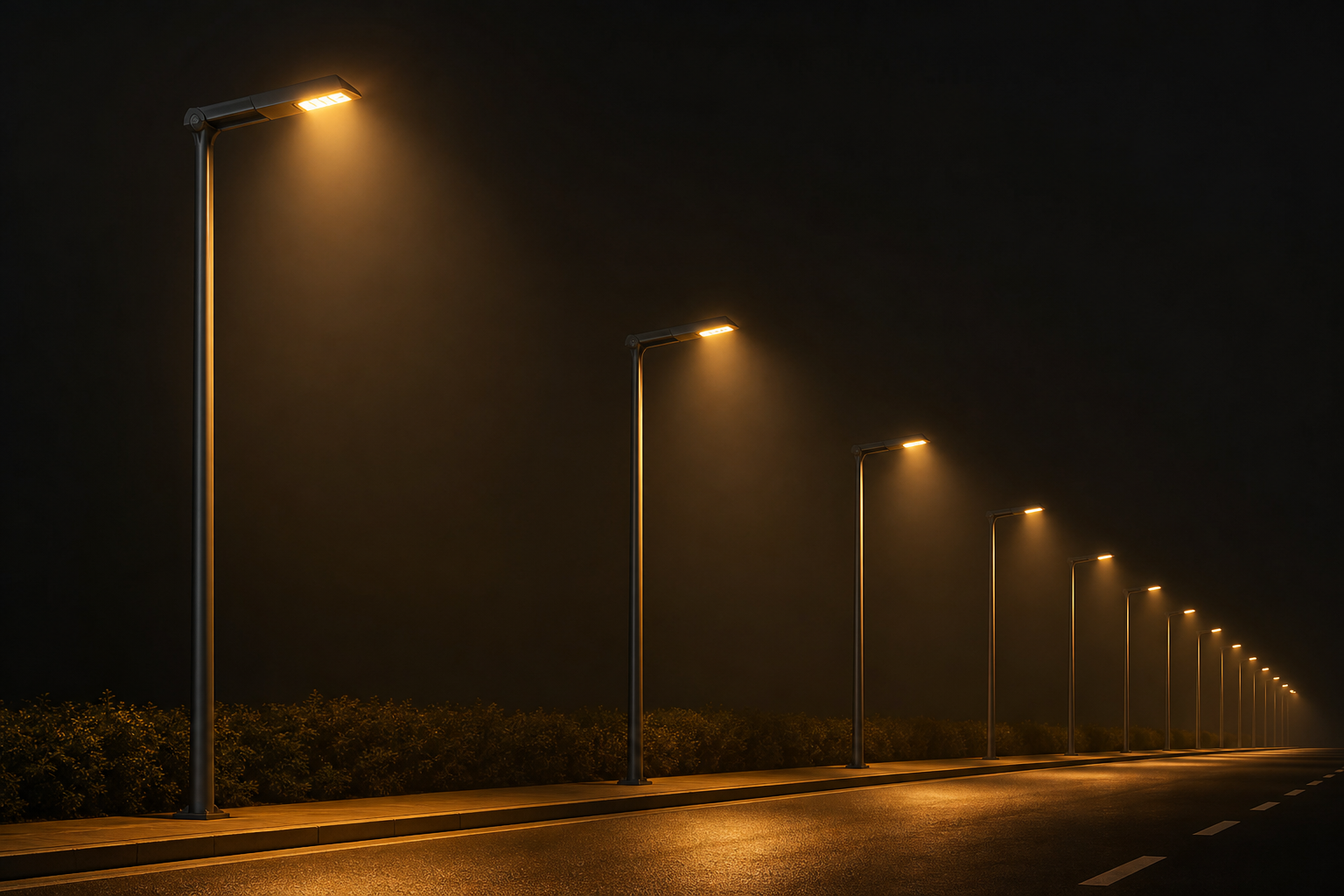
Pole heights and spacings by road class, from residential P-streets to M-class arterials — the table municipal buyers expect a supplier to quote against.
2026-09-10 · 6 min read · Reference guide
Street lighting design in the EN 13201 world does not start from lux — it starts from road classes, which set the luminance or illuminance the installation must maintain, and the pole schedule that delivers it. This guide translates those classes into the pole heights, spacings and lumen packages used in real export quotations, so a municipal buyer reading "M3 road, 10 m poles, 35 m staggered spacing" knows exactly what is being proposed. The figures are typical planning values for LED lanterns at 130-160 lm/W; every live project still needs a lighting calculation against the tender's specific road geometry and surface.
| Road class (typical) | Application | Pole height | Typical spacing | Arrangement | Typical lumen package |
|---|---|---|---|---|---|
| P1-P2 | Premium residential, town centre | 4-5 m | 18-25 m | Single side | 1,500-3,000 lm |
| P3-P4 | Residential streets, footpaths | 5-6 m | 22-30 m | Single side | 3,000-5,000 lm |
| C3-C5 | Collector roads, local junctions | 8 m | 28-35 m | Staggered | 5,000-9,000 lm |
| M4-M5 | Secondary main roads | 10 m | 30-38 m | Staggered | 8,000-14,000 lm |
| M2-M3 | Arterial roads, dual carriageway | 12 m | 35-45 m | Staggered or opposite | 14,000-20,000 lm |
| M1 | Motorways, major highways | 15 m+ | 45-55 m | Opposite or central | 20,000-30,000 lm+ |
Illustrative values for single-carriageway geometries with 0.5-1.5 m arm overhang and no tilt. Wider carriageways, curves and junctions shift both columns; the lighting calculation, not the table, is contractual.
| Class family | Based on | Where it applies | Design note |
|---|---|---|---|
| M1-M6 | Road luminance (cd/m²) | Motorised traffic routes | Depends on road surface class — asphalt vs concrete changes the result |
| C0-C5 | Horizontal illuminance (lx) | Conflict areas: junctions, roundabouts, crossings | Junction lighting must be one class higher than the roads it joins |
| P1-P7 | Horizontal illuminance (lx) | Pedestrian and low-speed areas | Also covers vertical and semi-cylindrical illuminance for facial recognition |
The practical consequence: two quotations can both claim "EN 13201 compliant" while proposing different pole counts — compliance is per class and per road, not per catalogue. Ask which class each road section was designed to, and ask for the calculation file, not just the summary.
The lantern families behind these tables sit in the street light range for mains-powered roads and under street and municipal lighting for full tender scopes — poles, arms, drivers and NEMA/Zhaga interfaces included. Solar variants for unlit roads are covered under outdoor and solar lighting. Send the road class, carriageway width and pole schedule per kilometre, and the quotation returns lantern lumen packages, optics and a dialux file per road section; the design logic behind the classes is expanded in our street lighting design guide.
From M-class selection to pole schedule — the full design logic.
Panels, batteries and autonomy — the arithmetic behind off-grid roads.
Total cost of ownership compared for municipal buyers.
CE, UKCA, SAA and SASO: which marks your market needs and how to verify them.
Class, carriageway width and pole schedule in — lantern schedule, optics and dialux file per road section out within 24 hours.