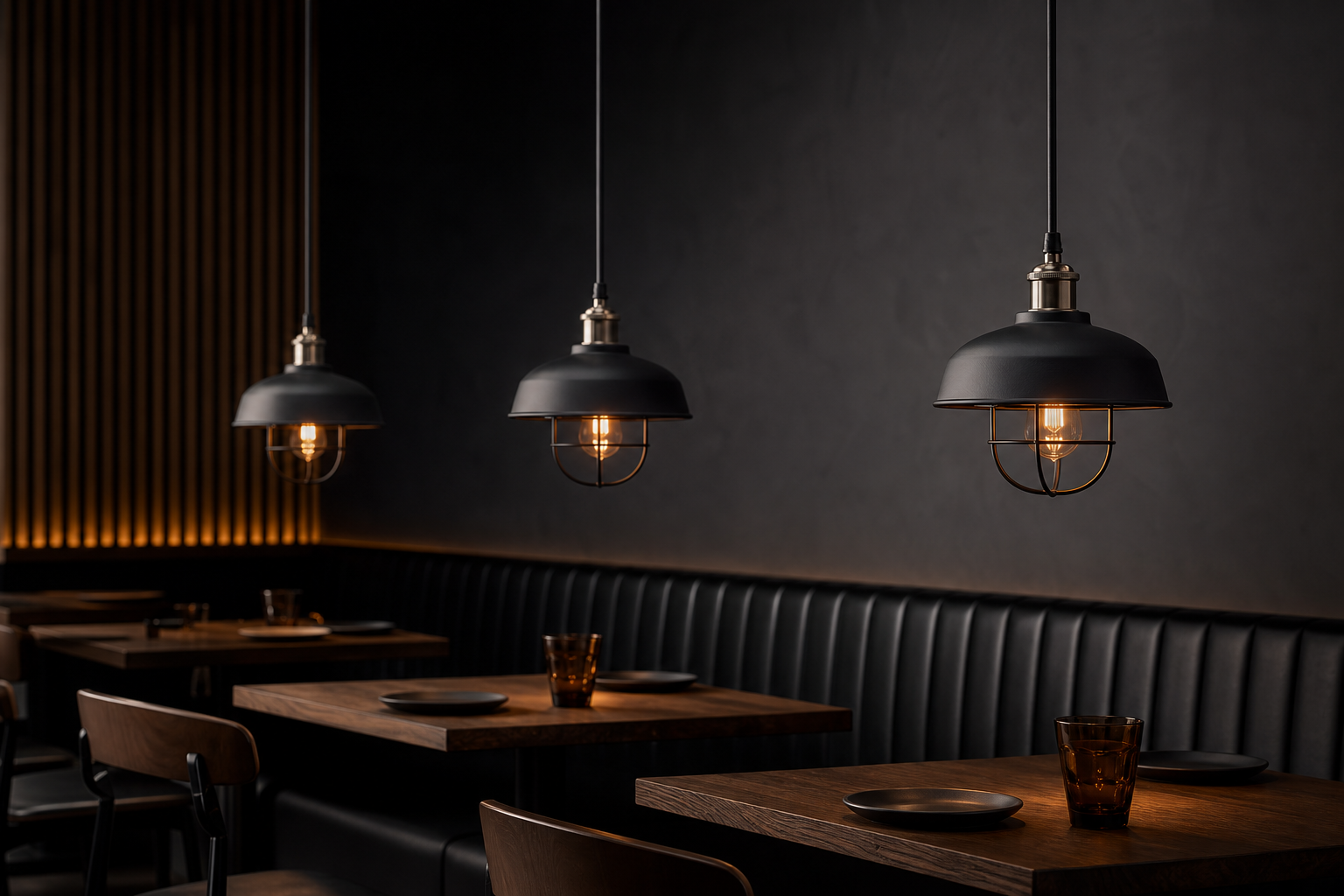
Light that makes food and faces look good — and keeps tables turning. Zone parameters, a dimming plan that survives two services a day, and the specs to demand from suppliers.
2026-09-10 · 9 min read · Lighting guide
Restaurant lighting is merchandising for perishable product and a mood machine at the same time. The plate, the menu and the dining companion are the three objects every guest looks at, and light that gets any of the three wrong gets the check average wrong with it. Yet a kitchen needs light a lunchtime cafeteria would envy, and the same room must flip from a brisk lunch trade to a slow, dim dinner service without an electrician in the loop. The guide below is the framework fit-out teams use: zones first, a dimming plan second, color discipline throughout.
Three goals govern. Flatter the food: color rendering is the headline number — CRI 90+ with attention to R9 (deep red) wherever red meat, wine, tomatoes and wood interiors matter, and spectra tuned to the cuisine where the operator cares to go further. Flatter the guests: light faces from the front at roughly 30-45° from vertical, not from straight overhead; guests seated under narrow downlights cast eye-socket shadows that read as fatigue in every photo taken at the table. Control the pace: brightness sets dining tempo — a lunch crowd eats and turns under 200-300 lx, a dinner crowd lingers under 100-150 lx pools — so the scheme must be dimmable scene by scene, not merely switched. Warm white 2700 K is the default across dining areas, with 3000 K at the bar where a little extra crispness sells bottles.
| Zone | Maintained lux (typical) | CCT | CRI | Notes |
|---|---|---|---|---|
| Entrance and host stand | 150-200 lx | 2700-3000 K | 90 | Smooth the street-to-interior transition; menu board lit for reading |
| Main dining, lunch scene | 150-300 lx average, table pools 300 lx | 2700-3000 K | 90+ | Higher scene for turnover; pendant or spot per table |
| Main dining, dinner scene | 75-150 lx average, pools 200-300 lx over tables | 2700 K | 90+ | Warm-dim preferred so pools stay warm as they lower |
| Bar and back shelf | 150-200 lx counter; bottle display accent 3-5× background | 2700-3000 K | 90 | Vertical light on bottles; under-counter task light for staff |
| Open kitchen and pass | 500-750 lx | 4000 K | 80-90 | Food-safety task levels; keep spill light out of dining sightlines |
| Restrooms | 100-200 lx | 2700-3000 K | 90 | Mirror front-throw; guests judge hygiene by light quality here |
| Private dining | Scene range 50-300 lx | 2700 K | 90+ | Full-scene presets from presentation to celebration |
Values are illustrative of hospitality design practice; the operator's concept brief and local code govern.
The pendant height rule belongs in every schedule: over a 750 mm table, the bottom of a pendant typically sits 75-90 cm above the tabletop — low enough to pool light on the plate and high enough that seated guests never see the source across the table. Pendants are also the most common cause of table glare when substituted with bare-lamp fittings; shielded sources or deep shades are not a style question but a comfort one.
Two services a day, seven days a week, means the dimming system is exercised more in a restaurant than in any other commercial interior, and the failure modes are all audible or visible to guests. Specify for four properties. Range: dimming must reach 1-5% of output for dinner scenes and hold there without dropping out; drivers that cut off below 8% make the "moody" scene impossible. Smoothness: transitions between scenes should crossfade over seconds, because a snap in the dining room is felt by every head at once. Color behavior: standard LEDs simply get dimmer; dim-to-warm drivers drift from 2700-3000 K toward roughly 1800-2200 K at low output, which mimics filament lamps and keeps evening scenes from feeling clinical — the reason most upscale concepts now specify them over tables. Silence and stability: no audible buzz at the fixture and no flicker (PstLM ≤ 1.0 as the usual reference; SVM ≤ 0.4 is the EU-facing figure). Control-wise, a DALI or equivalent scene system with presets — setup, lunch, dinner, late, cleaning — beats wall dimmers on reliability and locks the plan against well-meaning staff adjustments. The cleaning preset deserves a note: housekeeping needs 300-500 lx to actually clean, and a system without a bright "back of house" scene ends the night dirty.
Restaurants run on a schedule, and the lighting plan that ignores it fights the operation daily. The working timeline: setup and cleaning (300-500 lx, everything on, staff-safe), pre-service (lunch level, kitchen at full), lunch (200-300 lx, quick turnover), afternoon reset (dip to background while the room is re-laid), dinner (75-150 lx with table pools, accents up, dim-to-warm engaged), late (floor barely navigable, bars and features carry the room), and close (back to cleaning level). Programming these as timed presets — with a manual override the manager can actually find — converts the dimming plan from a promise into a routine. Two operational add-ons earn their place: the open kitchen and pass hold their own bright state (500-750 lx, 4000 K) on the dining scenes, because food safety does not dim at 7 p.m., and a small but constant exterior and entrance presence after hours keeps the frontage from going dead — a security consideration as much as a branding one. The energy consequence is real but secondary: a restaurant controls by scene, not by sensor, in the dining room; sensing belongs in back-of-house, restrooms and the kitchen corridor where nobody is watching the mood.
Two adjacencies extend the plan beyond the main floor. Private dining rooms serve the widest scene range in the building — corporate lunch at 300 lx to celebration dinner at 60 lx with candles — and the control failure mode is a scene system tuned only for the main room; private rooms deserve their own presets and, ideally, an in-room keypad guests cannot accidentally defeat. Terraces and courtyards blur into the street: exterior fixtures there must respect the same warmth and color discipline (nothing undoes a dining terrace faster than cool security-grade floodlighting over the tables), keep glare out of neighbors' upper windows, and step down on a curfew schedule where local code requires. Between inside and out, the threshold at the folding wall or terrace door is the detail to get right: matched CCT on both sides and a slight brightness rise at the boundary so the glass stops acting as a mirror at dusk. These are small line items in the schedule and disproportionate contributors to whether the venue photographs as one continuous place.
The restaurant purchase blends decorative and technical lines, so split the schedule. Decorative (pendants, sconces, chandeliers): require finish and material samples, a sample unit of the hero fixture, and dimming behavior demonstrated on the actual driver. Technical (downlights, spots, track, kitchen battens): require photometric files (IES/LDT), beam-angle options for table pools, CRI 90+/R9 data sheets, flicker figures, and IP-rated or cleanable fixtures wherever grease and steam reach. Certification by destination (CE, UKCA, SASO and others) is issued via certified partner factories with verifiable documentation. Insist on a dimming compatibility list covering every driver-dimmer pair in the order — it is the single most-omitted document in F&E fit-outs and the cause of most rework.
Illustrative commercial terms: samples of 1-5 pcs ship in 7-14 days; trial orders 100-200 pcs per SKU; bulk production 25-40 days after deposit; pricing quoted per project. The hotel and hospitality lighting page carries the F&B and function-space families, track and magnetic systems cover the adjustable accent layer over bars and displays, and the commercial lighting line indexes downlights and dimmable drivers. Send the floor plan with table count; a per-zone fixture schedule is the natural first reply.
Choosing warm white for dining, bar and transition zones.
Color rendering explained, including the R9 value that sells food.
The adjustable accent backbone behind bars, shelves and art walls.
Sourcing decorative and hospitality fixtures from Zhongshan's cluster.
Dining zones, dimming plan and CRI documentation with FOB quotation — first response within 24 hours.