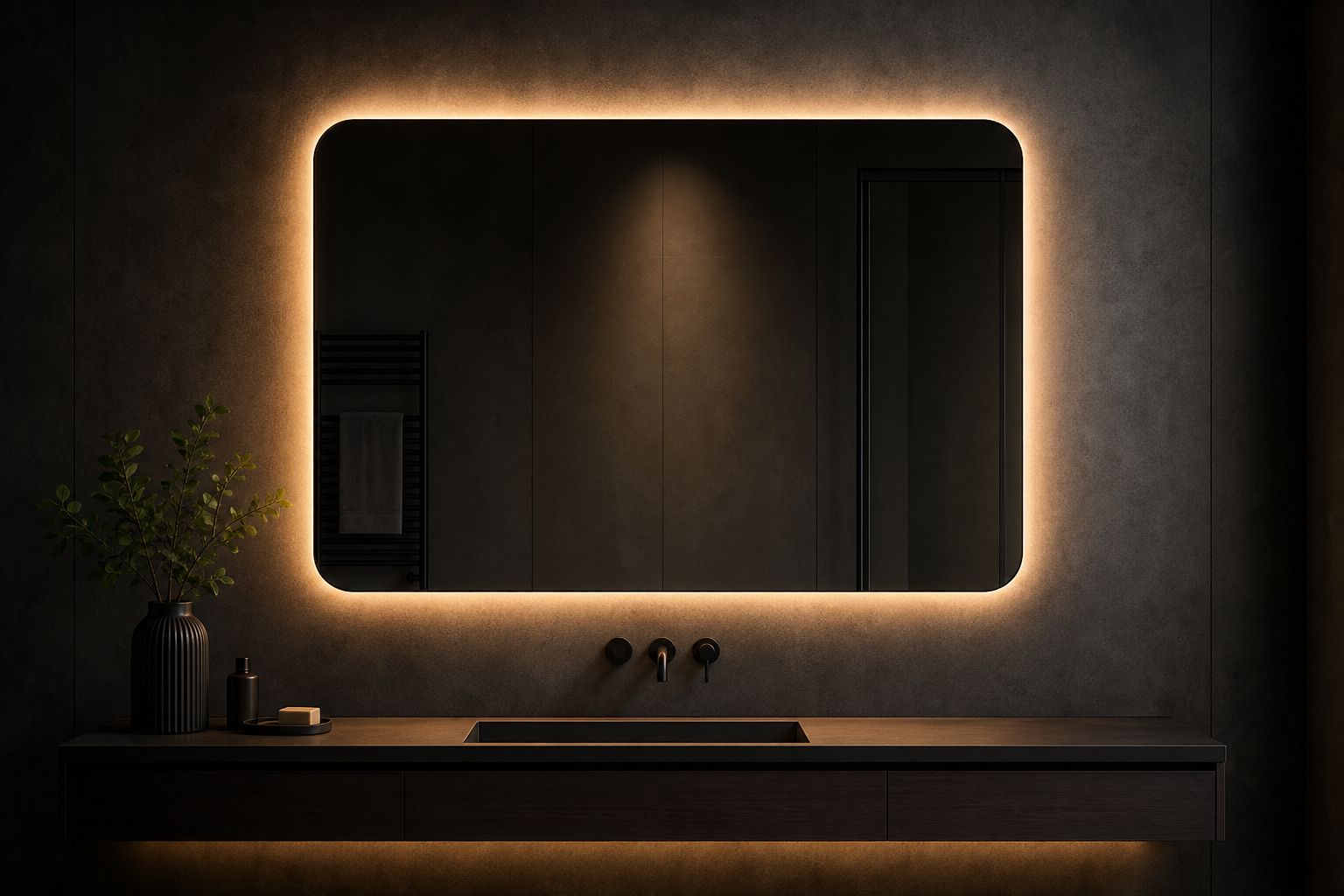
A mirror light is a luminaire designed to illuminate the viewer of a mirror — most often in a bathroom at the vanity, but also in dressing rooms, hotel wardrobes and retail fitting areas. It differs from ordinary bathroom lighting in one decisive way: its target is a face, seen frontally at close range, at the moment when people judge their own appearance. That single requirement drives every meaningful specification in the category — color rendering, shadow control, evenness across the mirror, and protection against the wettest domestic environment in a building.
For distributors and hotel program buyers, mirror lights are a compact, high-margin decorative line with real technical content underneath: bathroom zoning rules, glass integration, and the difference between a mirror that flatters and one that adds ten years. This guide covers the types, the standards that actually apply, and the sourcing checks that keep a program out of warranty trouble.
Why vanity lighting is a special case
Lighting a face for a mirror is the hardest common domestic lighting task. Overhead bathroom downlights — the default in cheap installs — throw light down the face and throw shadows into eye sockets, under the nose and chin, exactly where a person is trying to see detail. A mirror light solves this by placing light along or behind the mirror plane so the face is lit evenly from the front: shadowless, flattering and functional. It is the same principle a theater dressing room uses, domesticated.
Two environments shape the hardware. The first is water: bathrooms are zoned by regulation into areas of increasing splash and steam exposure, and fixtures must match their zone. The second is glass: modern mirror lights are frequently integrated with the mirror itself — LED modules behind a frosted border or edge-lit through the glass — which turns the product into a glass-and-electronics assembly with packaging and transit requirements closer to furniture than to lamps.
The main types of mirror lighting
| Type | Light direction | Typical output class | Typical protection | Notes |
|---|---|---|---|---|
| Backlit mirror / mirror with light | From behind the glass, halo plus face fill | Integrated LED, by mirror size | IP44 typical | Clean wall look; evenness depends on diffuser quality |
| Front-lit mirror luminaire (bar or frame) | Onto the face from above/side | 800-2,000 lm class, illustrative | IP44-IP54 | The classic vanity solution; best shadow control |
| Backlit mirror cabinet | Behind cabinet doors plus interior | Integrated LED | IP44 typical | Storage and light combined; hotel guestroom staple |
| Wall picture-light style fixture | Onto mirror and wall | 500-1,500 lm class | IP44+ by model | Decorative line; quality depends on optics |
Category-typical ranges, illustrative only — actual schedules follow each program's mirror dimensions and bathroom zoning.
The commercial distinction that matters most is front-lit versus backlit. Backlit mirrors sell on a clean halo aesthetic and have become the volume product in hotel guestroom programs; their functional weakness is that a halo alone lights the face less evenly than dedicated front light, so quality backlit designs combine the border glow with a front-facing fill through the diffuser. Front-lit bars and frames — above the mirror, or vertical battens at both sides — remain the optically superior solution for true vanity duty, which is why cosmetics areas and premium residential specs still lead with them. Side-lighting a face from two vertical sources is, optically, the ideal; a single top bar is the economical compromise.
The specification that decides quality: CRI, CCT and evenness
Because the task is judging skin and clothing color, color metrics are the headline spec. CRI 90+ is the working standard across hospitality and quality residential lines; anything lower shows up immediately in the mirror, where users compare their face against years of memory. On top of CRI, the R9 value — rendering of strong reds, the tone of skin and lips — is the number professional specifiers check that catalog sheets often omit; a fixture can pass CRI 90 averages while rendering reds poorly, and faces show it.
Color temperature splits by market and function: 3000K warm white dominates residential and hotel bathrooms for its flattering warmth, while 4000K persists in cosmetic and grooming contexts where a cooler light helps discriminate detail; tunable-white models bridging both are the current premium answer. Evenness is the third pillar — the face should be lit without a hot band above the eyes or a dark lap line, which comes down to diffuser design and the distance of LEDs behind the frosted layer. Dimming, motion or touch switching, anti-fog heating pads and integrated shaver sockets are the feature options that segment the price ladder in this category. Buyers comparing warm-white options across a program will find the judgment framework in our 2700K vs 3000K guide, and the color vocabulary in the CRI explainer.
Bathroom zones and installation rules
Bathroom electrical safety is zoned. The tub and shower volumes form the most protected zones where only fixtures of the highest ingress class belong; the area immediately around basin and bath — reachable splash — generally calls for IP44; and beyond those zones ordinary rules apply. A mirror above a basin sits squarely in the splash zone, which is why IP44 is the de facto baseline for the category, with IP54+ options for steamy commercial spa environments. Local wiring codes govern who may install what and where, but the fixture-side requirement is simple for buyers: match the IP rating to the zone drawing, and write it into the purchase specification rather than trusting product photos.
Installation details that programs should standardize: hardwired versus plug connection conventions per market; isolation and switching heights; and — for integrated mirror products — mounting systems that let one person hang a wired mirror safely. Hotel programs additionally standardize switch behavior (sensor versus touch) because housekeeping interacts with these fixtures daily.
Sourcing mirror lights for programs
- Certification per destination. CE (LVD/EMC/RoHS) for the EU, UKCA for the UK, SAA for Australia — via certified partner factories and verified per order with certificate numbers; the humidity duty of bathroom fixtures makes verified construction matter beyond paperwork.
- Driver placement and serviceability. Integrated mirrors hide drivers behind glass; a design that allows driver replacement without breaking the mirror halves the lifetime cost of the program.
- Packing as fragile goods. Mirror-integrated products ship as glass assemblies: foam-separated, drop-test cartons, palletization options for hotel waves. Transit damage is the number-one claimed defect in this line.
- Consistency across a program. CCT and diffuser appearance must match across mirror sizes in one hotel floor plan; order per program, not per room, and state binning.
- Order structure. Illustrative export reference: trial batches around 100-200 pieces, production roughly 30-45 days, FOB quotation within 24 hours of the item list — the standard entry path for the decorative lighting range this category belongs to. Hotel-scale programs are scheduled against fit-out dates as in the hospitality solution.
Common mistakes when buying mirror lights
- Under-rating for the zone. An IP20 fixture above a basin is a non-conforming install in most codes. Match IP to the zone drawing.
- Buying on lumens alone. A 2,000 lm halo with a bad diffuser lights a face worse than 1,200 lm well spread. Evenness and CRI outrank raw output.
- Ignoring R9. Skin and lip color live in the reds; CRI averages can hide poor red rendering that every user sees.
- Mixed CCT within one suite. Mirror light that clashes with the ceiling layer reads as a defect. State CCT and binning for the whole room schedule.
- Sealed-in drivers. The cheapest integrated designs make driver replacement impossible; the program pays in full-product replacements at year three.
- Weak packing. Margin earned on the carton is lost on breakage claims. Treat the line as fragile goods from the first sample order.
Mirror lights are a small fixture with a demanding brief — a room's most-used light and its most personal. Programs that specify CRI 90+, zone-correct IP and serviceable drivers end up with a line that sells itself on the lit demonstration wall, which is exactly where this category is decided.