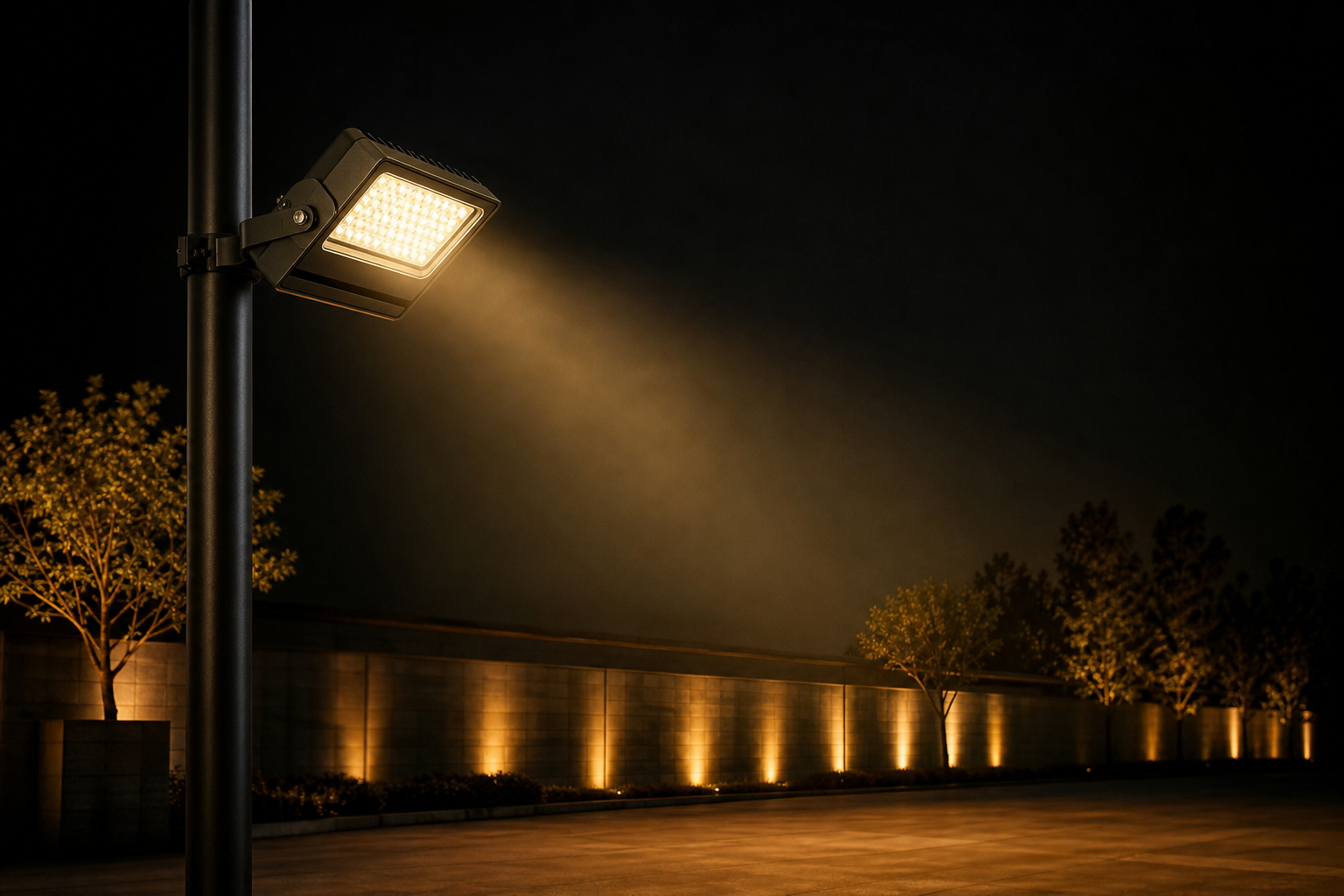
An LED flood light is a broad-beam outdoor projector: a sealed housing containing an LED array, driver and reflector or lens, mounted on a bracket and aimed at an area rather than a road or a room. It is the most traded fixture in the outdoor category — the SKU that distributors rotate fastest and the one contractors reach for first on yards, facades, signage, parking and sports areas. That ubiquity has a cost: the market is crowded with fixtures that look identical in photos and differ by half in delivered light, seal quality and driver life.
This guide covers how a flood light is built, which types exist, how wattage classes map to applications, and the specification checks that separate a defensible wholesale buy from a container of returns.
How an LED flood light works
A flood light throws a wide, controlled wash of light across a plane or area. Four subsystems define its quality. The LED array — SMD chips on a metal-core board in most designs, COB in compact ones (see our COB LED explainer) — determines flux and efficiency. The optic, a reflector or lens, sets the beam: wide floods (90-120 degrees) for area coverage, medium (60 degrees) for facades and signage, narrow (30 degrees and below) for long throw. The driver converts mains power and decides surge survival and lifetime. The housing and its seals decide whether all of the above survives its second winter outdoors.
Efficiency is the number that restructured the market. Where a 500 W halogen flood was once the reference, a modern LED flood producing equivalent light draws 100-150 W — roughly 120-140 lumens per watt in the current mainstream export band. That efficiency gap is why flood lights were among the first categories to convert wholesale to LED, and why buyers comparing quotations should always normalize to lumens, never watts.
Mounting and aiming complete the product definition. Bracket types range from fixed knuckle mounts for wall positions to yoke brackets and pole clamps for area duty, and aiming angle matters more than buyers expect: floods tilted well above the horizontal throw light into neighboring windows and push glare down the street — an increasingly regulated subject under obtrusive-light rules, covered in our light pollution guide. Accessories such as wire guards, visors and glare louvers, plus options like photocell heads, motion sensors and DALI or 1-10V dimming inputs, are specified per project and should appear as orderable variants in a distributor's line rather than as custom modifications discovered after the order.
The main types and where each fits
Flood lights sort into a handful of families by size and duty. The table below maps the common wattage classes to their natural applications; all figures are illustrative category norms, not guarantees about any specific listing.
| Class | Typical power | Typical flux (illustrative) | Beam | Natural application |
|---|---|---|---|---|
| Compact / mini flood | 10-50 W | 1,200-6,500 lm | Wide | Gardens, shopfronts, small signs, courtyards |
| Mid-range flood | 50-150 W | 6,500-20,000 lm | Medium-wide | Yards, building perimeters, mid-size signage |
| Large flood / area | 150-300 W | 20,000-40,000 lm | Medium | Parking, logistics yards, high walls |
| Sports / industrial tower | 300-500 W+ | 40,000-80,000 lm | Narrow to medium | Sports fields, ports, construction, tall masts |
Illustrative prototype figures — final specifications follow each order's photometric requirement.
Beyond raw classes, three structural variants matter commercially. Slim die-cast floods dominate retail and light-duty trade — thin, inexpensive, adequate seals. Modular floods carry replaceable boards and drivers, prized by contractors who maintain installed bases, because a failed module swaps in minutes. Projector floods with precision optics serve sports and long-throw duty, where beam control and glare management matter as much as flux. Separately, the solar flood light has become its own fast-growing segment for off-grid and cable-avoidance installs — it shares the optics but adds panel and battery, and is quoted with the same honesty checks described in our solar street light guide.
How to choose: matching class to site
Selection runs from the target backward: what illuminance the task needs, how far the fixture mounts from it, and what the environment will do to the housing. Recommended illuminance varies by task — a residential yard tolerates far less than a work yard — and our lux level chart gives the conventional targets by application. From there:
- Distance and height set the wattage class. The higher and farther the mounting, the narrower and stronger the beam required; doubling mounting distance roughly quarters the illuminance on the surface.
- Beam angle decides evenness. A wide flood close to a wall beats a narrow flood far from it, for glare, uniformity and shadow depth.
- Environment sets the rating. IP65 baseline outdoors, IP66 for coastal and wash-down exposure, IK08+ where fixtures are reachable. Heat dissipation design — finned housing mass relative to wattage — predicts year-three performance better than any brochure figure.
- Controls are now standard asks. Photocell and motion-sensor versions, and DALI or 1-10V dimmable variants for managed sites, increasingly appear in tender line items.
Finally, structure the range, not just the SKU. Distributors who run flood lights profitably usually carry two beam options per wattage class, one slim retail line and one modular contractor line, and hold a documented efficiency floor — fixtures below roughly 120 lm/W at realistic CCT find fewer tenders every season. Range logic matters more on floods than on most categories because the buyer audience spans homeowners, trade contractors and municipal specifiers, and the same catalog page is expected to answer all three without the seller explaining the difference twice.
For the ingress-protection detail behind those ratings, see our IP65 vs IP66 vs IP67 flood light comparison — it is the single most common point of confusion in flood light RFQs.
Sourcing flood lights for wholesale programs
- Test the seal, not the spec sheet. IP claims verified against test reports; gasket material and screw torque matter more in year two than lumen output.
- Driver brand on the BOM. The driver is the first component to fail on cheap floods; state the brand and surge protection level (kV rating) in writing.
- Certification per destination. CE (LVD/EMC/RoHS) for the EU, UKCA for the UK, SASO/SABER for Saudi Arabia, SAA for Australia — held via certified partner factories and verified per order with certificate numbers; North-American UL/ETL/DLC quoted case-by-case (see our DLC guide for rebate context).
- Packing for weight. Large floods are dense; drop-test cartons and sensible carton quantities protect both the goods and warehouse handling.
- Order structure. Illustrative export reference: trial orders of 100-200 pieces across mixed wattages, production 25-40 days, FOB quotation within 24 hours of the item list — the standard way new distribution partners start this line.
Common mistakes when buying flood lights
- Comparing watts. Two 100 W floods can differ by 30 percent in flux. Normalize everything to lumens at a stated CCT and CRI.
- Under-specifying surge protection. Outdoor grids hit fixtures with switching surges; the cheapest place a factory saves money is the MOV on the driver input — and the failure shows up as warranty claims, not at inspection.
- Ignoring heat sink mass. Overdriven chips in slim housings pass handover and fade within two seasons. Ask for the thermal design rationale on mid-range and above.
- One beam for every job. Stocking only wide beams forces contractors to over-mount or under-light. A range stocks 2-3 beam options per class.
- Skipping glare discipline. Raw floods aimed across neighbors' boundaries generate complaints and, in a growing number of jurisdictions, obtrusive-light breaches — see our light pollution guide before quoting municipal-adjacent sites.
Flood lights reward boring diligence: lumens over watts, seals over styling, drivers on the BOM. Run those three checks on any quotation and the price difference between offers starts to explain itself. The full outdoor and solar lighting range lists the classes above with order modes for trial and bulk programs.