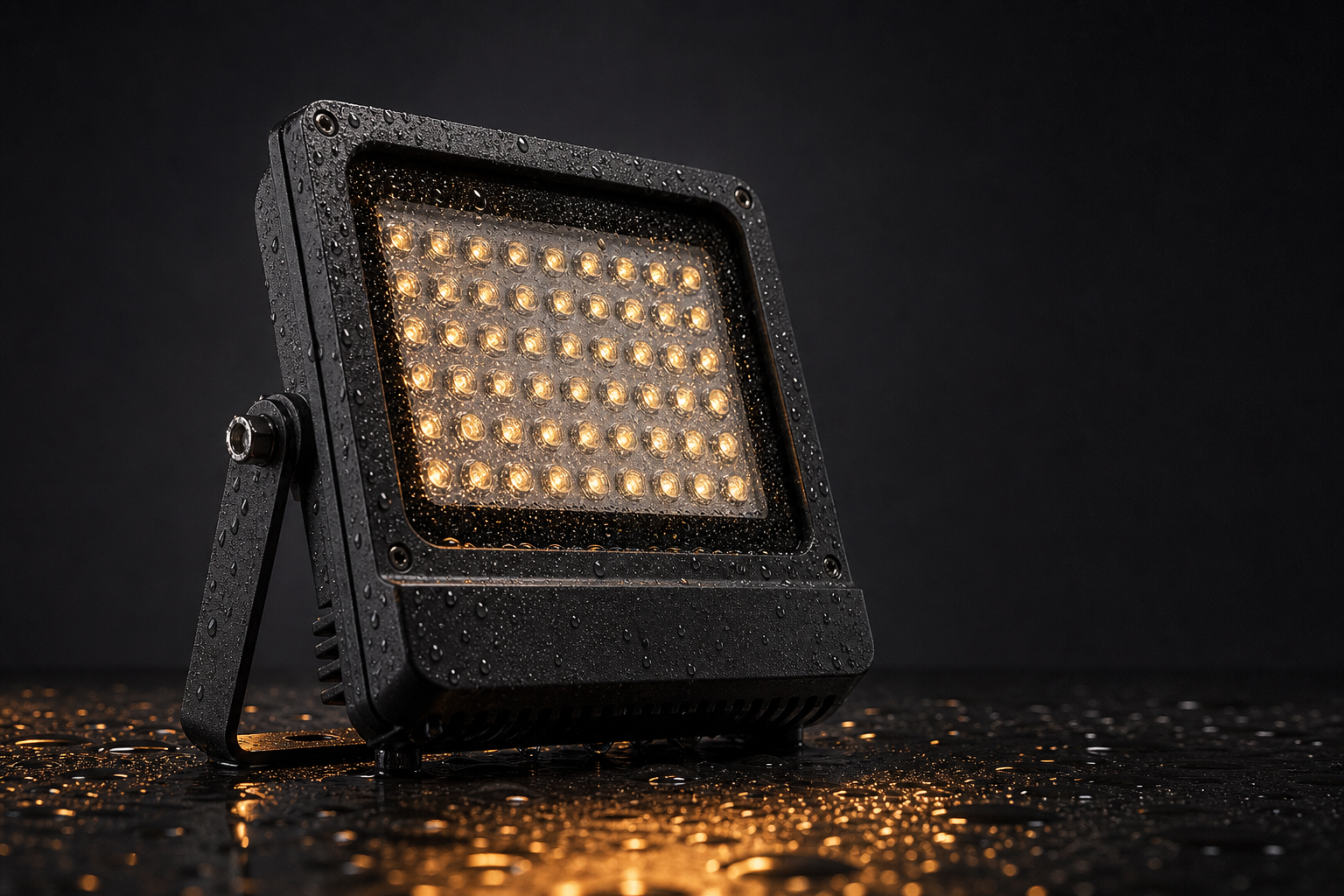
How the two digits of IEC 60529 decode, what each water-digit test actually does to a fixture, and why the rating survives procurement only if the installation does too.
2026-09-10 · 8 min read · Knowledge base
An IP rating — ingress protection, defined in IEC 60529 — is a two-digit code describing how well an enclosure keeps the outside world out. The first digit covers solids: 0 offers no protection, 5 resists dust deposits, and 6 means dust-tight, verified in a dust chamber with negative pressure inside the enclosure. The second digit covers water, on a scale that climbs from dripping water (3) through splashing (4) to jets, powerful jets and immersion:
So IP65 is dust-tight and jet-resistant; IP66 adds powerful-jet resistance; IP67 survives temporary immersion. An "X" may replace a digit when that axis is untested — IPX5, IPX7 — and for luminaires the solid-digit is almost always worth stating, because dust is the slower killer of outdoor fittings.
The solid scale is worth a sentence each at 5 and 6, because buyers meet both. IP5X devices are tested in a talc-dust chamber with the enclosure's normal cycling; dust may enter, but not in quantities that interfere with operation — "dust-protected". IP6X requires the same chamber with a vacuum applied inside the enclosure, proving no dust ingress at all — "dust-tight". For sealed LED gear the difference is mostly theoretical in favor of 6, which is why serious outdoor and industrial product simply states the 6 and moves on. A "6" first digit with an "X" second (IP6X) is the code seen on dust-proof-only industrial gear.
| Rating | What it survives | Typical fixture locations | What it does not cover |
|---|---|---|---|
| IP44 | Splash from any direction | Covered bathrooms (zone 2), under-canopy dry areas | Rain exposure, washdown |
| IP65 | Dust-tight, water jets | Outdoor wall lights, tri-proof battens, garden spikes | Powerful jets, immersion |
| IP66 | Dust-tight, powerful jets | Flood lights, coastal facades, industrial washdown | Immersion; waves are a design case, not a digit |
| IP67 | Dust-tight, 1 m / 30 min immersion | In-grade uplights, pool perimeters, ground-recessed | Continuous pressure; jets can force past gaskets |
Selection is illustrative market practice; bathroom zones, pool codes and municipal specs may set stricter local requirements. Always match the fixture's rated conditions to the worst credible event at its location.
The counterintuitive part for buyers: IP67 is not "better than" IP66 in general. The tests measure different threats. An in-grade uplight rated IP67 has passed still immersion; aim a pressure washer at it and water can be forced past its seals — the very scenario IP66 exists to pass. Conversely, an IP66 flood light has never been dunked. Specify against the site's dominant water event: jets, immersion or splash. We run the flood-light case in detail in IP65 vs IP66 vs IP67 flood lights, and the sealed-batten case in the tri-proof vs vapor-tight comparison.
Two neighboring marks complete the outdoor specification. IK ratings (IEC 62262) grade impact resistance — IK08 absorbs 5 joules, IK10 20 joules, roughly corresponding to serious vandal exposure; public-realm projects increasingly state IK alongside IP. And IP says nothing about corrosion: salt fog (ISO 9227-style testing) and chemical exposure are separate properties, which is why coastal and agricultural projects fail fixtures that technically passed their water test. Ask for both when the site is aggressive.
A third silent property is UV and heat aging of the enclosure itself. Unstabilized polycarbonate yellows under sunlight and turns brittle under years of lamp heat; once it does, the gasket it compresses relaxes and a rating earned in a test chamber erodes on a wall. UV-stabilized PC grades, marine-alloy or powder-coated aluminum bodies, and gasket materials specified for compression set are the difference between an IP66 claim that lasts a season and one that lasts a decade. None of these appear in the IP code — which is exactly why datasheets should be read past the two digits.
Many "leaking" fixtures never let liquid water past a seal. A sealed enclosure breathes — daytime heat expands the air inside, night cooling contracts it and draws in humid air, which then condenses on the cooler lens. The engineering answers are breather membranes that equalize pressure while blocking liquid water, and desiccant packs for small volumes, both standard on export-grade outdoor product. A fine condensation film inside a fixture that later clears says the seals are working and the fixture lacks pressure management; a standing droplet at a gland says the installation breached. Diagnosing the difference before opening a warranty claim saves everyone a container of return freight.
On the procurement side, insist that the IP test report names the exact model shipped — family-level certificates are how rating drift enters catalogs. Check that cable glands, gaskets and breather quality are part of the tested assembly, and that the report's optics match the version you order (a swapped diffuser can void the rating). Certification by destination (CE, UKCA, SAA, SASO) is issued via certified partner factories and verifiable by number and database link; the wider matrix is in our certification guide.
On site, ratings die in the last ten centimeters of the installation. Glands must be matched to the cable's actual diameter; unsealed rear entries and unpopulated gland holes are the classic leak paths; drain holes belong at the bottom, unblocked; and a fixture rated for vertical mounting may not be rated for underside-up mounting, where gravity works against the gasket. Condensation inside a "failed" fixture is often an installation breach, not a factory one — which is why both sides belong in the same conversation. Illustrative commercial terms: samples of 1-5 pcs ship in 7-14 days; trial orders 100-200 pcs per SKU; bulk 25-40 days after deposit; pricing quoted per project. For scene-level placement of outdoor fixtures, see our landscape and facade and outdoor and solar lines.
A worked example ties the digits to paperwork. A hotel bathroom project divides by zones: luminaires above the bath or shower (zone 1) need at least IPX5-class splash protection and often IP65; the wider outer zone (zone 2) accepts IP44 splash-rated fittings; and the ceiling outside those zones takes any standard IP20 downlight. A facade project writes IP65 minimum for wall washers, IP66 where sea-facing jets of storm wind drive rain horizontally, and IK08-10 wherever the public can reach the fixture. In both cases the schedule names the rating per location — the form tender committees can check, and the form that prevents a value-engineering substitution from quietly downgrading the wettest corner of the building.
What specifiers actually need — jets, immersion and the sites that decide between them.
The sealed industrial batten — how IP65 housing, gaskets and glands are built.
Types, watt bands and applications — the fixture most IP questions start from.
CE, UKCA, SAA, SASO and DLC by destination market — what your order actually requires.
Site conditions, mounting orientation and target rating — named-model test reports and FOB quotation within 24 hours.