2026-09-10 · 8 min read · Comparison
TL;DR — the short answer
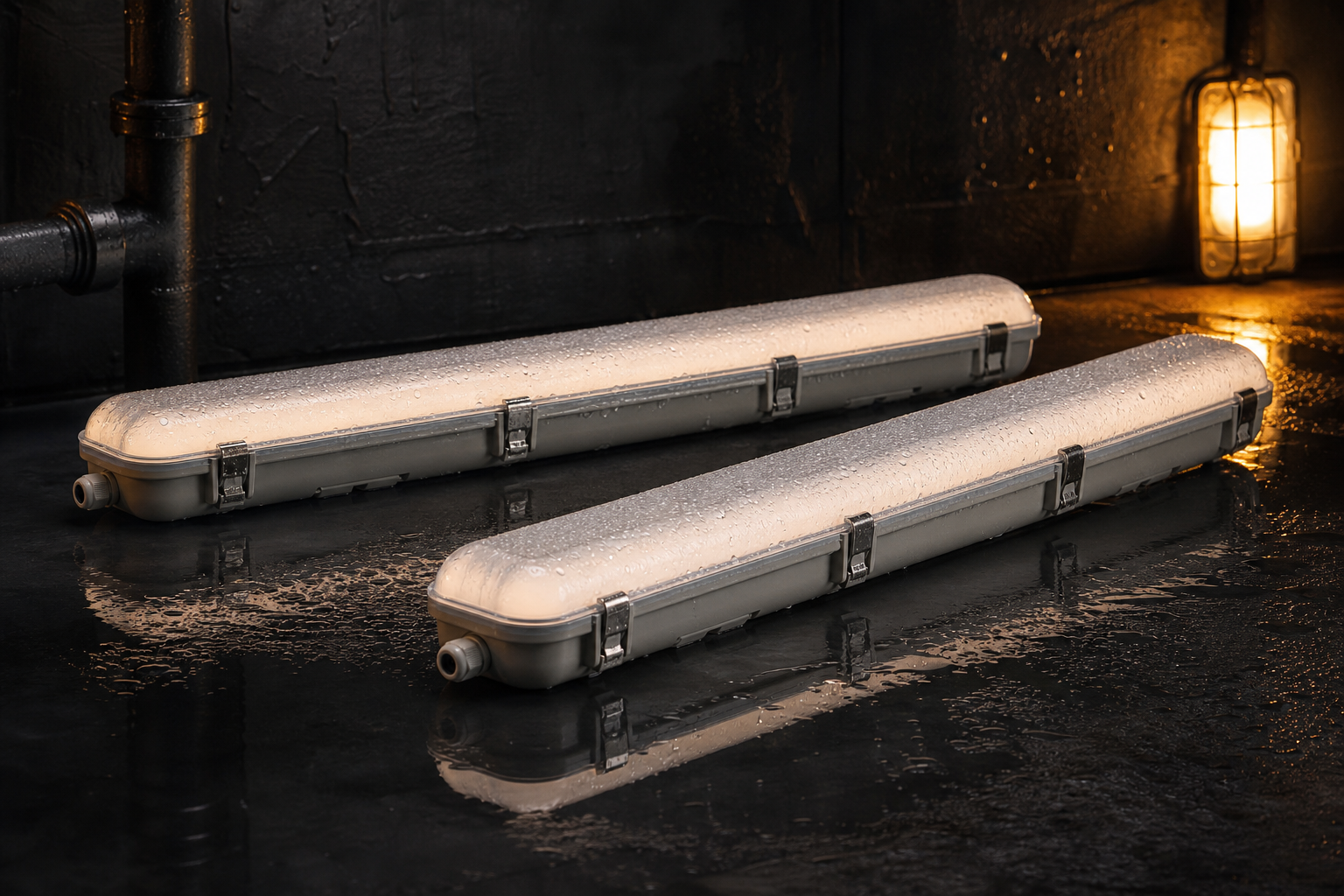
In day-to-day export practice, "tri-proof light" and "vapor tight fixture" describe the same product family: a fully sealed, gasketed LED batten built to keep out dust, water and impact in harsh interiors. The difference is largely vocabulary and market geography — "tri-proof" is the term used across Asia and the export cluster in China, while "vapor tight" (or "vapor proof") is the established term in North America. Neither name is a protected standard, which is exactly the problem: the same label can cover very different build qualities. Buy on the five specifications that actually separate quotes — ingress rating, impact rating, materials, driver placement and photometrics — not on the word on the box.
Where the names come from
"Tri-proof" refers to the three protections the fixture promises: waterproof (IP-rated sealing), dustproof (sealed optical chamber) and corrosion- or impact-resistant. The term took hold among Asian manufacturers and remains the dominant catalog word on export lines from the industrial lighting segment. A tri-proof batten is typically a polycarbonate housing extruded as a continuous profile, with a gasketed diffuser snapped or screwed onto the base and cable glands at both ends.
"Vapor tight" comes from the North American fixture market, where the category grew out of incandescent and fluorescent vapor-proof luminaires used in car washes, food processing and marine environments. US specification culture adds expectations the word implies: continuous gasketing, stainless or coated hardware, and — in food-adjacent plants — sanitary design details and, sometimes, NSF-related food-equipment expectations. When a US buyer asks for "vapor tight," a European buyer asking for "IP65 batten" and a Chinese factory quoting "tri-proof" are usually pointing at the same drawing. But usually is not always — and a tender that treats the names as interchangeable without checking specs invites the cheapest interpretation of each.
A quick vocabulary note for tender writers: because the words are market conventions, the safest specification names the product class ("sealed LED batten"), then pins IP, IK and materials — letting each market's sales team translate the label.
What actually separates quotes: the spec sheet, not the label
Five lines of the datasheet do the deciding. First, the ingress rating: IP65 is the working baseline for dust-tight, jet-water sealing; IP66 matters where fixtures face washdown or driven rain. Second, the impact rating: IK08 is common; IK10 (20 joules) is where forklift-adjacent aisles and parking structures should land. Third, materials — the grade of polycarbonate (UV-stabilized for any daylight exposure), diffuser clarity, gasket compound, and whether stainless clips and glands are included or "optional." Fourth, driver placement: internal drivers keep installation simple; external gear boxes ease maintenance in high-ambient or washdown zones. Fifth, photometry: a sealed fixture with a poor diffuser loses 20-30% of its raw lumen package to absorption — an illustrative range, but the reason you compare delivered lux, not catalog lumens.
Corrosion is the sixth consideration that rarely makes the label. Coastal plants, cold stores and chemical environments call for C4/C5-class protection thinking: coated steel ends, stainless hardware, and gaskets that survive thermal cycling. None of this is guaranteed by either name, and all of it is verifiable in a pre-shipment sample.
Applications where the difference shows
Both fixture types serve the same map: parking garages, warehouses and canopies, cold storage, car washes, food and beverage plants, stairwells and agricultural buildings. The vocabulary diverges more than the hardware. A Gulf-region tender will usually read "IP65/IP66 tri-proof batten"; a North-American submission reads "LED vapor tight, wet-location listed"; a European retrofit reads "IP65 luminaire, IK08." If your line exports to several regions, the commercial answer is one platform with two datasheets — the same housing and optics, labeled per market, with the destination-market certifications each expects.
Cold storage deserves its own sentence of caution: seals and polycarbonate behave differently at -25 °C than in the showroom, so gasket compound and diffuser impact strength must be rated for the actual temperature band — a question asked of the datasheet, not assumed from the IP number. Agricultural and livestock buildings add ammonia and washdown chemicals to the same checklist.
Installation and maintenance realities
The sealed format shapes the install. Tri-proof and vapor tight bodies are surface-mounted — ceiling, wall or suspended on chains — with wiring entering through end glands; most models support through-wiring, so one supply drop can feed a continuous row. That row logic is the category's quiet cost advantage: a parking deck lit by linked battens needs a fraction of the junction boxes and conduit runs of an equivalent downlight layout. Check two details in the sample: gland sizing against your cable program, and whether the diffuser opens for driver service without dismounting the whole fixture — half a maintenance day per aisle across a warehouse's life hangs on that answer.
Maintenance centers on three wear points: gaskets (inspect at every driver intervention), diffuser yellowing in UV-exposed positions (specify UV-stabilized PC anywhere daylight reaches), and clip fatigue after repeated service openings. In washdown areas, plan gasket replacement as a consumable line item rather than a surprise — the kits are inexpensive, and scheduled replacement preserves the IP rating the fixture was bought for.
Side-by-side comparison
| Dimension | Tri-Proof (export/Asia term) | Vapor Tight (North America term) |
|---|---|---|
| What the name promises | Water + dust + impact/corrosion protection | Sealed against vapor, moisture and washdown |
| Typical ingress rating | IP65 standard; IP66 for washdown | Wet-location listed; commonly IP65/IP66 equivalent |
| Typical impact rating | IK08 baseline, IK10 available | Often specified as IK-equivalent in tenders |
| Construction | PC extruded body, gasketed diffuser, cable glands | Same family; adds sanitary/hardware expectations |
| Standards behind the name | None — IP/IK codes do the defining | None — listing marks do the defining |
| Buyer checklist | IP, IK, gasket, driver, photometry | Identical checklist, plus destination listings |
Ratings characterize common catalog practice across the cluster; exact values vary by model. Treat them as a checklist, not a guarantee — request test reports per order.
How to choose — three decision rules
- Match the name to the market, the spec to the site: label per region, but hold both to the same IP/IK/materials table.
- Washdown or driven-rain exposure: IP66 with stainless hardware; IP65 is the dry-side baseline.
- Forklift routes and public parking: IK10 optics and housing, regardless of which word the tender uses.
Advice for procurement teams and dealers
Put the numbers in the RFQ, not the noun. Asking suppliers to quote "tri-proof" invites a spread of interpretations; asking for "IP66, IK10, UV-stabilized PC, stainless clips, driver accessible, delivered-lux photometry at 4 m" prices the same product everywhere and makes quotes comparable line by line. Ask for the gasket specification and a torque/twist test on sample diffusers — the diffuser clip is where sealed fixtures most often fail in the field.
For dealers and distributors: this is a category where one platform can carry an entire program. A single sealed-batten platform, documented as tri-proof for Asian and Middle East channels and vapor tight for North American channels, cuts SKUs while covering both vocabularies. Certification is handled via certified partner factories per destination — verify the IP test reports, impact certificates and destination listings against official databases before the first container, not after. Sample cost and per-unit pricing at your volumes are quoted per project; any generic price gap between "tri-proof" and "vapor tight" labels is illustrative, because the hardware underneath is frequently identical.
When comparing sealed-batten quotes, insist every bidder answers the same five-line spec table from the earlier section — the exercise routinely reveals that the cheapest quote is quoting a thinner housing, a lower IK rating, or an unnamed gasket, none of which appears in the unit price.