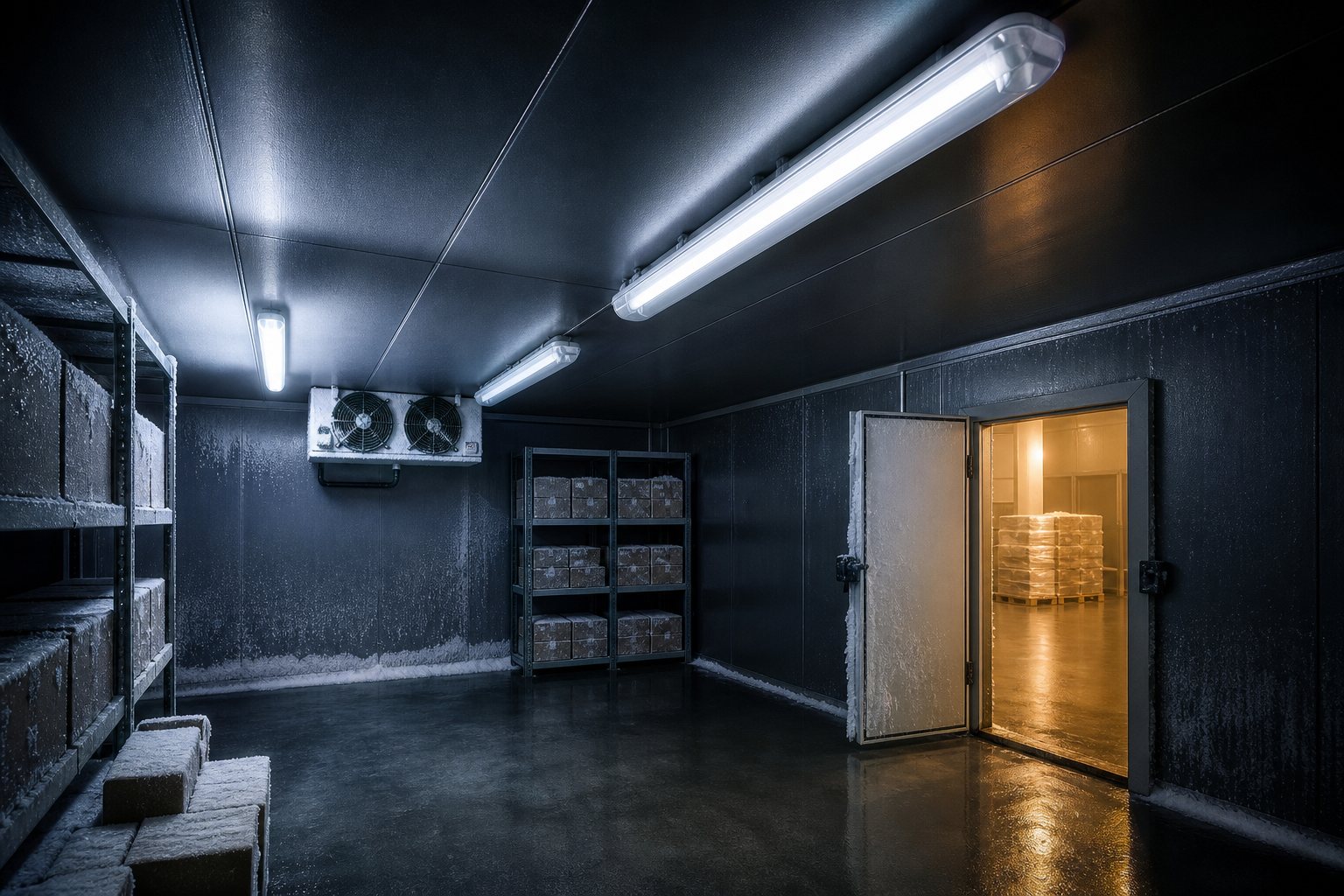
What separates a freezer-rated luminaire from a warehouse fitting in a cold box — cold-start drivers, sealed housings, condensation control and the sensor strategy that pays for the upgrade.
2026-09-10 · 9 min read · Lighting guide
A cold chain facility is really three environments sharing a floor plan. The chill store runs at 0 to +4°C and punishes fittings with humidity and condensation. The freezer at -18 to -28°C adds the harder constraint: electronics that start and run reliably far below the rating of an ordinary office driver. And the dock and airlock zone swings between both worlds several times an hour, fogging lenses and corroding anything with an unsealed seam. A lighting design that treats all three as "warehouse, but colder" is the pattern behind most cold store lighting failures.
The economics are unusual, too. A freezer runs lights on a fraction of the hours a warehouse does — rooms are entered for picking waves, then empty — and every hour the doors stay closed matters for the refrigeration load. That combination of short run time, hard access and expensive interruption means the two decisions that dominate a cold store project are fixture survivability and automatic control, in that order. Relamping in a -25°C room is not a maintenance task; it is a planned shutdown with defrost, lifts and protective clothing.
Targets follow EN 12464-1 style practice and are modest compared with offices: typical figures are 100-150 lux for bulk storage areas and 200-300 lux at picking faces, order staging and docks, with the vertical component on rack faces mattering as much as the floor plane — a picker reads labels, not the aisle floor.
Access economics deserve early attention. A walk-in freezer between picking waves is not a workplace for lifts and ladders, so the design should assume fixtures are serviced rarely and replaced never — hence the emphasis on complete spare units, tool-free clip fittings that open without unscrewing housings, and mounting heights reachable from a standard platform. Every fixture that avoids a specialist access visit pays for its specification premium within the first maintenance cycle, an illustrative rule but one visible in any cold store's service log.
Structure the design around the room types and the work happening in them:
| Zone | Typical lux | Where light must land | Notes |
|---|---|---|---|
| Freezer bulk storage (-18 to -28°C) | 100-150 | Aisle floor and lower rack faces | Cold-rated fixtures only; surface mount above rack top |
| Freezer picking aisles | 200-300 | Vertical, on rack faces | Asymmetric optics or paired rows opposite tall racks |
| Chill store (0 to +4°C) | 150-300 | Aisles plus staging edges | Condensation-rated sealing; IP65 minimum, IP66 preferred |
| Airlocks / vestibules | 200-300 | Door faces and floor | Frequent fogging; sealed diffusers, high-cycle sensors |
| Docks and marshalling | 200-300 | Tail lift and trailer faces | Mixed ambient; standard industrial fittings acceptable |
| Corridors, plant, offices | 100-500 | Per task | Standard commercial products; no freezer spec needed |
Values follow common EN 12464-1 style practice and are illustrative; confirm against the operator's work-study and national code.
The default fixture in the cold rooms themselves is the sealed tri-proof batten — an IP65/IP66 luminaire with a gasketed polycarbonate body and diffuser, rated for low-temperature starting. The distinction that matters is inside: the driver must be specified for the room temperature. Standard commercial drivers typically start at -20°C or -25°C on the datasheet and may behave unpredictably near the limit; freezer-grade variants are rated to -30 or -40°C and use components and electrolytic capacitors specified for the cold. Our tri-proof vs vapor tight comparison explains the naming, and the tri-proof guide covers the construction details that matter here: continuous gaskets, stainless or coated clips, and cable glands rather than knockout holes.
| Specification line | Freezer typical | Chill / dock typical |
|---|---|---|
| Driver low-temp start | -30 to -40°C, stated on datasheet | -20 to -30°C |
| Ingress / impact | IP66, IK08 | IP65, IK07-IK08 |
| Housing | PC body, gasketed, stainless clips | PC or coated steel |
| Mounting | Surface, clear of rack tops and airflow paths | Surface or suspended |
| Emergency pack | Cold-rated variant, per escape route zone | Standard variant |
Typical export-market specification lines; verify each with the factory test report for the exact model.
Because cold rooms are intermittently occupied, presence-controlled lighting is the single highest-return line in the project. A freezer lit by wave schedule rather than by switch schedule typically cuts lighting energy by well over half — figures of 60-90 percent savings versus always-on are commonly reported in the industry, illustrative but consistently repeated, because the room simply stands empty most of the day. The control layer is cheap relative to the fixture count: microwave or PIR sensors rated for the cold, zoned aisle by aisle, with a hold time of 5-15 minutes and a dimmed "background" level of 10-20 percent so the room never appears dead on a camera feed.
Three control details deserve specification attention. First, sensor rating: a sensor whose electrolytics fail at -15°C will brick within its first summer of door openings. Second, door-interlock logic: lighting in airlocks should follow door state, not occupancy alone, so lights are not burning against a closed freezer door all shift. Third, emergency and escape lighting must remain on or come on independently of the sensor scheme, with cold-rated battery packs on the escape route — this line is often forgotten until the inspection. DALI addressability is worth the small premium in larger facilities, giving the operator per-aisle reporting and the ability to re-zoning after rack moves without rewiring.
Larger operators add a monitoring layer on top: per-fixture or per-circuit reporting through a DALI system shows which aisles actually ran, where output is decaying and when a door seal is failing — lighting data often flags refrigeration issues before the maintenance round does. In retrofit projects, log one week of operation before and after at the distribution board; the measured kWh curves are the acceptance document, and they usually show the sensor savings exceeding the estimate, because the true occupancy pattern was emptier than anyone assumed.
Cold storage rewards buyers who verify behavior before shipment. The closing checklist: low-temperature start test report for the driver, IP and IK test certificates for the housing, photometric files (IES/LDT) with the asymmetric optic option if picking aisles are involved, driver brand stated by name, and the flicker and surge figures for the record. Certification follows the destination market — CE for the EU, UKCA for the UK, SAA for Australia, SASO/SABER for Saudi Arabia — issued via certified partner factories and checkable by certificate number. Our certification guide summarizes the matrix by market.
Practically, insist on a freezer sample test: one or two units held at -25°C for 24 hours and started repeatedly. It costs a week and answers the only question that matters about a cold store luminaire. Commercial terms in this cluster typically run samples of 1-5 pcs in 7-14 days, trial orders from 100-200 pcs, and bulk production 25-40 days after deposit — illustrative, confirmed per order. Fixtures consolidate naturally with the wider industrial lighting program, and the layout work pairs directly with our warehouse lighting solutions team, who can run the picking-aisle photometrics and the sensor zoning in one pass. Specify the spare ratio on the order — for cold rooms we recommend holding 3-5 percent of complete spare units, not parts, because replacing a gasketed fitting at -25°C is a whole-fixture job.
Same thing or not — what the naming hides and which sealed fixture to quote where.
Aisles, racks and the energy math that decides the fixture count before price does.
Uniformity classes and camera-ready light for the hardest multi-purpose hall in the building.
CE, UKCA, SAA, SASO and DLC by destination market — what your order actually requires.
Zoned layout with cold-rated fixture selection and a per-project quotation — first response within 24 hours.