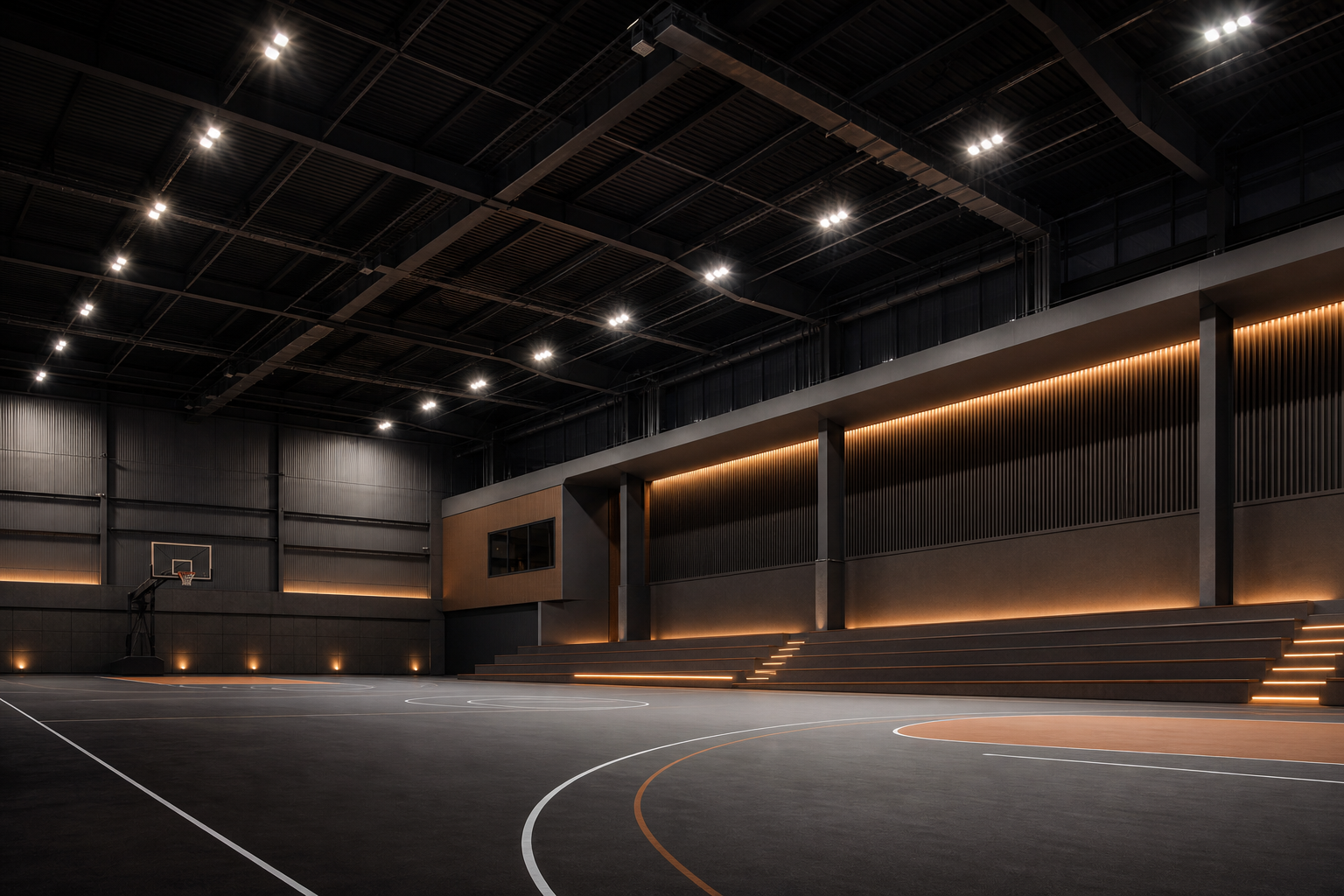
How to light a multi-use sports hall for players, referees, spectators and cameras at the same time — and which specification lines decide whether the layout survives tender, install and broadcast.
2026-09-10 · 9 min read · Lighting guide
A school or club sports hall is the hardest multi-purpose space in the building portfolio. One hour it hosts a PE class, the next a league basketball match, the weekend a graduation ceremony or a market — and increasingly, a livestream. The lighting has to satisfy four audiences at once: players tracking a fast ball against the ceiling, referees making calls at speed, spectators watching partly against the light, and cameras whose exposure meters are far less forgiving than the human eye.
That is why sports lighting is specified by class and uniformity, not just lux. In the style of EN 12193 practice, a multi-purpose hall typically targets around 300 lux for training and school sport, 500 lux for league competition, and 750 lux or more at regional and national level — typical values, adjusted by national federations. Broadcast venues add a vertical-illuminance requirement on the players, often in the 1,000-1,400 lux range for standard-definition streams at lower tiers, higher for professional work. The horizontal number on the floor is only half the story.
Uniformity is where most failed installations actually fail. A hall that averages 300 lux but runs from 120 lux under the hoops to 480 lux mid-court reads as patchy, slows play and ruins camera exposure. Typical practice requires minimum-to-average uniformity of 0.5 or better (U2) for training and 0.7 or better for competition, confirmed in a DIALux or Relux layout before a single fixture is ordered. The floor average in the photometric file is the number the tender checks; the uniformity grid is the number the players feel.
Design the hall as zones, not as one flat plane. The playing area is the center of the calculation, but the surrounding safety margin, the spectator seating and the circulation behind the benches all carry their own targets. A typical structure:
| Zone | Typical lux | Uniformity (min/avg) | Glare / notes |
|---|---|---|---|
| Main court (training) | 300 | ≥ 0.5 | Fixtures offset from shooting sight lines; UGR ≤ 22 typical |
| Main court (competition) | 500 | ≥ 0.7 | Second scene level; same optic layout, higher dimming step |
| Safety margin around court | 200-250 | ≥ 0.5 | Continuous with court light to avoid a visible "wall of dark" |
| Spectator seating | 150-200 | ≥ 0.4 | Glare controlled toward seats, not toward the court |
| Fitness / gym side zones | 300 | ≥ 0.4 | Mirror walls need shadow-aware placement |
| Circulation, stores, changing | 100-200 | ≥ 0.4 | Presence control; changing rooms at the higher end |
Values follow common EN 12193 / EN 12464-1 style practice and are illustrative; confirm the governing class with the federation or the tender documents.
Fixture choice follows mounting height and ball impact. At 7-10 meters, the default is a high bay with a wide or asymmetric optic — asymmetric beam plates push light across the court from fittings mounted outside the main sight lines, which is exactly what a shooting player looking upward needs. At 5-7 meters, linear high bays with wide distribution do the same job wall-to-wall. Below the scoreboard, behind the hoops and anywhere a ball travels, specifiers call for IK08 or higher impact resistance and wire guards; polycarbonate diffusers beat bare arrays. The second table is the quick selection logic:
| Mounting | Typical fixture | Optic | Protection |
|---|---|---|---|
| 8-12 m | UFO high bay, 150-240 W | Asymmetric or 90° | IK08, wire guard over courts |
| 6-8 m | Linear high bay, 100-150 W | Wide / batwing | IK08, PC diffuser |
| 4-6 m (gyms, studios) | Linear batten or low bay, 60-100 W | Wide, micro-prismatic | IK07-IK08 |
Power ranges are illustrative industry-typical packages; the photometric file decides the final count and optic.
Camera-readiness is bought in the driver, not the fixture housing. Rolling-shutter cameras expose frame by frame, and any residual 100/120 Hz ripple in the LED drive current shows up as dark bands across slow-motion footage. The specification line that prevents it is flicker performance: quality drivers hold flicker index below roughly 0.05 with SVm under 0.4 and deep, high-frequency PWM — typical figures buyers now demand for streamed sport. Ask the factory for the flicker datasheet of the exact driver, not a general "no flicker" claim; our flicker and SVm guide explains what the numbers test.
Scene control is the second half. A hall that lives between 300 lux training and 500 lux match modes should switch through DALI presets — training, match, cleaning, ceremony — rather than contactor banks, because preset scenes also hold uniformity: every fixture dims together on the same curve. Daylight harvesting pays back in halls with clerestory windows, and presence sensing cuts energy hard in changing rooms, stores and corridors. A sensible split keeps the court on manual-plus-preset and hands the ancillary zones to sensors entirely. For buyers planning wider controls, our smart lighting program covers DALI-2 and sensor ecosystems.
Commissioning closes the gap between the layout and the court. Before handover, an as-built lux survey on the court grid should be compared against the tender class and the uniformity targets, with the meter points marked on the same plan used for the photometric design; deviations beyond roughly 10 percent usually trace to aiming, wrong optics or fixtures installed out of position rather than to the design itself. Write the acceptance grid into the contract, photograph the aiming settings, and file the scene schedule — the next contractor to touch the hall inherits exactly what was documented, and nothing else.
Every one of these mistakes is common because each passes a casual inspection. They surface weeks or months later, in complaints, in footage and in the energy bill, when the fixtures are paid for and the punch list is closed. The pattern behind them is identical: decisions taken from catalogs instead of from the hall's geometry. Five failure modes cover most of what goes wrong:
The sports hall conversation with a supplier should close the same lines every time. First the documentation: IES/LDT photometric files for the exact model, a DIALux layout showing the court grid and uniformity calculation against the tender class, and flicker data for the nominated driver. Then the hardware: LED package and binning window, driver brand stated by name, IK rating, surge protection of 4-10 kV, and ambient ratings covering unheated halls. Certification follows the destination market — CE for the EU, UKCA for the UK, SAA for Australia, SASO/SABER for Saudi Arabia — issued via certified partner factories and verified by certificate number, not catalog logos; our certification guide maps the matrix.
Commercially, expect samples of 1-5 pcs in 7-14 days, trial orders from 100-200 pcs and bulk production 25-40 days after deposit — illustrative figures, confirmed per order and season. For a new hall, ask for a one-fixture photometric sample test or a mockup corner before the full release; for retrofits, check whether existing suspension points and circuits can be reused, which is often where the budget is won. High bays rarely travel alone: they consolidate naturally with industrial lighting lines in the same container, and the wider hall-and-storage pairing with our warehouse lighting program shares drivers, spares and binning policy. Set the spare-parts ratio at order stage — 2-3 percent of drivers and optics stored on site is the difference between a one-hour swap and a six-week claim.
Aisles, racks and the energy math that decides the fixture count before price does.
Fixtures, drivers and sensors rated to survive freezers without a maintenance climb every month.
The payback math industrial buyers check first, with a worked illustrative example.
CE, UKCA, SAA, SASO and DLC by destination market — what your order actually requires.
Photometric layout with uniformity check and a per-project quotation — first response within 24 hours.