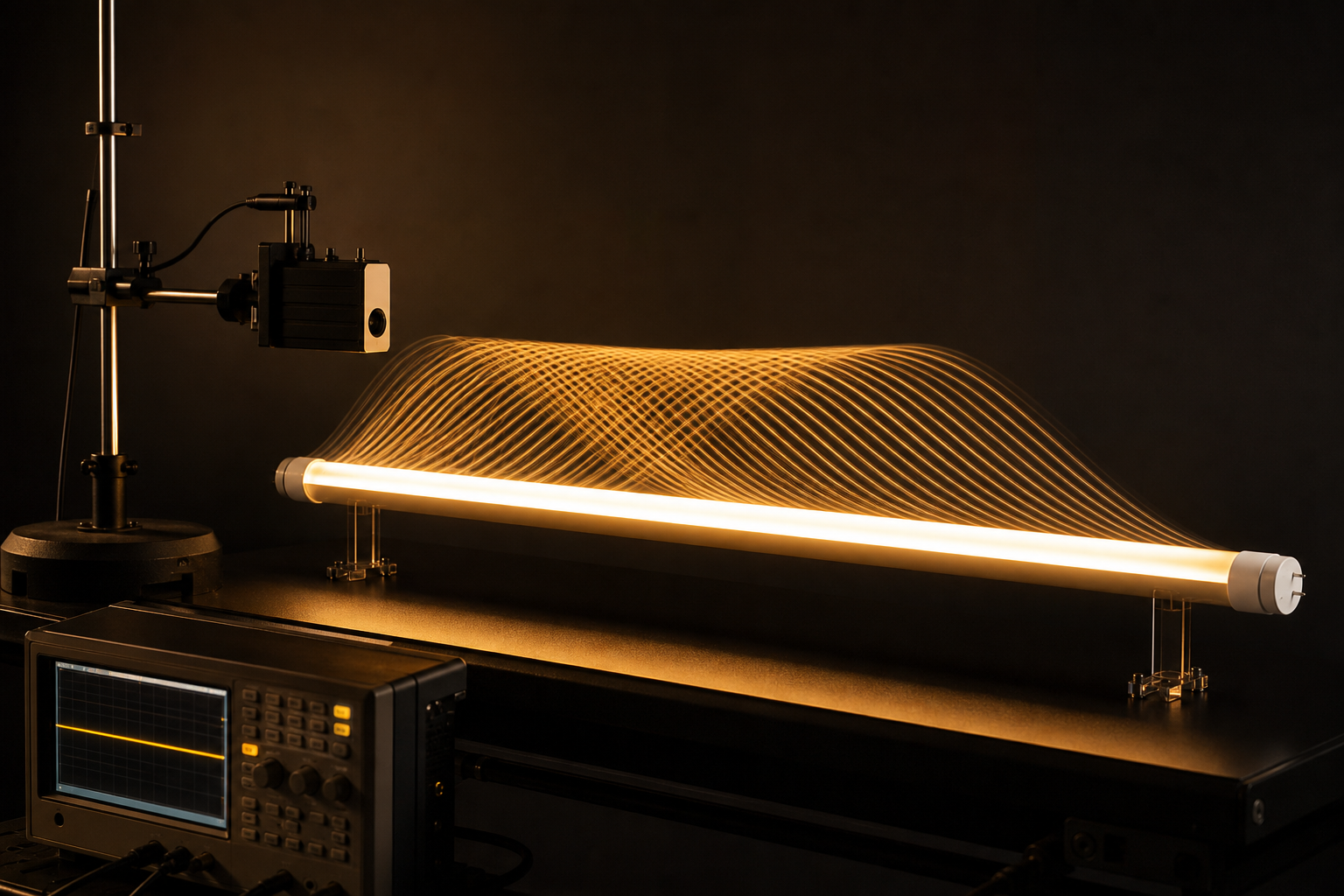
The two metrics behind Europe's flicker rules, the driver decisions that produce them, and the reports that separate real claims from datasheet decoration.
2026-09-10 · 6 min read · Reference guide
Flicker is the invisible defect: invisible until someone waves a hand under the fitting, films a machine in the workshop, or complains of headaches in the classroom. Since September 2021 it has also been a regulated defect in the EU, where single regulation (EU) 2019/2020 sets hard limits on two flicker metrics — PstLM for perceived flicker and SVM for stroboscopic effects — for every light source and separate control gear placed on the market. For exporters this makes flicker a documents question as much as an engineering one: EU buyers increasingly ask "what is your PstLM and SVM?" before they ask the price. This guide collects the metrics, the limits, the causes and the paperwork in one place.
| Metric | Reference | What it measures | EU 2019/2020 limit | What to request |
|---|---|---|---|---|
| PstLM | IEC TR 61547-1 | Short-term flicker indicator — modulation a human eye perceives as flicker at 0.5-80 Hz | PstLM ≤ 1.0 | Test report per driver family, not per catalogue |
| SVM | IEC TR 63158 | Stroboscopic visibility measure — visible artefacts on moving objects from 80-2,000 Hz modulation | SVM ≤ 0.4 | Report per fixture at full and dimmed output |
| Flicker percent | Legacy measure | Relative amplitude of light modulation ((max-min)/(max+min)) | No EU limit | Context only; quoted when no PstLM data exists |
| Flicker index | Legacy measure | Area-based modulation shape over one cycle | No EU limit | Context only; useful for comparing legacy Retrofits |
| IEEE 1789 practice | IEEE Std 1789 | Low-risk and no-effect regions by modulation frequency and depth | Not law | Used as a design benchmark where no EU limit applies |
The EU limits apply from 1 September 2021 under regulation (EU) 2019/2020 to light sources and separate control gear; installations and national schemes may reference them through ErP/energy-labelling paperwork. Values are as published in the regulation — treat them as contractual where the destination market is the EU.
| Cause | Where it appears | The fix |
|---|---|---|
| Single-stage driver topology | Budget lamps and battens; high 100/120 Hz ripple | Two-stage or active-filter drivers for any occupied space |
| Phase-cut (trailing/leading edge) dimming | Retrofit dimming on old wall dimmers | Dimmer-LED matched pairs or DALI/1-10V control instead |
| PWM dimming at low frequency | Aggressive constant-current dimming in cheap modules | PWM above 3-4 kHz, or amplitude (analogue) dimming |
| Sensor and emergency add-ons | Microwave sensor kits, emergency inverters retrofitted to the line | Integrated, tested sensor-driver combinations |
| Camera and machine interaction | Sports venues, high-speed lines, fan blades under light | SVM ≤ 0.4 drivers — the stroboscopic artefacts are what cameras catch |
In practice the conversation runs: "Is the driver flicker-free?" — answered by driver brand and topology, since the major EU-market driver platforms publish PstLM/SVM data per family. "Does it hold when dimmed?" — the regulated values apply at the dimming levels the product is used at, and cheap drivers that pass at 100% fail at 20%, which is why dimmed-state reports matter for DALI projects. "Do you have the reports?" — test files per IEC TR 61547-1 and 63158 from an accredited lab, with the fixture or driver model named. A supplier who answers those three with documents is safe to shortlist; one who answers with the word "flicker-free" and no report is not. For the control-layer side of dimming quality, see our DALI dimming explainer.
AURELUX commercial and industrial lines under commercial lighting, office lighting and industrial lighting run flicker-compliant driver platforms as standard for EU shipments, with PstLM and SVM reports issued per driver family and dimmed-state data on DALI projects. Certification and conformity documents (CE, ErP declarations, test reports) are provided via certified partner factories, verified by number and database link — the paperwork trail is set out in the lighting certification guide, and glare's companion metric, UGR, is explained in what is UGR.
DALI and DALI-2 controls — where dimming quality is actually decided.
UGR, flicker and learning outcomes in one specification brief.
Unified glare rating for offices and schools — the number next to flicker.
CE, UKCA, SAA and SASO: which marks your market needs and how to verify them.
Driver platform, compliance reports and dimmed-state data supplied with every EU-bound quotation — send the project list.