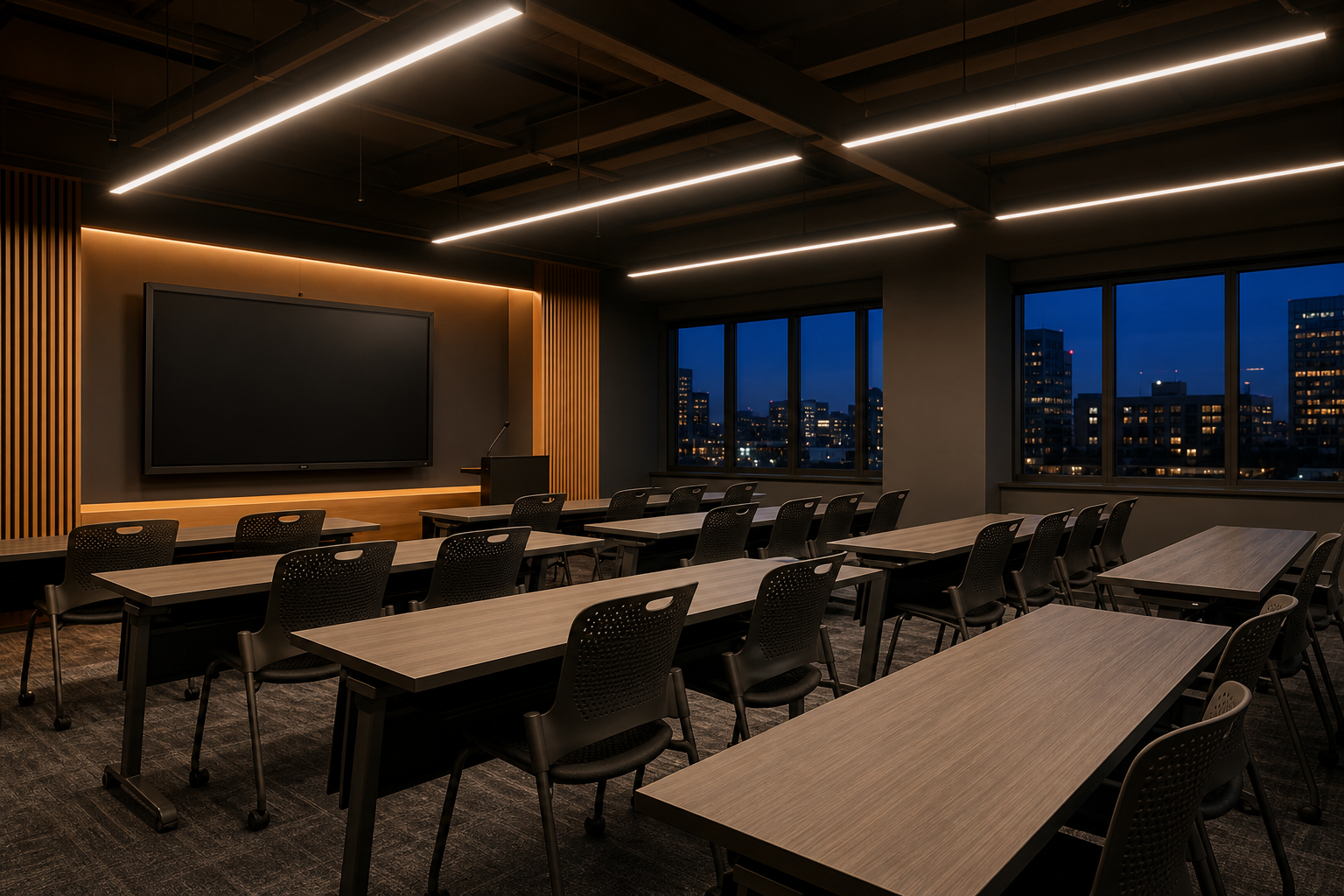
Schools buy lighting against tenders written around three numbers — lux, UGR and flicker — plus one fixture most suppliers forget: the blackboard luminaire. The full parameter set is here.
2026-09-10 · 9 min read · Lighting guide
Educational lighting is the most tender-driven corner of the B2B market: parameters arrive in the bid documents, and fixtures win or lose on whether their documentation answers them. It is also the sector with the clearest human stakes. Children spend roughly a thousand hours a year in classrooms, much of it reading text at close distance or facing a bright board, and the research consensus — careful not to overclaim — is that glare, flicker and poor visual conditions add load to exactly the cognitive work a classroom is trying to do. This guide assembles the working parameter set: the EN 12464-1 targets, the two numbers that decide comfort (UGR and flicker), the blackboard fixture that generic designs omit, and the procurement documents that make a bid auditable.
A classroom is a two-direction room. Every seat looks at the teaching wall — board, screen or both — and the teacher faces rows of horizontal desk tasks, all day. The goals follow: comfortable, uniform light on desks for reading and writing; a teaching wall bright enough to carry every seat's attention without becoming a glare source; faces lit well enough that teacher-student eye contact works from the back row; and no flicker anywhere in the visual field, because it is the one defect children rarely report and always endure. The standard parameters are stable across markets: 500 lx maintained on desks, Uo ≥ 0.60, UGR 19, Ra 80, with 4000 K the default and tunable white an increasingly specified option.
| Zone | Maintained lux (typical) | CCT | CRI | Glare / flicker |
|---|---|---|---|---|
| General classroom desks | 500 lx, Uo ≥ 0.60 | 4000 K (tunable 3000-5000 K option) | 80 | UGR 19; PstLM ≤ 1.0, SVM ≤ 0.4 |
| Blackboard / teaching wall | 500 lx vertical on the board | 4000 K | 80 | Dedicated asymmetric optics; luminance-limited in viewing angles |
| Library / reading areas | 300-500 lx | 3000-4000 K | 80-90 | UGR 19 at reading positions |
| Laboratories | 500 lx | 4000 K | 80 | UGR 19; moisture-rated fixtures where required |
| Corridors / stairs | 100-150 lx | 4000 K | 80 | UGR 25; robust housings, IK-rated |
| Sports halls | 300-500 lx by level | 4000 K | 80 | Impact-resistant, high-mount optics |
| Staff rooms / offices | 300-500 lx | 4000 K | 80 | UGR 19 per workplace practice |
Values are illustrative of EN 12464-1 practice for educational buildings; the current standard edition and national annexes govern, and tender documents frequently set stricter figures.
The blackboard row is where generic office designs fail education projects. A board seen from every seat is a vertical task in a high-glare position: it needs asymmetric blackboard luminaires mounted clear of sightlines, washing the board surface evenly while keeping luminance out of students' direct field of view. Where a projector or display shares the wall, the zone needs its own dimmable circuit — a "projection mode" that drops the board wash and the front ceiling row — which is a controls decision, not a fixture swap.
UGR 19 is the tender default for classrooms, and it is a property of the room as much as the fixture. Delivering it in practice means deep-recessed or louvered optics, sensible spacing, and the honest document chain: the luminaire's UGR table for standard rooms plus a DIALux or Relux calculation of the actual classroom geometry. A datasheet badge without the room calculation will not survive a technical review. Flicker is the quieter defect. LED flicker from low-quality drivers sits in exactly the frequency band that causes eyestrain and, in a fraction of people, visible strobing; in classrooms it adds a hidden load to eight hours of reading. The reference figures: PstLM ≤ 1.0 (short-term flicker severity) and SVM ≤ 0.4, the latter now a legal requirement for most light sources placed on the EU market under Regulation (EU) 2019/2020. Bid evaluation should require the driver-level test report, not a "flicker-free" line on a datasheet. As for learning outcomes: published research links good visual conditions — glare and flicker control, adequate and well-distributed light — to comfort, attention and reading performance, while conceding that lighting is one factor among many. Tenders are safest grounded on the standards, with wellbeing claims framed as supporting rationale rather than as measured effect sizes.
The baseline control set pays for itself quickly in schools that run long days: presence sensing in classrooms and cores, daylight harvesting on window rows, and scene switching — full teaching, projection (front rows dimmed), audio-visual (all dimmed), cleaning. DALI-2 addressing makes the projection mode and per-row harvesting possible without rewiring. Tunable white — cooler in the morning, warmer toward the end of day, often tied to the timetable — is now commonly specified in new builds as a wellbeing feature; procure it as a system, with the control protocol, driver range and scene programming documented, because tunable fixtures bought without a control plan arrive as expensive fixed-4000 K fittings. Finally, the maintenance factor: school luminaires live with chalk dust and student projectiles, so specify cleanable optics and a realistic maintenance factor (0.8 typical) — a classroom that computes at 500 lx new and reads 380 lx at first re-lamp inspection was under-designed, not unlucky.
Education bids live and die on documentation, so the submittal list is worth writing out in full. For each fixture family in the schedule, require: photometric files (IES and LDT); the UGR table in standard rooms plus the classroom calculation per room type showing Em, Uo, UGR on desks and verticals on the board; flicker test reports per driver stating PstLM and SVM; photobiological safety classification (RG0/RG1 as usual for general lighting); IK and IP ratings with evidence for corridors, sports halls and labs; DALI-2 or protocol compatibility statements for the control scope; tunable-white system documentation where specified, including driver range and control wiring; and L70/L80 lifetime figures stated at realistic ambient temperatures. Public buyers will additionally check certification by destination (CE, UKCA, SASO and others), issued via certified partner factories with verifiable numbers. Programs that bind this list at award stage review smoothly; programs that leave it to delivery discover which fixtures have no documents at exactly the wrong moment.
Education bids are won on documents, so the schedule writes itself: photometric files (IES/LDT) per fixture; the UGR table plus a DIALux/Relux calculation per classroom type; flicker test reports per driver (PstLM, SVM); tunable-white system documentation where specified; IK and IP ratings for corridors and sports halls; and the DALI-2 or equivalent control compatibility statement. Certification by destination (CE, UKCA, SASO and others) is issued via certified partner factories with verifiable documentation — public-sector buyers in particular will check the numbers and the databases. For large school programs, a mock-up classroom with the proposed fixtures, dimming scenes and board lighting lets the client's technical team sign off in one visit; it is the cheapest de-risking step available at program scale.
Illustrative commercial terms: samples of 1-5 pcs ship in 7-14 days; trial orders 100-200 pcs per SKU; bulk production 25-40 days after deposit; pricing quoted per project or per school program. The office and education lighting page maps the fixture families to these requirements, the commercial lighting line carries panels and anti-glare linears, and the classroom-oriented knowledge base lives in our UGR explainer. Send one classroom type as the pilot; the full program schedule follows from it.
The glare number in every school tender, and how it is proven.
The flicker metrics EU buyers ask for and how they appear in reports.
Scene control, projection modes and addressable classroom lighting.
CE, UKCA, SASO and more by destination — the documents tenders check.
Layout, UGR calculation, flicker reports and FOB quotation — first response within 24 hours.