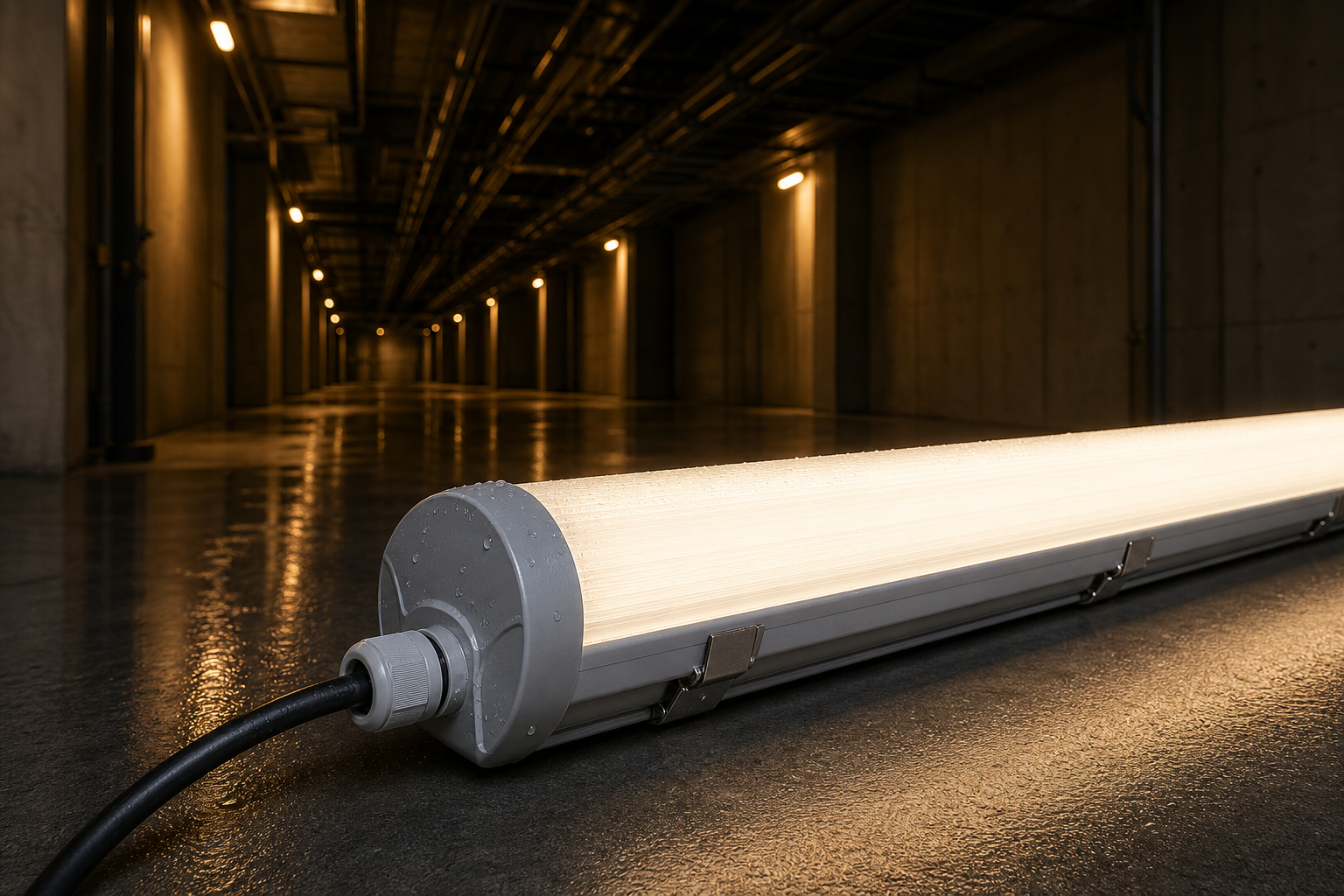
The sealed industrial batten behind one of the category's least official names — what "tri-proof" claims, how the sealing actually works, and where these fixtures belong.
2026-09-10 · 8 min read · Knowledge base
A tri-proof light is a fully sealed LED batten built to resist water, dust and corrosion — the three hazards that kill ordinary fittings in parking garages, food-processing plants, cold stores and workshops. The name is trade usage, not an IEC term: you will not find "tri-proof" in a standard's index, and it carries no fixed test requirement. What actually defines the product is its ingress protection rating, almost always IP65 or IP66, sometimes IP69K for washdown-critical versions, plus impact resistance around IK08. The specification conversation should therefore start from the rating and the test report behind it, not from the marketing word — a point we develop in the tri-proof vs vapor-tight comparison.
Construction is straightforward to describe and easy to get wrong: an extruded or molded PC (polycarbonate) body and diffuser, a continuous silicone gasket compressed between them, stainless or coated screws, and cable glands rated to the same IP level as the housing. LED tubes or modules sit behind the diffuser; the driver is inside the sealed volume. Every penetration — end caps, glands, clips — is a potential leak path, which is why gasket compression and gland quality are the first things a pre-shipment inspection should look at.
Three build details separate fixtures that keep their IP65 rating in year five from ones that do not. The gasket path: a continuous, compressed silicone or EPDM gasket along the full diffuser-to-body seam beats four-corner pads decisively; ask how the gasket is seated and retained. The diffuser material: polycarbonate should be UV-stabilized, because yellowing and brittleness destroy both light output and seal elasticity outdoors and under skylights. The cable entries: glands must be supplied rated to the housing's IP level, sized to the actual cable, and preferably include a blanking plug for unused entries — an open gland hole is an IP00 hole in an IP65 fixture. Continuous-run versions add a further seam per joint, so linked installations should use the manufacturer's joint kits rather than installer improvisation, and the run's rated IP applies only if those kits are used.
Tri-proof fixtures follow the batten format: 2 ft, 4 ft and occasionally 5 ft lengths, single or twin lamp rows, individually mounted or joined into continuous runs with linking kits. Power and output sit in predictable bands across the market:
| Format | Typical power | Typical flux | Protection | Typical application |
|---|---|---|---|---|
| 2 ft batten | 15-25 W | 2,000-3,500 lm | IP65 / IK08 | Stairwells, corridors, small stores |
| 4 ft single | 30-50 W | 4,000-7,500 lm | IP65 / IK08 | Parking decks, workshops, kitchens |
| 4 ft twin / high output | 50-80 W | 7,000-12,000 lm | IP65-IP66 / IK08 | Warehouses, cold stores, food plants |
| Continuous run | Per module | Per module | IP65 rated joints | Aisles, galleries, underground parking rows |
Figures are illustrative industry-typical ranges; efficacy typically lands at 120-150 lm/W. Confirm per model against photometric files.
Anywhere moisture, dust or cleaning regimes defeat a standard fitting. The recurring applications: underground and deck parking (dust, exhaust, hose cleaning), food processing and commercial kitchens (washdown — check IP69K or food-grade variants), cold storage (sealed housing plus a low-temperature driver rated to -30°C, a variant that must be requested explicitly, as covered in our cold storage guide), agricultural buildings (ammonia and humidity — corrosion resistance matters more than raw IP), and workshops and loading docks (impact and vapor). Exterior canopies and walkways also take tri-proof battens, though dedicated wet-rated fixtures often win on optics there.
Where they do not belong: dry offices and retail ceilings, where an IP65 seal costs efficacy and glare control for protection the space never needs. Specifying protection to the environment, not to the catalog maximum, is the mark of a disciplined schedule.
The economics that make the category durable are maintenance economics, not purchase price. In a parking deck or food plant, every lamp change is a cherry-picker hire and a work permit; a sealed fixture that simply does not need opening for five years repays its premium several times over in avoided access alone. That is also why the failure points buyers should probe are the ones that force opening — gasket set, driver access philosophy, and whether the design accepts a future driver swap without destroying the seal. A tri-proof light that cannot be serviced without ending its IP rating is a consumable pretending to be a fixture.
Match four parameters to the space. Ingress rating: IP65 (dust-tight, jet-resistant) covers most industrial interiors; IP66 for heavy hose use; IP69K only where high-pressure, high-temperature washdown is routine — the differences between these levels are explained in our IP rating guide. Impact: IK08 is the common baseline; low ceilings with forklift traffic justify more. Temperature range: state the coldest and hottest the fixture will see; standard drivers are usually rated 0 to +45°C and cold stores break them. Controls: microwave or PIR sensor versions are standard options and, in parking applications, do most of the energy saving; emergency inverter variants are available for escape routes.
Verification is where export buyers earn their margin. Ask for the IP test report for the specific model, not a family claim; ask how the gasket is compressed at the end caps; check that glands and cable entries are supplied rated. Certification by destination (CE, UKCA, SAA, SASO) is issued via certified partner factories and verifiable by number and database link — the wider matrix is in our certification guide.
Plan the option set per area while the schedule is open. Sensor versions — microwave detectors handle the low temperatures and thin obstacles of parking decks better than PIR — do most of the energy saving in 24-hour spaces. Emergency variants with self-contained inverters cover escape routes in underground parking and stairwells, and DALI-addressable emergency drivers report their self-test results on the building's control bus. Dimming via 1-10V or DALI matters less in utility spaces than sensing, but food plants running constant washdown shifts often specify DALI for zone control. Each variant changes the fixture's internals while leaving the housing identical — which is precisely why variants must be named on the purchase order and confirmed at sample stage, and why a site fault traced to a standard driver in a cold store is a specification failure, not a factory one.
Illustrative commercial terms across the cluster: samples of 1-5 pcs ship in 7-14 days; trial orders start from 100-200 pcs per SKU; bulk production 25-40 days after deposit, quoted per project. Packaging should keep fixtures upright with diffuser protection, since a scratched diffuser on a sealed fixture cannot be polished out. Tri-proof battens also consolidate well with the rest of an industrial order — panels for offices, high bays for the hall, battens for back-of-house — and the full families are indexed on our industrial lighting and commercial lighting pages for mixed-container planning.
Same thing or not — the housing and gasket differences behind two overlapping names.
Fixtures that survive freezers: low-temperature drivers, condensation and switching.
IP65 vs IP66 vs IP67 — what IEC 60529 actually tests and what each level buys you.
CE, UKCA, SAA, SASO and DLC by destination market — what your order actually requires.
Temperature, washdown regime and mounting — the right sealed fixture and FOB quotation within 24 hours.