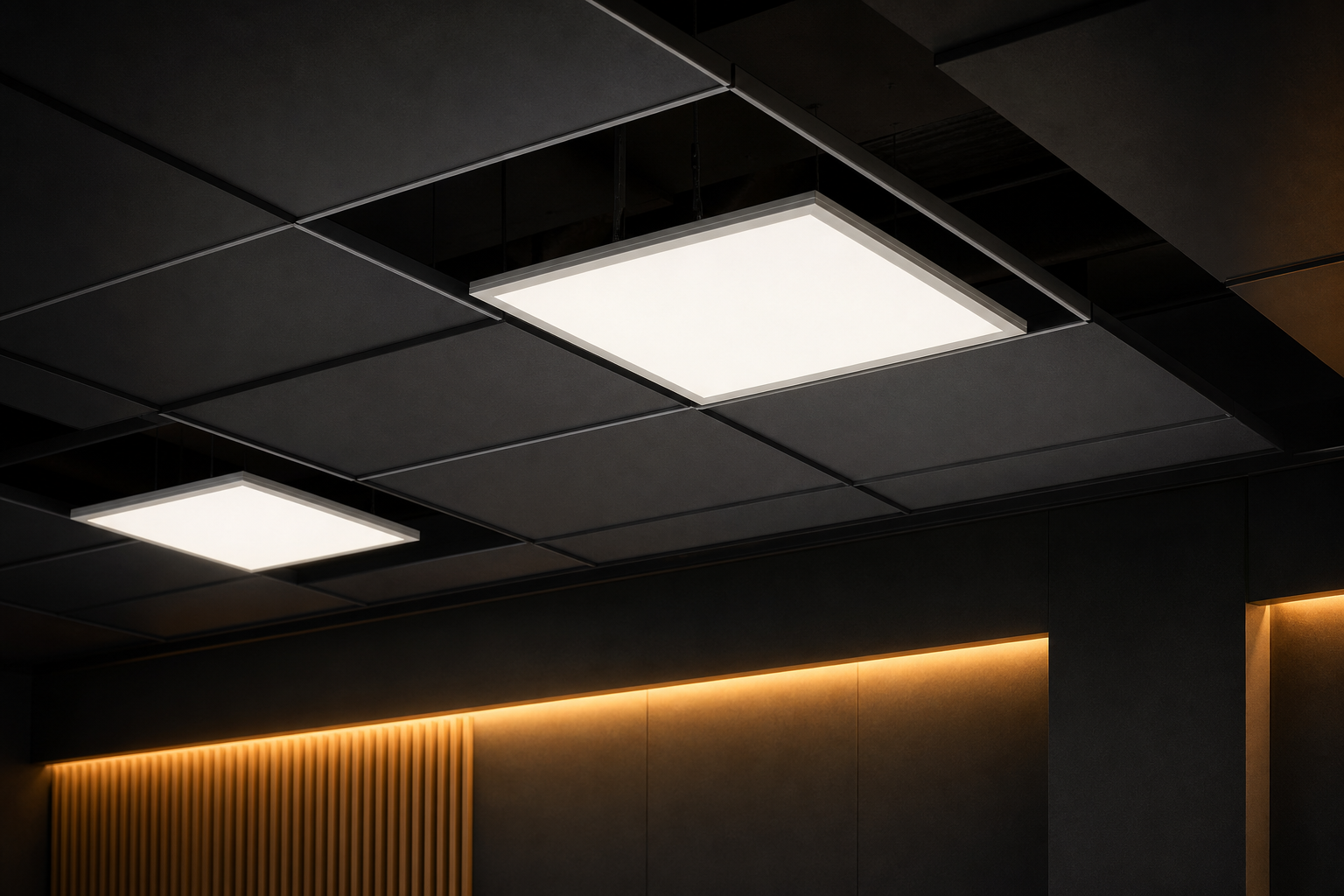
LED panels are the closest thing lighting has to a commodity: 600x600, 620x620, 1200x300 — the dimensions are standardized, the prices are public, and every quotation looks interchangeable. Then the ceiling goes in, the lights come on, and the differences appear: gray patches near the edge where the light-guide plate fails, a driver hum on a phase-cut dimmer, yellowing diffusers by year two, or a panel that will not talk to the DALI line the building specified. These are manufacturing differences — LGP grade, diffusion film quality, driver pairing, frame construction — and they survive in a category buyers assume is safe to buy on price alone.
This comparison therefore reads "Top 10 manufacturers" the only way that survives contact with a real ceiling: as a framework. AURELUX works the panel category as a cluster sourcing partner matching your specification to evaluated partner factories across the Pearl River Delta and Zhongshan cluster (illustrative network size); every commercial figure below is illustrative and confirmed at quotation.
| # | Check | What to request | Red flag |
|---|---|---|---|
| 1 | Light-guide plate quality | LGP source (new PMMA vs recycled); dark-corner and dot-pattern uniformity judged on a lit sample at low dim. | Gray corners at 30% dim; LGP origin not declared. |
| 2 | Edge-lit vs backlit | Construction declared per model; backlit for UGR-sensitive offices, edge-lit for slim depth. | Construction unknown to the salesperson quoting you. |
| 3 | Driver pairing | Driver brand named per version (isolated vs non-isolated); flicker data — PstLM and SVM for EU-bound orders. | "Built-in driver" with no brand and no flicker figures. |
| 4 | Glare performance | UGR<19 versions with micro-prismatic or opal diffuser options; UGR calculation file, not a sticker claim. | UGR claimed without optical construction to support it. |
| 5 | Efficacy & flux honesty | Lumens and wattage from integrating-sphere reports; 100-120 lm/W band typical for quality panels (illustrative). | Efficacy that beats physics without a test report. |
| 6 | Dimming options | DALI, DALI-2, 0-10V and phase-cut versions with tested low-dim behavior; emergency inverter option. | One dimmable SKU "compatible with everything". |
| 7 | Frame & safety | Aluminum frame thickness; safety cable for suspended installs; fire-rated options where specified. | Frame flexing in hand; no safety-cable provision. |
| 8 | Size & version range | 600x600, 620x620, 1200x300/600 plus surface-mount kits and Recessed/lay-in frames on one platform. | Only the single best-selling size. |
| 9 | Certification | CE (LVD/EMC/RoHS) via certified partner factories, ErP/EPREL status per product for the EU; certificate numbers verifiable. | CE without RoHS scope; no EPREL answer for EU delivery. |
| 10 | Consistency at volume | Binning policy, batch color consistency, AQL-based pre-shipment inspection with burn-in sampling. | Sample perfect, bulk unverified — the classic panel failure. |
Panel manufacturing sits where LED module assembly, driver supply and PMMA processing intersect: the Shenzhen-Dongguan corridor for driver-dense and smart-ready versions, Zhongshan and the wider cluster for volume commercial production feeding the export apparatus of a region shipping lighting to 180+ countries and regions (Zhongshan municipal sources, 2024-25). Because panels ship flat and stack well, freight economics favor any factory with disciplined export packaging — carton crush tests and edge protection are a quality signal you can see in the sample shipment itself.
| Archetype | Profile | Best for | Watch for |
|---|---|---|---|
| Office-spec quality house | UGR-oriented backlit constructions, DALI-2 depth, flicker documentation, EN 12464 fluency. | EU-bound office and education programs where controls are scored. | Price above commodity tiers; justify it in the tender scoring. |
| Volume commercial line | Edge-lit standard sizes at market pricing; fast repeats, broad stock. | Distributor shelf lines and price-led fit-outs. | Driver and LGP drift between batches; lock the BOM. |
| Platform specialist | One panel platform with surface kits, frames, emergency and sensor versions. | Multi-site rollouts needing one SKU family in many configurations. | Platform lock-in; confirm roadmap for driver versions. |
Panel quotations hide their differences in the footnotes, so normalize before comparing. Fix the specification first: size, construction (edge-lit or backlit), UGR target, driver brand class, dimming protocol, efficacy band and CCT bin. Then require each quote to state the driver brand, LGP source, flicker metrics, warranty term (2-3 years is the working commercial band; illustrative) and the certification scope with numbers. A quote that cannot fill in those lines is not cheaper — it is unpriced risk. Finally, order a lit burn-in: thirty panels on a dimmer for 48 hours exposes LGP defects and driver hum that a cold sample never shows.
Working terms across the cluster: samples 7-14 days, trial orders 100-200 pcs, bulk 25-40 days after deposit, T/T 30% + 70% against B/L copy, FOB Zhongshan or Shenzhen (illustrative). For system context, see panel vs troffer, the controls layer in DALI dimming, and the glare metric in UGR explained. Fit-out level guidance lives on our commercial lighting catalog and office lighting solution page.
Panels used to be the category where documentation requests died politely. That era is over for EU-bound product. The ecodesign regulation's flicker and stroboscopic metrics (PstLM, SVM) attach to the light source and control gear, which means panel programs delivering into Europe increasingly carry driver-level test obligations — and the panel's driver choice is where those obligations are won or lost. In parallel, office and education tenders now routinely annex the energy data: standby consumption, control-scenario watts with DALI dimming, and the UGR calculation behind the glare claim. The practical consequence for sourcing is that the driver brand and its documentation are no longer a footnote to the panel; they are half the product. A manufacturer who can hand over PstLM/SVM figures, DALI-2 evidence and standby data without a two-week delay is manufacturing for the market you are selling into — the one who promises to "check with the engineer" is not.
Freight discipline is the second quiet differentiator. Panels are the best-flat-packing category in lighting — corner protection, interleaved layers, stacked cartons with crush tests — and the difference between disciplined and casual packaging shows up as damaged corners on site, which read as defects regardless of whose truck caused them. Ask to see the export carton spec and a drop-test record with the sample; mature factories have both on file. Container economics follow: panels cube out a container before they weigh it out, which is exactly why mixed commercial programs consolidate them with heavier lines under one loading plan — the mixed-SKU logic described in our container loading guide, and the office-side specification context in our EN 12464-1 office guide.
Standards, sizes and applications compared for suspended and grid ceilings.
DALI and DALI-2 controls explained for project buyers and tender writers.
Unified glare rating for office and school lighting — the number behind the spec.
How professional buyers work the lighting capital — districts, audits and export routes.
Send the ceiling schedule — a specified panel platform with driver options, UGR data and FOB quotation within 24 hours.