2026-09-10 · 8 min read · Comparison
The short answer
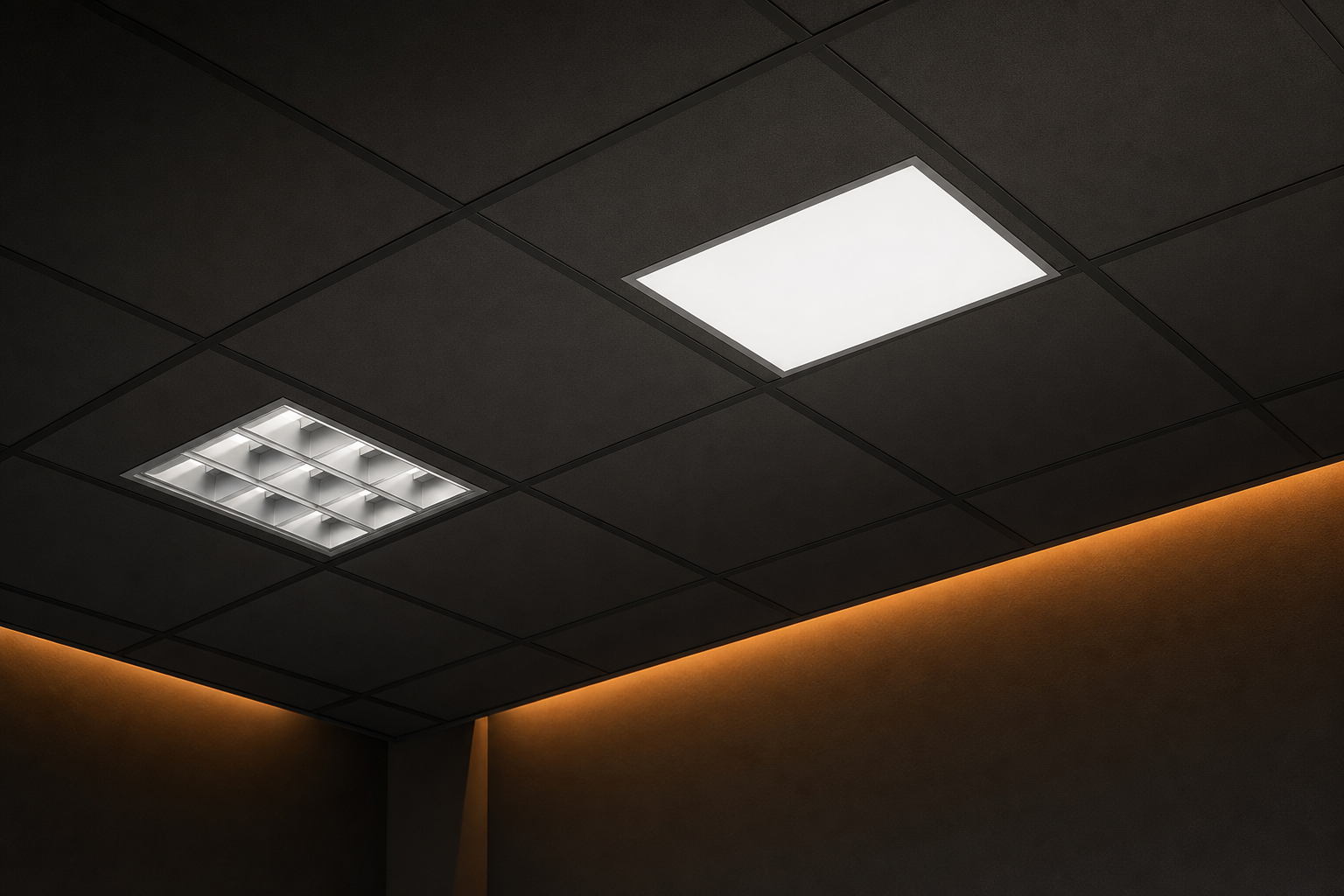
Quote an LED panel when the project sits in a metric ceiling market — Europe, the Middle East, Australia, Southeast Asia — with a 600 x 600 mm or 1200 x 300 mm grid, or when the tender demands slim aesthetics and low-UGR optics. Quote a troffer when the project is a North American imperial ceiling — 2 x 2 ft or 2 x 4 ft lay-in — or a retrofit into existing troffer cells where a prismatic lens and heavy-gauge frame are expected. They are not direct substitutes: construction, standards and market expectations differ more than the "square ceiling light" description suggests. Both live in the commercial lighting index and both feed the same office and education projects — on different continents.
Construction: edge-lit panel versus framed troffer
The modern LED panel is an edge-lit device. LEDs line the perimeter of a slim aluminium frame and pump light into a light-guide plate; a diffuser on the face emits it as a uniform, thin sheet. Bodies run 10-14 mm thick, which is why panels read as architectural — flush in the grid, clean lines, no visible cell structure. The light-guide plate is the quality-critical component: cheap LGPs yellow or show bright edges within a couple of years, so experienced buyers press suppliers on LGP material grade and ageing samples.
A troffer descends from fluorescent-era construction: a substantial steel frame, a direct or direct/indirect LED engine behind a prismatic lens, and a robust housing built for decades of lay-in service. Troffers are thicker and heavier, cost more to ship per lumen, and project a more utilitarian look — but their direct-lit optics can deliver very high uniformity, and the format is what North American facility managers expect to find above their tiles. Neither construction is better; they answer different ceiling cultures.
Sizes, grids and the standards behind them
The size systems are inherited, not invented. Metric markets standardized on modular suspended grids — 600 x 600 mm, 1200 x 300 mm, 1200 x 600 mm — and panels are built to drop straight in, with surface-mount kits and suspended-cable kits as accessories. North American grids use 2 x 2 ft and 2 x 4 ft cells, and troffers are dimensioned to those cells with lay-in T-bar flanges. A 600 x 600 panel will technically sit in a 2 x 2 grid with adapter frames, but nobody specifying a real project does this: the local electrician, the spares inventory and the inspector all expect the native format.
Standards follow the same split. European projects test panels against EN 12464-1 workplace requirements and EU single-market rules (CE, ErP/EPREL), while North American tenders reference DLC listing for utility rebates and NRTL marks — programs that are quoted case-by-case through our partner network. Middle East projects often accept either construction but insist on destination certification such as SASO/SABER. Education and meeting-room projects add a switching dimension: North American spec sheets often ask for 0-10 V dimming troffers, while metric-market equivalents default to DALI — a wiring decision that belongs in the schedule, not in the electrician's van. In practice the destination market picks the fixture family before performance ever enters the conversation — a useful shortcut when triaging an inquiry, and a compliance question we map per order as described in the certification centre.
Optical performance: UGR, uniformity and controls
On glare, both families now offer low-UGR variants, but the routes differ. Panels achieve UGR below 19 with microprismatic diffusers over the LGP — the standard answer for European open-plan offices — while standard opal panels sit around UGR 19-22 (illustrative class values) and suit corridors and back-of-house. Troffers reach low glare with parabolic louvres or deep-lens optics, preserving the controlled downward distribution that direct/indirect-system specifiers expect. Neither family has a glare monopoly; the diffuser technology decides, not the badge.
Controls integration is table stakes on both sides: DALI and DALI-2 versions, 1-10 V, and sensor-equipped models for daylight and occupancy are all standard catalogue options. For EPBD-driven European projects, panels with integrated sensors and DALI-2 drivers increasingly arrive as the default line item — the controls side of that shift is covered in our smart lighting program.
Two further spec items separate mature offers from brochure offers. Flicker: EU-bound projects increasingly test panels and troffers against PstLM and SVM limits, and commodity drivers fail these quietly — hold the driver tier before comparing prices. Emergency: both families ship with optional emergency inverter packs (3-hour class is the common request, illustrative), and the emergency variant frequently moves the final price more than the standard unit does; quote it as its own line so the client sees the cost of compliance rather than absorbing it as margin loss later.
Installation, logistics and market reality
Installation is a draw — both drop into their grid in minutes. Logistics favours panels: slim cartons pack flat and dense, and a container carries far more lumen-panels than troffers. Robustness favours troffers: the steel frame tolerates rough handling on site, while a thin panel needs corner protection it does not always get. On price, volume-grade 600 x 600 panels and 2 x 4 troffers both sit in aggressive commodity territory (illustrative FOB from the low-teens USD for basic panels; troffers typically somewhat higher per lumen) — driver brand and diffuser grade create the real spread between quotes, so compare those two lines first.
Comparison at a glance
| Dimension | LED panel | Troffer |
|---|---|---|
| Construction | Edge-lit, light-guide plate, slim frame | Steel frame, direct-lit engine, prismatic lens |
| Typical sizes | 600 x 600, 1200 x 300, 1200 x 600 mm | 2 x 2 ft, 2 x 4 ft lay-in cells |
| Home markets | EU, Middle East, Australia, Southeast Asia | North America and imperial-grid retrofits |
| Glare control | Microprismatic versions for UGR<19 | Louvres or deep lenses for low UGR |
| Aesthetics | Architectural, flush, minimal | Utilitarian, institutional |
| Logistics | Flat cartons, dense packing | Bulkier, heavier per lumen |
| Site robustness | Needs corner and face protection | Tolerates rough handling |
| Key quality check | LGP yellowing, edge darkening over time | Lens quality, frame finish, driver access |
How to choose: three rules
- Let the grid and the market decide first. Metric grid outside North America: panel. Imperial grid or NA retrofit: troffer. This single question resolves most inquiries.
- Let the room's glare spec decide the diffuser. Open-plan offices and classrooms: microprismatic panel or louvred troffer for UGR below 19. Corridors, storage and back-of-house: standard opal grades save budget.
- Let the controls scope decide the driver. Sensor-and-DALI-2 packages cost more up front and repay them in EPBD-era compliance and energy reporting; price both variants while the option is still free.
What this means for distributors and procurement teams
Distributors should stock to the geography of their customers, not to the category's hype: a Gulf or EU-facing wholesaler runs panels as the volume office line and keeps a troffer SKU only for American-branded corporate campuses; an NA-oriented buyer inverts that. For OEM programs, panels offer fast private-label entry — the format is standardized, the customization surface is the driver, diffuser and packaging — and our partner factories support both with certification dossiers via certified partner factories, verified per order.
When comparing quotations, hold constant: driver brand, LGP or lens grade, UGR data for the actual model, and flicker metrics (PstLM / SVM) where the destination market requires them. Send the project schedule — grid size, room types, controls scope, destination market — and we return panel and troffer options priced side by side with FOB terms within 24 hours.