2026-09-30 · 7 min read · Wall Lamps · Buying Guide
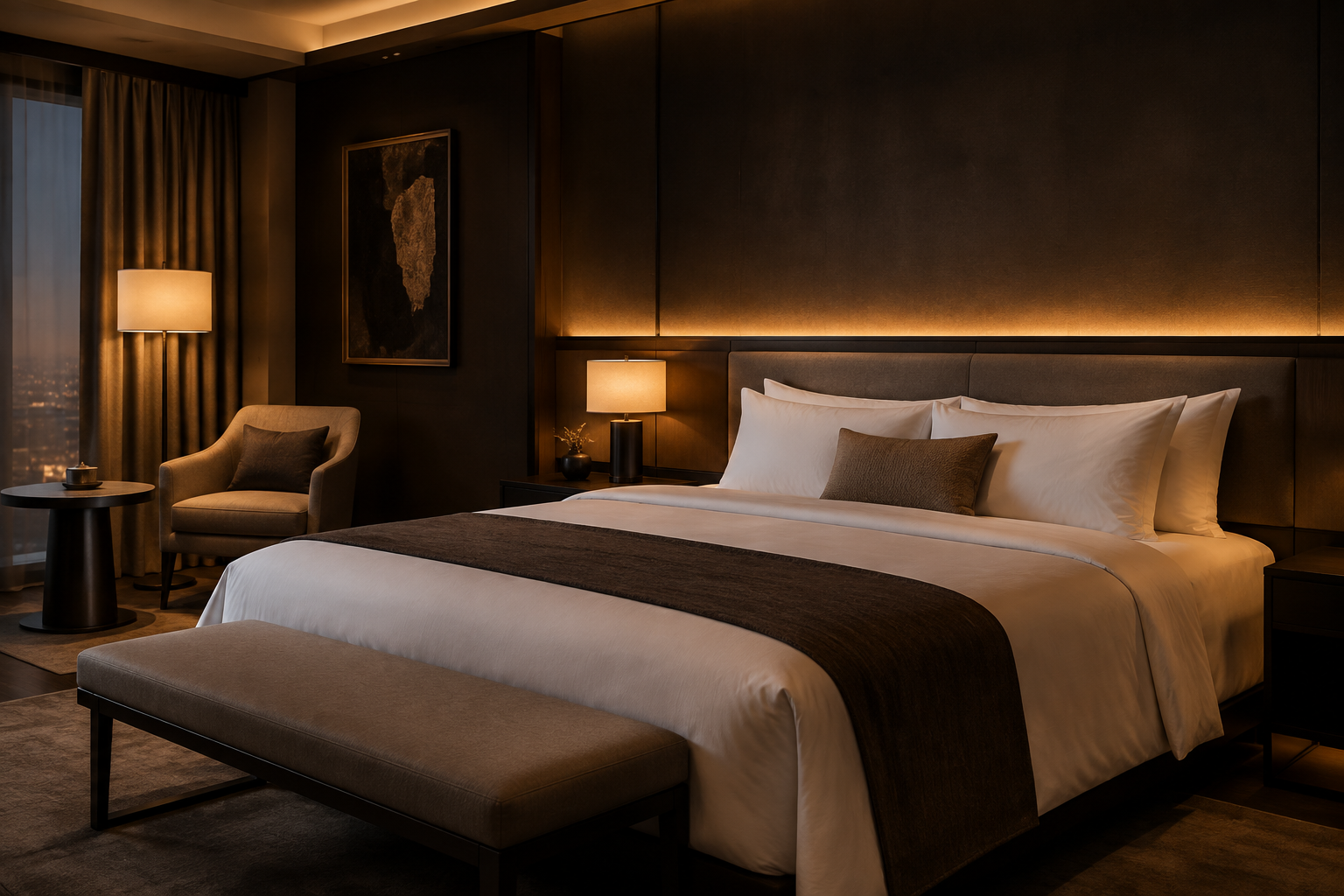
Most wall lamps are fixed compositions: they light a wall, a mirror or a artwork, and their position is a design decision made once. A swing arm wall lamp is different — it is a tool. Its articulated arm reaches out over a bed, a chair or a desk, puts light exactly where a task happens, and folds back to a slim profile against the wall when the task is done. That single mechanic explains why the category dominates search for reading lights and why hospitality programs specify it room after room: guests adjust the light to themselves, rather than arranging themselves around the light. This guide walks through the geometry that makes a swing arm work, the settings where it earns its wall space, and the specification points — reach, joints, switching, power format — that separate a lamp guests love from one housekeeping re-aligns every morning. For the broader category context, start with our wall sconce overview.
What a swing arm actually buys you
Three capabilities, all from the same hinge logic. First, reach: a typical swing arm extends roughly half a metre to a full metre from the wall (illustrative range across the market), which is enough to position a light source over the centre of a bedside table, the shoulder of a reader or the pages of a book held in a chair — positions no fixed sconce can reach. Second, adjustment: arm joints and a pivoting shade let each user tune the angle, so one lamp serves a tall reader and a short one, an upright reader and a slouched one. Third, retraction: folded closed, the fixture projects only a few centimetres from the wall, keeping narrow nightstands, tight corridors and headboard walls clear of hardware.
That combination is why interior designers describe swing arms as space-saving purchases rather than lighting purchases. The lamp replaces a table lamp's entire footprint — base, shade, and the surface area both consume — while delivering better-placed light than the table lamp ever could. In compact bedrooms, holiday apartments and hotel rooms where every square metre of nightstand is contested, the wall wins the argument.
Bedside reading: height, reach and glow
Bedside is the category's core application, and three placement numbers decide whether it works. Mounting height sits above the mattress line — commonly in the range of 100 to 120 centimetres from the floor for a standard bed, or roughly an arm's length above the shoulder of a seated reader (illustrative; adjust for bed height and user). Reach should cover from the wall to a point above the reader's lap or the book on the nightstand, which is why arm length matters more than total lumen output. Angle should put the light source beside or slightly behind the reader's line of sight: light arriving from behind the shoulder illuminates pages without glare, while a source that can pivot down into the reader's eyes becomes a complaint within one night.
Light quality matters as much as geometry. Reading light wants warm, high-fidelity output — 2700K is the default hospitality choice for its calm, skin-friendly tone (the trade-offs against 3000K are covered in our 2700K vs 3000K comparison), and colour rendering above 90 CRI keeps print and textiles honest, a property explained in our CRI guide. Output at the page — not at the fixture — is the meaningful figure: a focused shade delivering a comfortable reading pool is better than a bare bright source the reader must deflect. A small independent switch at the fixture or on the cord, rather than a shared room circuit, is what lets one partner sleep while the other finishes a chapter.
Office and task settings
The same mechanics translate directly to work. In home offices and study corners, a wall-mounted swing arm frees the entire desk surface a desk lamp would occupy and positions task light above the work plane without adding monitor glare — the arm swings out for paperwork and folds aside for screen work. In professional settings, the pattern appears over reception desks, in libraries and study rooms, at hotel headboard walls where the lamp doubles as a reading light and a work light for travellers, and in clinics and salons where adjustable directional light is a working requirement. For commercial programs, our hotel lighting line uses swing arms as standard bedside equipment for precisely this dual reading-plus-task role.
Two task-setting nuances are worth specifying deliberately. One, damping: a joint that holds its position under a hand's adjustment but does not drift over weeks is the difference between a tool and a nuisance — spring-balanced and friction-joint designs behave differently, and both appear in the market at different price grades. Two, reach discipline: an arm longer than the task requires becomes something people bump; the correct reach is the distance from wall to task, plus a small margin, and no more.
Hardwired vs plug-in swing arms
Swing arms come in two power formats, and the choice is as consequential as the arm itself. The comparison below summarizes how they trade off.
| Dimension | Hardwired swing arm | Plug-in swing arm |
|---|---|---|
| Installation | Electrician, junction box, wall box behind canopy | Bracket and screws; cord to an outlet, minutes to fit |
| Appearance | Cord fully concealed; cleanest wall | Visible drop cord, managed with covers and routing |
| Switching | Wall switch, fixture switch, or both | Inline cord dimmer or on-fixture switch |
| Portability | Fixed for the life of the wiring | Moves with the occupant; renter-compatible |
| Cost structure (illustrative) | Fixture plus electrical labour | Fixture only; lowest installed cost |
| Natural fit | New hotels, renovations, permanent headboard walls | Rentals, retrofits, staged rooms, pilot installations |
Both formats share the same arms, shades and light engines, which is why many suppliers — including our wall lamp program — produce each design in both versions from one tooling base. The full installation mechanics of the corded version, including swag mounting, are covered in our plug-in wall lamp guide.
Specs to check before ordering
A swing arm specification is mostly a list of small decisions, and each one generates or prevents returns. Reach and fold: confirm extended reach and folded projection in millimetres, not catalogue photography. Joint type: spring-balanced arms hold position best for frequent adjustment; plain friction joints cost less and suit set-once installations. Light source: integrated LED engines remove bulb-replacement entirely and lock the beam angle, while shade-and-bulb versions keep the fixture serviceable and let the buyer tune output with the lamp chosen. Switching: on-fixture toggle, touch step-dim, or inline cord dimmer — pick one consistent across the program so guests and housekeeping learn one behaviour. Finish and shade material: metal arms in matte black, brass or nickel dominate current demand, and shade materials run from metal to fabric to stone-look composites in step with the broader decorative lighting wave.
For program buyers, two commercial checks complete the list: certification for the destination market, requested per shipment through the process described in our certification guide; and spare-parts availability for the two wear items — joints and switches — since a swing arm that cannot be serviced is discarded whole. Send the room type, mounting substrate and power format, and we return matching options with dimensions and certificates within 24 hours via get a quote.