2026-09-30 · 8 min read · Wall Lamps · Buying Guide
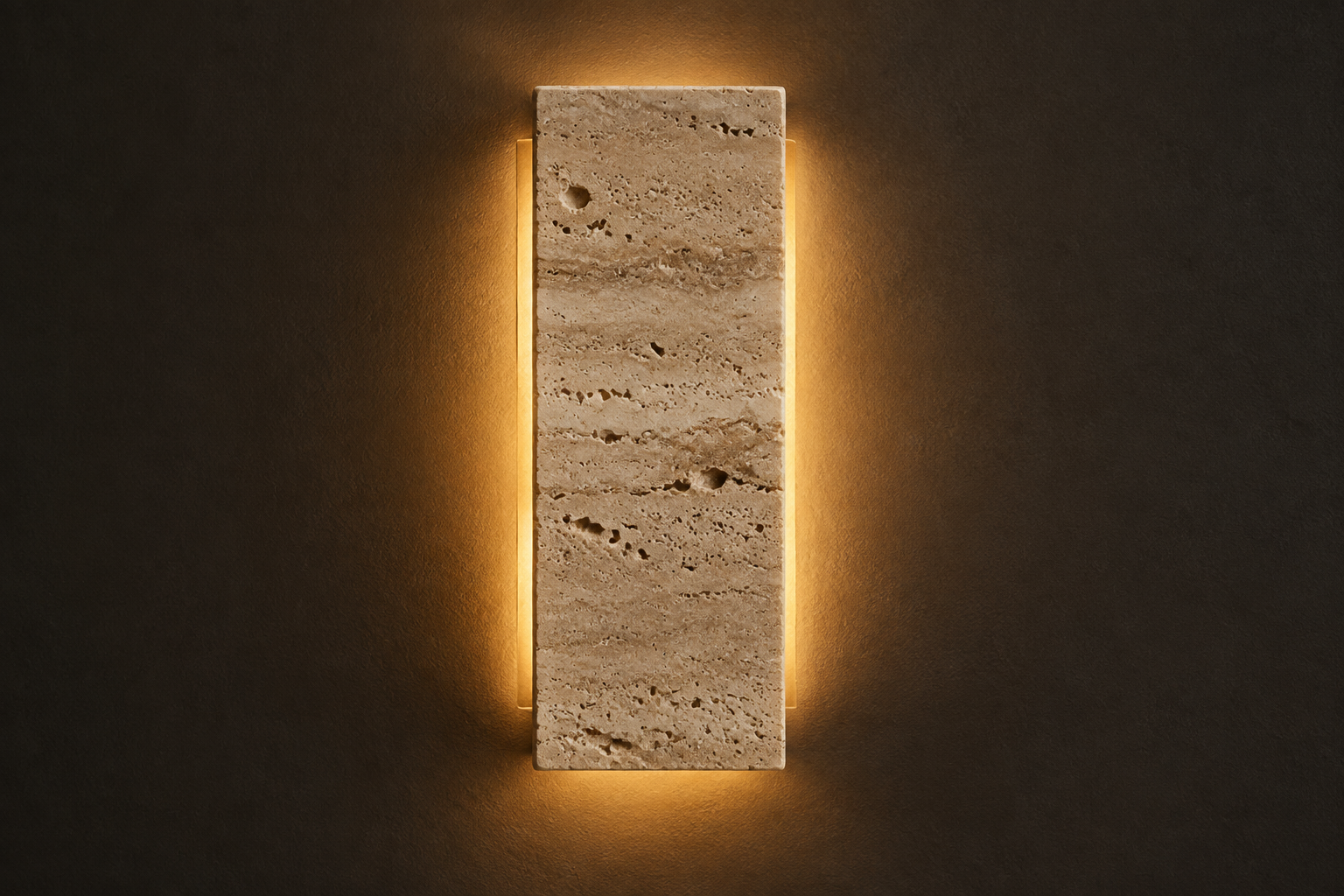
A plug-in wall lamp is a wall-mounted fixture that draws power from a standard outlet through a cord, instead of from a junction box roughed into the wall. Catalogues and search traffic often render this as "plug in wall lamp sconce", and the audience behind that phrase is consistent: renters, new-build owners whose electricians never roughed in bedroom circuits, hotel operators testing a layout before committing, and importers building programs for exactly those buyers. The fixture delivers the two things only wall-mounted lighting delivers — light positioned exactly where it is needed, and floor and nightstand space left completely clear — without the electrician, the wall damage or the permanence of hardwiring. This guide covers how they mount, where the cord goes, how plug-in versions of swing arms work, and how the category compares against hardwired and rechargeable alternatives in our wall sconce range.
Why plug-in wall lamps exist
Hardwiring is the strongest and cleanest way to put light on a wall, and it is also the most expensive and least reversible. A hardwired sconce assumes a builder cut openings, pulled cable and installed a box at the right height on the right wall — assumptions that fail in rentals, in older buildings, in rooms where furniture has moved since the plans were drawn, and in most of the housing stock of the markets where wall-lamp demand is strongest. The plug-in format exists for exactly those failures: it decouples the fixture from the building's wiring, so a wall lamp becomes a furniture-grade purchase rather than an electrical one.
That decoupling explains the category's commercial shape. Plug-in sconces are bought one or two at a time, installed in minutes by the end user, and taken along when they move — which makes them a natural retail and e-commerce SKU with low installation friction and low return anxiety. For B2B buyers the same logic applies at program scale: hotel groups pilot a headboard-wall scheme in ten rooms before committing to electrical work; short-stay operators fit units that cleaners can remount after repainting; staged and rental properties get wall-level lighting without touching the deposit. The format is not a compromise version of a sconce — it is a different product with a different contract between the light and the building.
Swag installation: hooks, cords and cord covers
Most plug-in sconces mount in one of two ways. The first is a direct wall mount: two screws into anchors or a stud, a bracket, and the fixture hung on it — mechanically identical to hanging a picture, with the same weight discipline. The second is swag mounting, where the fixture hangs from a hook on the ceiling or high on the wall and its cord runs down to the outlet, sometimes across the ceiling first. Swag installation turns any pendant-style shade into a wall-positioned light: the hook defines the position, the cord defines the reach, and nothing structural happens to the wall at all.
The cord is the format's one honest trade-off, and cord management is where good products separate from careless ones. A well-designed plug-in sconce ships with a fabric-braided or paintable cord cover, clips that route the drop neatly down the wall, and sufficient cord length — commonly in the three-to-five metre range across the market (illustrative) — to reach an outlet from a swag point without tension. Two practical rules prevent most complaints: never run a cord under a rug or through a doorway where it can be pinched, and match the anchor to the wall material, because the failure mode of a sconce is not electrical but gravitational. Weight matters for freight too — a plug-in sconce with a metal arm and glass shade typically ships in the one-to-three kilogram range per carton (illustrative), which keeps the category cheap to move compared with hardwired housings and their mounting hardware.
Plug-in swing arms and where the format wins
The most-searched subtype in this category is the plug-in swing arm: a sconce whose articulated arm extends, folds and rotates, bringing the light source out over a bed or chair and back flat against the wall when unused. It delivers reading light at exactly the right position — above the page, not behind the reader's shoulder — and folds away to nothing, which is why it dominates bedside and reading-nook applications. Our separate guide to swing arm wall lamps covers the geometry in depth; the plug-in point is that the cord removes the last excuse, since the arm's flexibility no longer has to be planned into the building's wiring.
Beyond beds, the format wins anywhere wall light is wanted temporarily or recently: reading corners, nursery walls (out of reach of small hands, on a cord short enough to be safe), vanity walls in rentals, corridor art walls in restaurants being re-staged seasonally, and headboard walls in hospitality programs that redesign rooms on a three-to-five-year cycle (illustrative). Dimming, where offered, is typically an inline rocker or rotary switch on the cord or a touch step-dim on the fixture — simpler than wall-box dimmers, and compatible with any outlet because the dimmer is in the product, not the wall. For finish and material direction, the current decorative wave runs through plaster, travertine and alabaster looks covered in our alabaster trend analysis, and plug-in formats exist across all of them.
Plug-in vs hardwired vs rechargeable: comparison
The category now has three power formats, and choosing between them is the first specification decision. The table below summarizes the trade-offs as they matter to a buyer building an assortment or specifying a fit-out.
| Dimension | Hardwired sconce | Plug-in (corded) sconce | Rechargeable sconce |
|---|---|---|---|
| Installation | Licensed electrician, junction box, wall work | Screws into anchors or a swag hook; minutes, no electrician | Bracket and screws; fully cordless |
| Position flexibility | Fixed where the box was roughed in | Anywhere an outlet or swag point reaches | Anywhere the bracket fits, indoors or sheltered outdoors |
| Light output | Highest; limited only by the circuit | Standard lamp-level output, dimmable via inline switch | Moderate; bounded by battery capacity (illustrative) |
| Runtime / continuity | Continuous | Continuous while plugged in | Hours per charge; recharging required |
| Reversibility | None; patching required on removal | Total — two screw holes | Total — one bracket |
| Visible cord | None | Yes; managed with covers and routing | None |
| Relative cost (illustrative) | Fixture plus electrical labour | Fixture only; lowest installed cost | Fixture premium for battery and charging hardware |
| Natural fit | New builds, renovations, permanent feature walls | Rentals, retrofits, pilot rooms, swap-friendly programs | Heritage walls, display windows, short-term staging |
Specifying plug-in sconces for programs
For importers and program buyers, three specification points decide whether a plug-in sconce line succeeds. First, market compliance: the plug, cord and switch must match the destination market — North American units expect listed cord-and-plug construction with polarized or grounded plugs, EU and UK units their own plug standards — and certification documentation should be requested per shipment, the same discipline described in our certification centre and lighting certification guide. Second, cord hardware as a product feature, not an afterthought: length, braid quality, cover options and clip count are the difference between five-star "looks built-in" reviews and three-star "visible wire" ones. Third, packaging that protects shades and arms in transit — the flat-pack and foam-in-mould disciplines used across our decorative lighting programs apply directly, because the category's margins live in e-commerce parcels where transit damage is the main loss driver.
Sourcing-wise, plug-in sconces sit in the same Zhongshan cluster supply chain as their hardwired siblings, sharing shades, arms and finishes, with the cord-and-switch set differentiated by market. That overlap means a factory line can usually produce both formats from one tooling base, which is why mixed hardwired-plus-plug-in assortments price well. Send the destination market, the plug standard and the target price band, and we return options with cord specifications and certificates attached within 24 hours via get a quote.