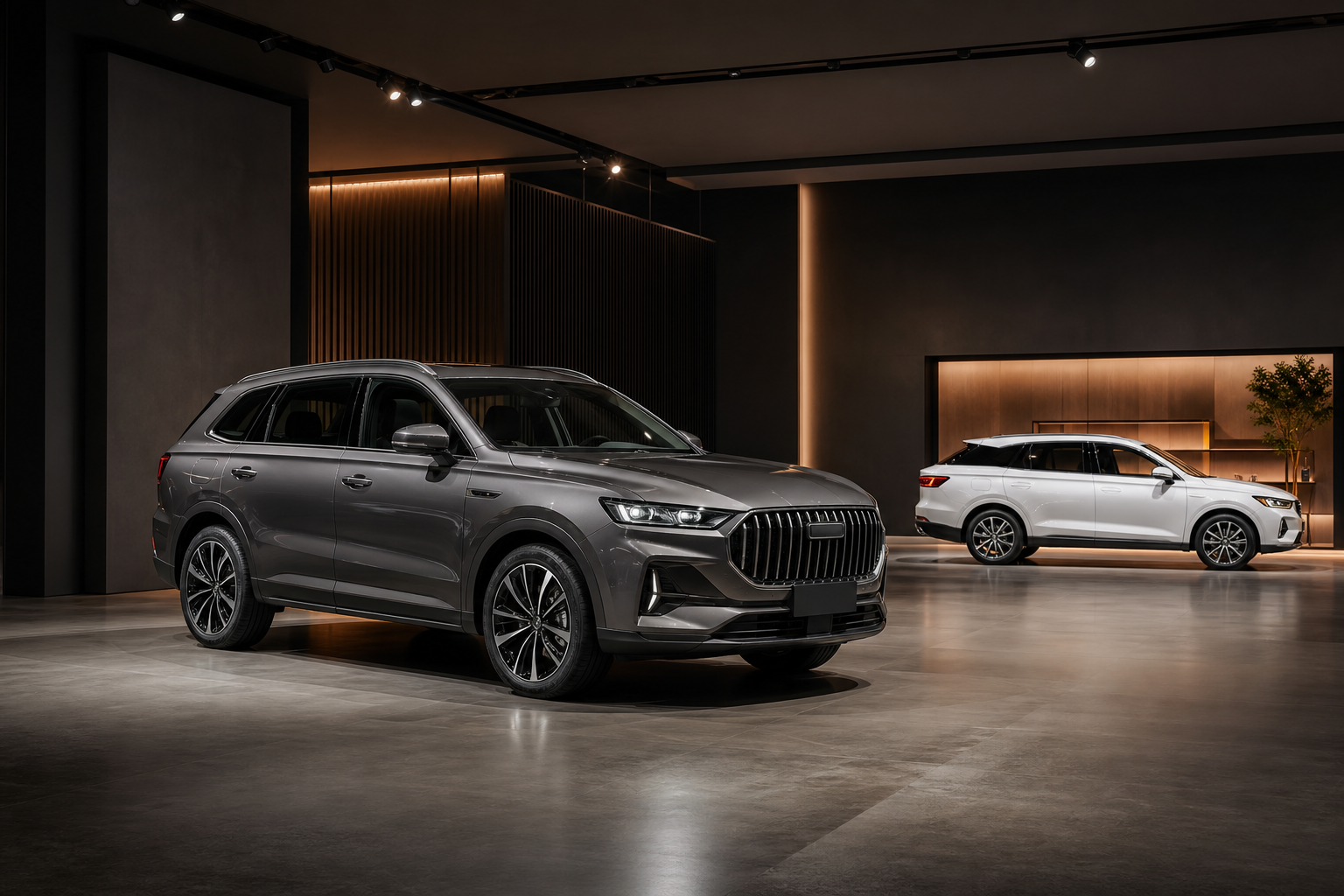
A showroom sells paint: every car is a curved mirror under every light. CRI, color temperature, vertical illuminance and reflection geometry — the four decisions that make or break the floor.
2026-09-10 · 9 min read · Lighting guide
No retail product punishes bad lighting like a car. Body panels are continuous curved mirrors, paint is a metallic or pearlescent film whose sparkle lives in precise directional light, and the customer circles the vehicle slowly, watching their own reflection travel across the door. Under poor lighting, a premium metallic gray turns flat and gray-brown, a red turns bruised, and the ceiling's wavy reflection makes a straight panel look dented. The dealership lighting package is therefore not "bright industrial"; it is a color-accuracy and reflection-design problem with an industrial fixture budget — and it is solvable with four decisions made in the right order.
A dealership is three businesses in one building: the showroom, where the product is sold on visual drama and trust; the handover and delivery bay, where the car is presented in its final, best light; and the service workshop, where technicians need real task light but the paint still matters on every car that returns to the floor. The design goals: paint rendered truthfully — the customer's impression under showroom light should match daylight exactly; a controlled, continuous highlight line along every car's shoulder, which is what makes paint look "wet"; vertical illuminance on the car's sides high enough to model the body; and zero glare path from fixtures into the customer's eye across the hood. The constants that get there: CRI 90+ with high R9, 4000 K neutral white as the showroom default (why, below), and a fixture layout planned against the reflection geometry of a car's surfaces.
Automotive paint is the most color-critical common product in retail, and LED has a specific weakness against it: cheap fittings hit CRI 80 by averaging their color errors, and the errors land hardest on deep red — exactly the R9 sample that decides whether a red or burgundy car looks premium or oxidized. The specification answer: CRI 90+ with R9 kept high (R9 above 50 as a working floor, higher for red-heavy brand palettes — illustrative), and, where the brand cares enough, TM-30 Rf/Rg data on file. Color temperature is the second half: 4000 K neutral is the dealership default because it holds both silver and white paint honestly — 3000 K warms whites toward cream, and 6500 K "cool" light drains warmth from reds and yellows while graying silvers; metallic flake especially depends on a neutral, even spectrum to read as intended. Keep one CCT across showroom, handover and the path between them: a car that looks right on the floor but shifts tone in the handover bay is a small daily betrayal customers feel before they can name it.
Every luminaire in a showroom appears, reflected, somewhere on the cars. The craft is deciding where. The classic scheme is continuous linear rows running the length of the floor, laid out so that each row's reflection draws one clean highlight along the car's shoulder line as the customer walks — the automotive equivalent of a photo-studio softbox. The failure schemes are equally recognizable: scattered point sources (round high bays on a wide grid) produce dozens of small wandering reflections that make flat panels look rippled; fixtures visible as bare bright points at seated eye level produce direct glare across hoods and windshields. Practical rules: keep fixtures low-luminance from below the critical angle — recessed, lensed or shielded optics, the same discipline offices use for screens; run rows parallel to the intended viewing axis, typically perpendicular to the storefront so the glass facade carries the highlight outward; and mind the polished floor, which doubles every fixture — a floor-fixture pair that works in a matte showroom can double-glare on epoxy terrazzo.
| Zone | Maintained lux (typical) | CCT | CRI | Notes |
|---|---|---|---|---|
| Showroom floor (general) | 300-500 lx | 4000 K | 90+, R9 ≥ 50 | Linear rows; low-luminance optics at eye angles |
| Car verticals (1.0-1.5 m plane) | 500-1,000 lx, Uo ≥ 0.4-0.5 | 4000 K | 90+ | The modeling number; verticals sell the body lines |
| Hero / feature cars | Accent 3-5× ambient | 4000 K | 90+ | Narrow-beam accents from front three-quarters; sparkles the flake |
| Handover / delivery bay | 750-1,000 lx | 4000 K, matched to showroom | 90+ | The final impression; CCT must match the floor exactly |
| Service workshop | 500-750 lx | 4000-5000 K | 80-90 | UGR 22; task-ready, but keep color honest for returns |
| Customer lounge / sales desks | 200-300 lx | 3000-4000 K | 90 | Warm enough to sit in; paper and screen tasks at desks |
| Forecourt / entrance glazing | Transition zone by day | 4000 K | 90 | Daylight-linked trimming; night keeps floor visible from street |
Values are illustrative of automotive retail practice; brand image programs (OEM corporate identity manuals) set binding figures where they exist.
Dealerships change modes more often than most retail: sales floor by day, launch events at evening, service-only weekends. The control layer is a modest DALI or equivalent scene system with day, evening and event presets — evening and event lift the accent layer and drop ambient slightly to stage hero cars; daylight harvesting trims the rows near the glass facade, which in a glass-walled showroom is a large share of the floor; and occupancy control in the workshop and offices, with the handover bay on a simple scene switch so the delivery moment is always staged. Two integration notes: cameras for forecourt and floor security again want vertical illuminance on faces, and the workshop — often forgotten in control plans — usually pays back sensor retrofits fastest, because its doors and bays sit empty between jobs.
The paint problem starts before the front door. Forecourt displays under canopy or pole light sit in a different visual world from the showroom behind the glass, and the transition decides whether a car parked outside looks like the same product a customer walks in to buy. Three practical measures close the gap: keep the forecourt within roughly one CCT step of the showroom (4000 K both sides, or 3000 K both — never mixed); light the outdoor cars with the same CRI 90+ discipline as the floor, since discounting the ones "only on display" is visible immediately; and balance the glazing with daylight-linked trimming so the floor never reads dark against the forecourt by day. Signage and architecture belong to the facade scope, but the lighting plan should at least hold its boundary: forecourt fixtures for vehicle areas, facade washers for the building, and no accidental overlap that double-lights the pavement and flares the showroom glass. Done together, these keep the dealership's one product — the same car — looking consistent from the street to the signing desk.
The automotive package is decided by one demonstration and three documents. The demonstration: a mock-up with two cars — one silver, one red — under the proposed fixtures, walked by the dealer principal; nothing in a datasheet replaces seeing the shoulder highlight and the R9 rendering live. The documents: color data per fixture (CRI, R9, and TM-30 where offered, with binning consistency across the order); photometry with vertical-plane capability (IES/LDT) so the layout can report the 1.0-1.5 m verticals the cars actually present; and the low-luminance evidence — luminance at the eye-critical angles — for the showroom rows. Add flicker data (PstLM ≤ 1.0; SVM ≤ 0.4 for the EU file), IP/IK ratings for workshop and forecourt fixtures, DALI compatibility in writing, and certification by destination (CE, UKCA, SASO and others) issued via certified partner factories with verifiable documentation.
Illustrative commercial terms: samples of 1-5 pcs ship in 7-14 days — enough for a two-car mock-up; trial orders 100-200 pcs per SKU; bulk production 25-40 days after deposit; pricing quoted per project. The retail and showroom lighting page maps the showroom families, the industrial line carries the workshop and forecourt fixtures, and track and magnetic systems cover the accent layer over hero cars. Send the floor plan with facade orientation; a row-layout sketch with the mock-up proposal is the natural first reply.
Color rendering, R9 and TM-30 — the paint-fidelity numbers.
Turning products into hero displays across retail formats.
The Kelvin scale from 2700 K to 6500 K, mapped by application.
How to buy commercial and showroom lighting from the cluster.
Paint-fidelity specification with CRI documentation and FOB quotation — first response within 24 hours.