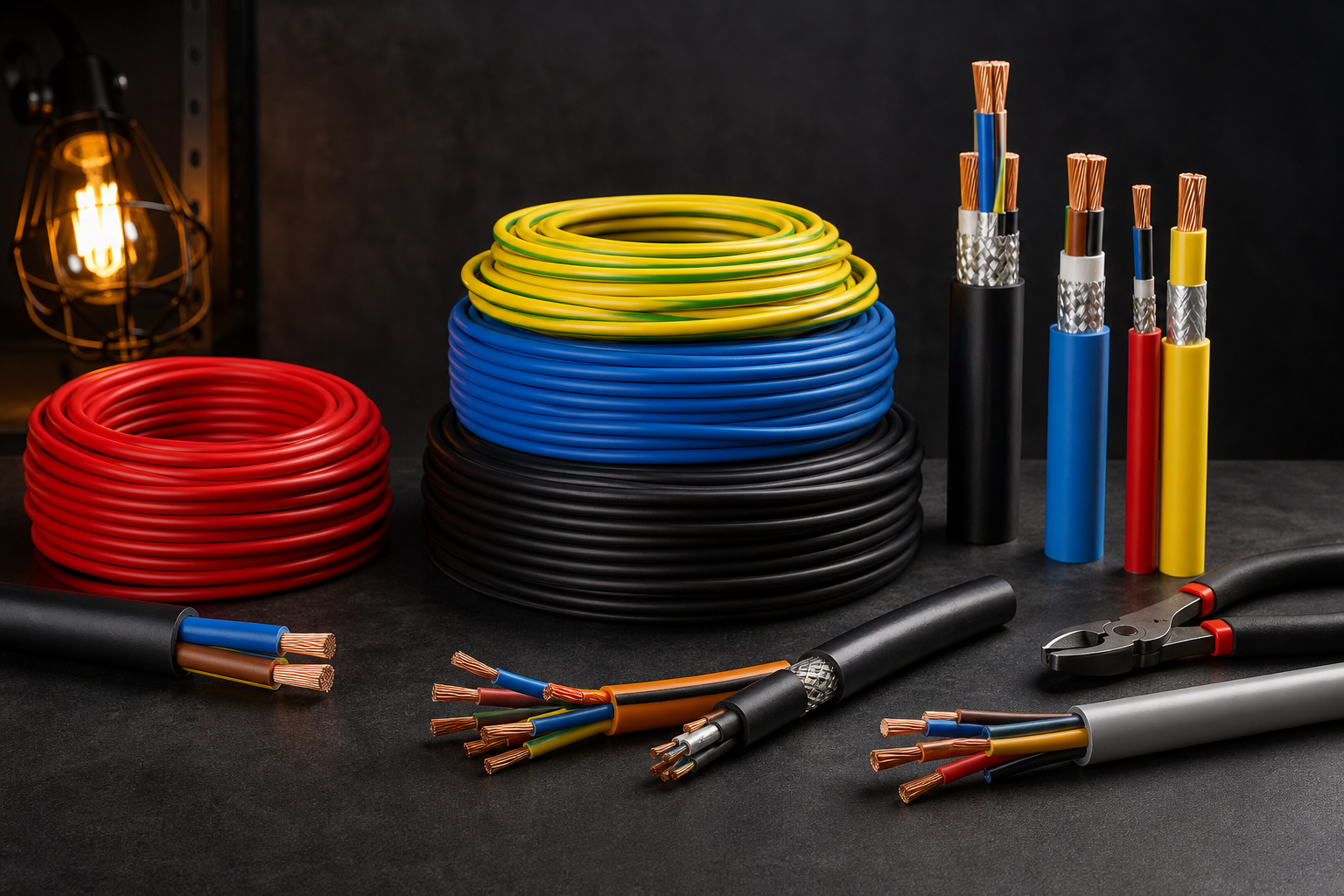
Conductor sizes from 0.75 to 10 mm2 against their AWG equivalents, the ampacity and drop rules that size them, and the cable specs that appear in export inspections.
2026-09-10 · 6 min read · Reference guide
Cable size is where lighting quotations quietly carry risk. Under-specify the conductor and a project fails inspection or, worse, runs hot behind a ceiling; over-specify and every metre of every circuit costs more than it should. This guide collects the sizing reference that export projects argue about most: the mm²-to-AWG translation between metric and North American drawings, typical ampacity by conductor size, and the low-voltage drop arithmetic that governs LED strip runs. All ampacity values are illustrative for common PVC/XLPE building cable in typical installation conditions — the prevailing local code (IEC 60364-5-52, NEC, AS/NZS 3000 and their national variants) always governs the final selection.
| Conductor (mm²) | AWG equivalent | Typical ampacity (illustrative) | Typical lighting use |
|---|---|---|---|
| 0.5 | 20 | 3-4 A | Internal luminaire wiring, small fittings |
| 0.75 | 18 | 6 A | Flexible cords for portable and decorative lamps |
| 1.0 | 17 | 10 A | Short drops, small lighting circuits |
| 1.5 | 16 | 10-16 A | Standard lighting circuits, EU residential and commercial |
| 2.5 | 14 | 16-20 A | Socket circuits, driver feeds on long runs |
| 4.0 | 12 | 25-32 A | Sub-mains, high-bay and industrial feeders |
| 6.0 | 10 | 32-40 A | Distribution feeders, large installations |
| 10.0 | 8 | 43-55 A | Mains distribution, central driver rooms |
Illustrative values for copper conductors at 70-90°C insulation in typical enclosed installation conditions. Derating for grouping, ambient temperature and insulation class is code-specific — size with the local standard, not this table alone.
Mains circuits rarely stress cable size — a 100W flood draws under half an amp at 230V. Low-voltage strip is different: the same 100W at 24V draws over 4 A, and at 12V over 8 A, so voltage drop across the run becomes the real constraint. Keep drop below 3% on low-voltage runs (and total circuit drop under 5% including mains side) or the far end visibly dims and shifts colour.
| Strip run | Load | Current | Recommended conductor | Practical outcome |
|---|---|---|---|---|
| 24V, 5 m | 48 W | 2 A | 0.75-1.0 mm² | Drop under 2% — standard feed fine |
| 24V, 10 m | 96 W | 4 A | 1.5-2.5 mm² | Feed from both ends to be safe |
| 12V, 5 m | 48 W | 4 A | 1.5 mm² | Workable; 24V preferred |
| 12V, 10 m | 96 W | 8 A | 2.5-4.0 mm² | Inject power at both ends or re-spec to 24V |
Illustrative single-feed figures. Beyond about 5 m, the cheapest fix is usually a higher-voltage system (24V over 12V, or constant-current 48V for long lines), not thicker copper.
Industrial and outdoor lines carry the heaviest cable decisions: feeder sizing for high-bay banks under industrial lighting, rubber-jacketed and UV-stable supply cable for outdoor and solar lighting (where the solar sizing arithmetic also sets battery-to-lantern cable runs, per our solar sizing guide), and fire-performance requirements on commercial circuits under commercial lighting. State conductor material, harmonised cable code and insulation class on the inquiry and the BOM comes back auditable — which is what inspectors, and ten-year warranty claims, actually read.
The complete buyer's guide to industrial high bay classes and specs.
Panels, batteries and autonomy — the arithmetic behind off-grid sizing.
Types, standards and battery circuits behind the exit sign.
CE, UKCA, SAA and SASO: which marks your market needs and how to verify them.
Conductor material, harmonised codes and insulation class stated on every quotation — send the project and get the auditable BOM within 24 hours.