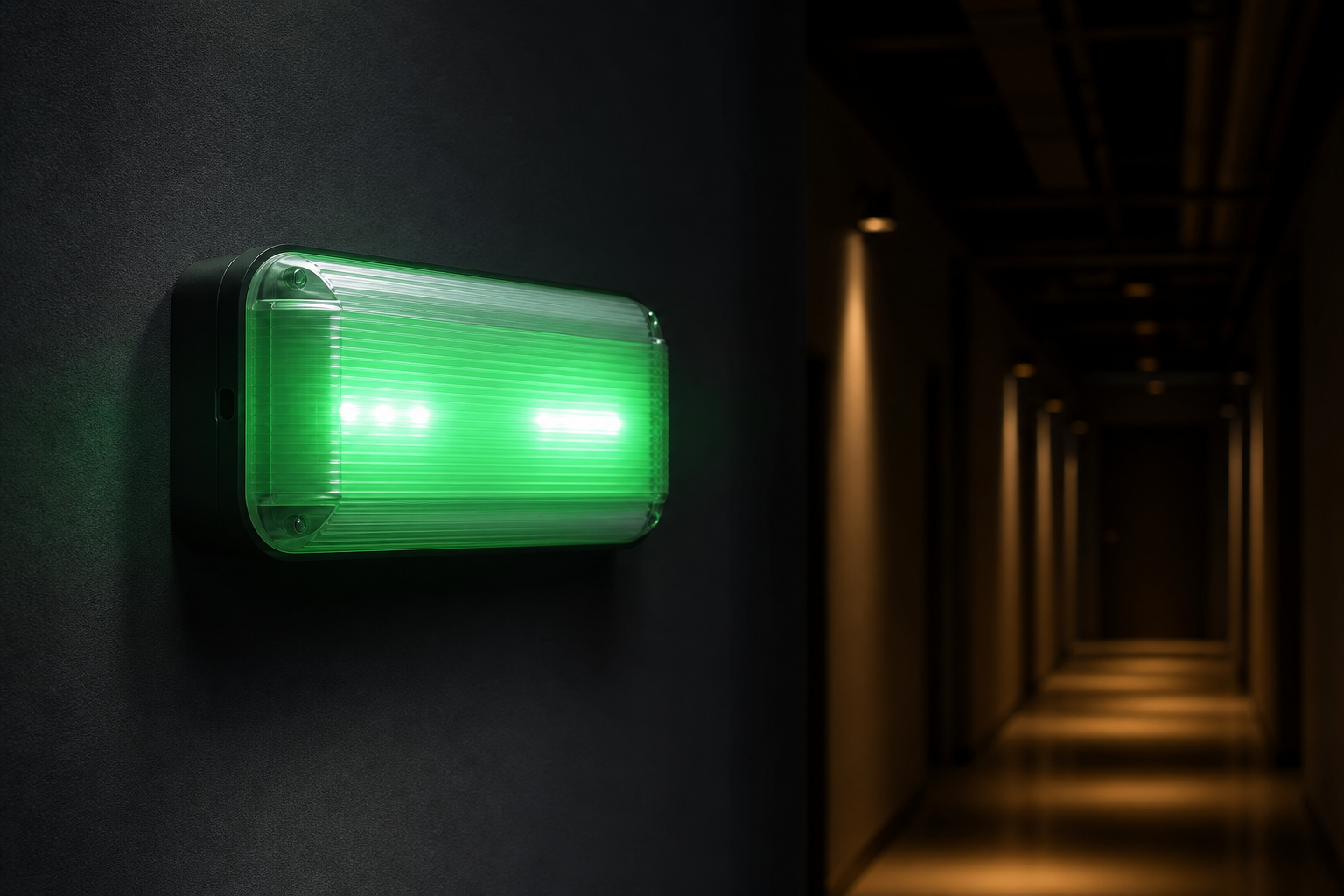
Emergency lighting is the subset of luminaires designed to keep working when the mains supply does not: escape route lights, open-area anti-panic lights, high-risk task lights and exit signs. Its purpose is not comfort or productivity but safe evacuation — enough illumination, in the right places, for occupants to find their way out, and enough signage for them to know which way that is. Because its performance is measured in emergencies, it is the most heavily standardized corner of the lighting catalog, and the one where certification paperwork is inspected most literally.
For distributors and contractors, emergency products also behave differently commercially. They are specified by regulators and fire consultants rather than chosen for aesthetics, order volumes are smaller per SKU but stickier — once a building standard settles on a fitting, it reorders for years — and the penalty for a non-compliant shipment is not a discount request but a refused occupancy certificate.
What emergency lighting must do
European practice, set by EN 1838, divides the duty into three classes with distinct photometric targets. Escape route lighting must keep a defined minimum illuminance along the center line of the route so people can walk out safely — a small number but one that must hold continuously along the path, including at doors and direction changes. Open-area (anti-panic) lighting must give occupants in large rooms enough light to see the space, each other and the routes out, preventing the crowd panic that darkness triggers. High-risk task lighting covers the specific locations where a process must be shut down safely before evacuation — a control room, a cutting line, a laboratory bench — and carries the highest illuminance requirement of the three.
Alongside these sit luminous exit signs, governed by their own photometric and viewing-distance rules, which define how far a sign may be from the viewer and still read clearly. The interplay matters in practice: a corridor can have perfect route lighting and still fail review if the signage spacing leaves a junction unsigned.
Maintained, non-maintained and the main product types
Product classification starts with operating mode. A maintained fitting works as a normal light and remains lit from its battery on failure — the standard choice for escape routes, assembly spaces and anywhere the fitting doubles as everyday lighting. A non-maintained fitting is dark in normal operation and lights only on supply failure, suited to premises normally used in daylight. A sustained fitting carries two separate light sources, one on mains and one on battery, and is used where the emergency source must be independently proven.
Onto those modes map the common hardware families. The table below shows the range a distributor typically stocks; figures are illustrative of the category, not any specific listing.
| Product type | Typical duty | Common duration class | Typical ingress / impact rating | Where it goes |
|---|---|---|---|---|
| Exit sign, surface or recessed | Directional escape guidance | 1 h / 3 h | IP20-IP65 by model | Corridors, doors, stair cores |
| Emergency bulkhead | Escape route and open area | 1 h / 3 h | IP65, IK08-IK10 typical | Stairs, plant rooms, external routes, parking |
| Downlight / ceiling type with emergency pack | Open area in finished interiors | 1 h / 3 h | IP20-IP44 | Offices, hotels, retail fit-outs |
| Emergency conversion kit | Upgrades a standard luminaire | 1 h / 3 h | Follows host fitting | Projects with specified decorative fittings |
| Central battery / addressable systems | Whole-building supply and monitoring | System-defined | Per slave fitting | Hospitals, tunnels, large complexes |
Category-typical ranges, illustrative only — project specifications govern actual selection.
Two engineering realities sit behind the hardware. First, duration is a battery property: self-contained fittings carry nickel-cadmium, nickel-metal-hydride or lithium cells sized for one or three hours at rated output, and battery quality decides whether the third year of service still meets the first hour of a test. Second, monitoring has become a default expectation in commercial work — self-test fittings that run their own monthly and annual function checks, and addressable systems that report faults to a central panel, are increasingly written into tenders because manual testing across hundreds of fittings is a cost no facility manager wants.
The standards a buyer will actually be asked about
The documents cluster by role. EN 1838 defines the photometric design requirements — the lux targets, uniformity and disabling-glare limits for the three duty classes. EN 60598-2-22 defines the product safety requirement for emergency luminaires specifically — how the fitting must behave on failure, what its battery and charging circuit must withstand, and how duration is declared — sitting as a section within the general luminaire safety standard EN 60598-1. Photometric data for design work comes from measurements under CIE and EN 13032 conventions, and in North America the equivalent anchor points are UL 924 for emergency lighting equipment plus NFPA 101 Life Safety Code requirements for egress illumination and signage.
For an importer, the practical mapping is: EU and UK markets ask for CE or UKCA marking with the emergency section of the luminaire standard addressed and EN 1838 design compliance shown in the layout software; Saudi programs run through SASO/SABER as with other lighting; North American projects specify to UL 924 listings. Certificates in our sourcing model are held via certified partner factories and verified per order with certificate number and official database link — the same discipline described in our certification center, which matters doubly here because a lapsed emergency-product certificate invalidates the occupancy paperwork built on it.
Sourcing and installation checkpoints
- Match duration to the building class. Hotels, high-rise and sleeping-risk premises generally require three hours; single-storey commercial often one. Write the class into the purchase order, not just the offer.
- Check the emergency lumens, not the mains lumens. Many fittings produce a fraction of their normal output in battery mode. Design to the emergency-mode photometry from the supplier's files.
- Verify battery documentation. Cell type, duration test report and — for lithium — transport documentation should accompany the shipment. A fitting whose battery is undocumented is a fitting whose third hour is fiction.
- Confirm monitoring expectation. Self-test versus manually tested versus addressable changes both price and the client's maintenance regime; decide it at specification stage.
- Plan placement with the layout, not the floor plan. Escape route lux is measured along the path; signage at viewing distance. Software layouts from the supplier's photometric files settle arguments before installation.
Emergency fittings share installation environments with the sealed industrial range — stairwells, plant rooms, parking structures — and distributors commonly pair them with the industrial lighting line, where tri-proof fixtures cover the always-on general lighting and bulkheads cover the never-off emergency layer.
Common mistakes in emergency lighting procurement
- Designing to mains output. A fitting that meets route lux in normal mode may fail it in emergency mode. Only emergency-mode photometric data is valid for the design.
- Treating duration as a catalog constant. Achieved duration falls with battery age and temperature. High-temperature plant rooms derate real duration well below the label.
- Mixing incompatible signage conventions. Sign formats and viewing-distance rules differ between markets; a sign compliant in one jurisdiction can be illegible or non-conforming in another.
- Skipping the emergency standard section. A CE mark earned on the general luminaire standard does not automatically cover EN 60598-2-22 behavior. Ask which section the certificate was issued to.
- Ignoring test regime cost. Hundreds of manually tested fittings create a permanent maintenance bill. The self-test option usually pays for itself within the first inspection cycle.
Emergency lighting rewards unglamorous diligence: correct duration class, verified battery documentation, photometry taken in emergency mode. Those three checks eliminate most of the compliance failures we see in inbound project reviews — and they are the checks our team runs before any emergency line ships.