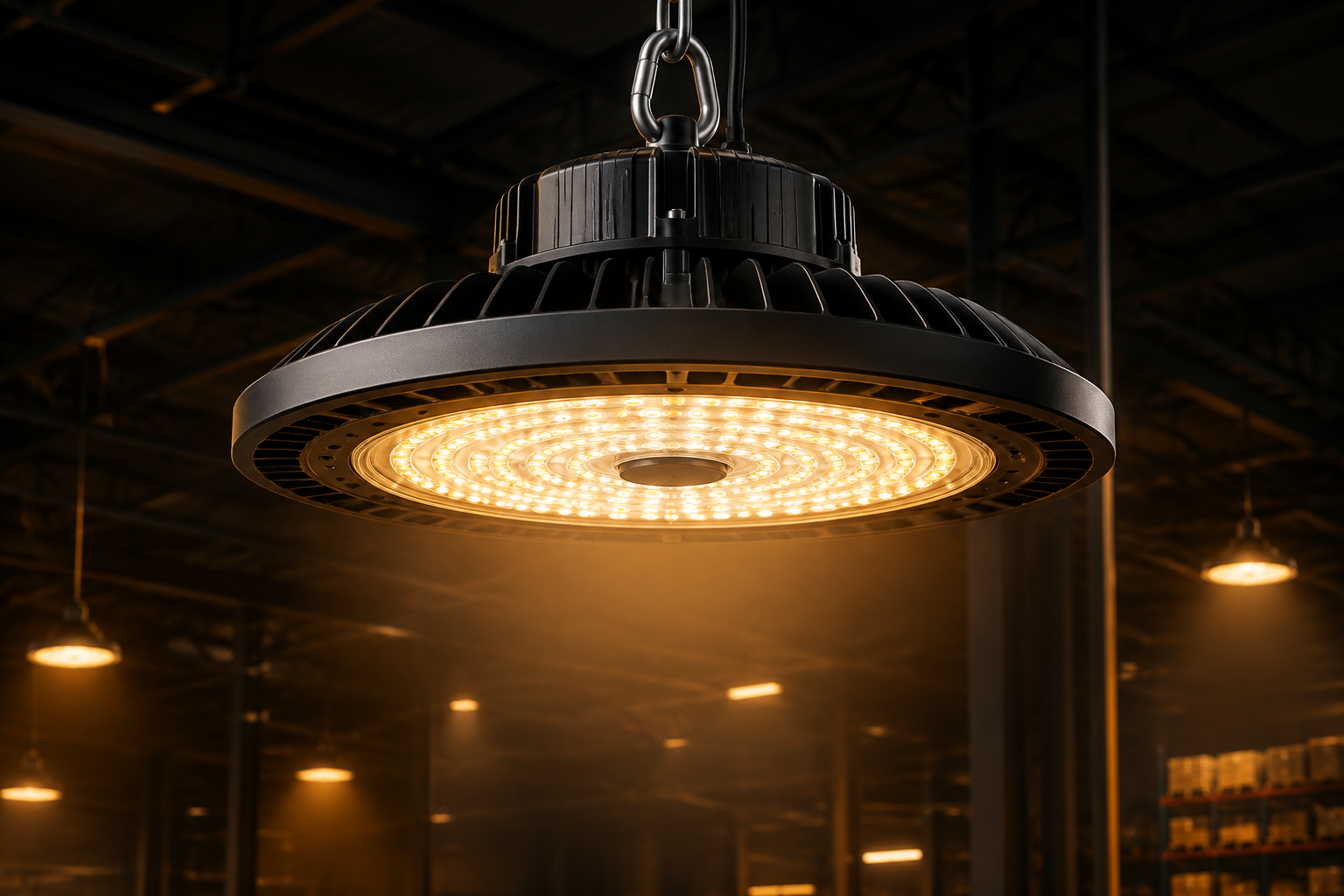
What separates a high bay from an ordinary industrial light, how UFO and linear formats differ, and the specification and sourcing points distributors and contractors should close before ordering.
2026-09-10 · 8 min read · Knowledge base
High bay lighting is the category of luminaires designed for ceilings roughly 6 meters (20 ft) and above — the heights typical of warehouses, production halls, gymnasiums, cold stores and big-box retail back-of-house. At those distances an ordinary batten or low bay wastes most of its output: the light spreads before it reaches the floor, arrives dim and uneven, and leaves the working plane patchy. A high bay does the opposite job. It packages a large lumen output into a controlled beam, usually 60 to 120 degrees, so that light delivered from 8, 10 or 12 meters still lands as useful, uniform illuminance on racking, workbenches or floor markings.
The category was defined by discharge-era hardware: 250 to 400 W metal halide or HPS lamps in large reflectors, slow to strike, slow to re-strike after a power cut, and maintained by crews working at height — which is exactly where the real cost sits. LED moved the arithmetic. A typical 400 W metal halide replacement today is a 100 to 150 W LED high bay, illustration numbers that hold across most manufacturers, with instant start, full dimmability and a service life quoted as L70B50 of 50,000 hours or more — meaning the fixture is expected to still deliver at least 70 percent of initial lumens at that point. Fewer lamp changes at height is, for most operators, the first and fastest saving they notice.
One definition matters contractually: "lifespan" in LED is lumen maintenance, not failure-free time. Drivers, the usual weak point, are replaced or warranted separately. Serious suppliers state both — the LED package's rated life and the driver's warranty window — on the same datasheet.
Export catalogs group high bays into two dominant formats, plus the low bay category that begins below roughly 6 meters:
| Format | Typical power | Typical flux | Beam | Best suited to |
|---|---|---|---|---|
| UFO high bay | 100-240 W | 14,000-36,000 lm | 60°-120° | Racking aisles, 8-15 m heights, high ambient temperatures |
| Linear high bay | 100-200 W | 15,000-30,000 lm | Wide | Open floors, assembly lines, continuous rows at 3-8 m |
| Low bay | 50-100 W | 7,000-15,000 lm | Wide | Workshops, docks and stores below ~6 m |
Figures are illustrative industry-typical ranges; actual values vary by LED package, driver and optics. Confirm against photometric files for the specific model.
Start from the working plane, not the fixture. Typical design targets, in the style of EN 12464-1 practice, run from about 100-150 lux for transit and bulk storage up to 300-500 lux for fine assembly or inspection — illustrative values that shift with national codes and task detail. From the target lux, mounting height and racking geometry, a layout tool (DIALux or Relux, fed with the manufacturer's IES or LDT files) produces the count, spacing and expected uniformity. A supplier who cannot produce photometric files is asking you to design blind.
The specification lines that decide whether the layout survives contact with the site:
Two specification lines deserve their own mention. First, the driver is the warranty: high bays live long enough that the driver's quality tier decides the fixture's real service interval, so the driver brand belongs on the BOM by name, and emergency inverter variants should be priced per zone at the same time, not retrofitted later at height. Second, mounting hardware is part of the electrical design — hook versus bracket, safety cables, and in food environments washdown-rated suspensions. A fixture spec without its mounting method is half a specification, and installers quote labor against the method they are given.
For export buyers, the high bay conversation with a factory should close the same items every time. Certification first: the destination market decides the file — CE (LVD/EMC/RoHS) for the EU, UKCA for the UK, SAA for Australia and New Zealand, SASO/SABER for Saudi Arabia, with North-American DLC handled case-by-case. Certificates are issued via certified partner factories and should be verified with number and official database link, not accepted as logo images in a catalog PDF.
Then the bill of materials: driver brand stated by name, LED package and binning window stated, surge spec stated. Commercial terms in this cluster typically run trial orders of 100-200 pcs, samples of 1-5 pcs shipping in 7-14 days, and bulk production 25-40 days after deposit — illustrative figures, confirmed per order. Packaging deserves a line item too: high bays ship stacked, and a carton that survives one drop test is cheaper than a claim. Pre-shipment inspection with photo reports per item, before container loading, is the standard we hold across the schedule. The wider compliance matrix is summarized in our certification guide.
For mixed industrial programs, high bays are rarely ordered alone — they share containers with industrial lighting lines such as flood lights and tri-proof battens, and consolidating the shipment with consistent binning and driver tiers is exactly where a sourcing partner earns the freight back. Also ask, before the order is cut, what documentation arrives with the goods: photometric files, LM-80 style data for the LED package, and installation sheets in the destination language are export-grade basics that commodity quotes tend to omit.
For a worked scene, see our warehouse lighting solution page; for the retrofit payback arithmetic buyers check first, see the factory retrofit guide.
Which format to quote for which hall — optics, mounting and cost compared for specifiers.
Aisles, racks and the energy math that decides the fixture count before price does.
Who to quote in the Chinese market, and how to separate factories from trading desks.
CE, UKCA, SAA, SASO and DLC by destination market — what your order actually requires.
Mounting height, racking plan and target lux — photometric layout and FOB quotation within 24 hours.