2026-09-10 · 8 min read · Comparison
The short answer
Quote a UFO high bay when the mounting height is above roughly 8 m, the space is open and dusty, or the tender is driven by lumen output per dollar and per carton. Quote a linear high bay when the mounting height sits between 3 and 8 m, the layout is dominated by aisles and racking, or the client wants continuous light lines instead of a grid of round fixtures. In most mixed-use industrial halls, the honest answer is both — zoned by area, not a winner-takes-all choice. The comparison below explains why, dimension by dimension, so your next industrial lighting quotation is defensible in front of the client.
Beam optics and mounting height: the first filter
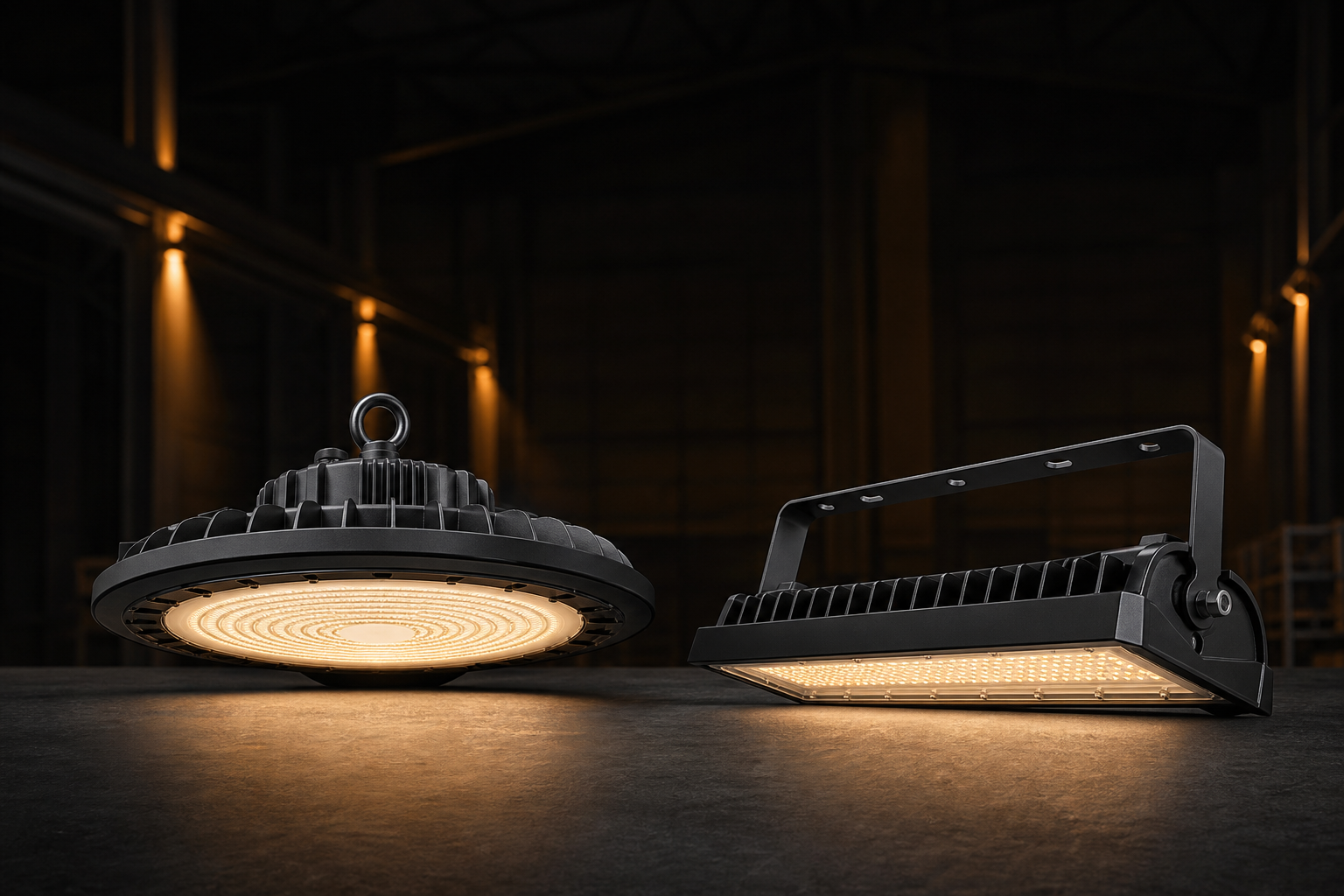
The two fixtures are optical opposites. A UFO high bay is a compact round body — typically a die-cast aluminium heatsink with a sealed lens or reflector — designed to throw light downward from height. Standard beam angles run 60, 90 and 120 degrees, and at 10 m a 60-degree optic concentrates the beam into a tight pool that still delivers usable lux on the floor. That is exactly what open storage halls, fabrication bays and sports halls need.
A linear high bay is a wide rectangular extrusion, usually with a batwing or wide-angle diffuser that spreads light laterally. Its natural habitat is the racking aisle: mounted at 4 to 8 m along the aisle centreline, it lights the vertical faces of the rack as much as the floor — which is where pickers and forklift cameras actually look. Mount a linear fixture at 12 m and the wide beam wastes lux into the racking; mount a UFO at 4 m and every aisle becomes a series of hot spots and dark gaps.
So the first question on any inquiry is not wattage — it is mounting height and rack layout. A serious supplier will ask for it before quoting, because it changes the recommended fixture, the lens and sometimes the entire layout.
Efficiency, thermal design and lifetime
On paper, both families now sit in the same efficacy band — roughly 130 to 200 lm/W for volume-grade product (illustrative ranges; actual figures depend on the LED package, driver and drive current). The difference is how each body handles heat. A UFO concentrates high power — 150 to 240 W is common — into a small diameter, so thermal design and the quality of the die-cast housing decide whether it holds its claimed L70 lifetime. A linear body spreads the same LEDs across a much larger surface, which is gentler on the chips and usually easier to keep cool in continuous rows.
For buyers, three practical checks matter more than the datasheet headline: the driver brand and its warranty, the TC point temperature stated at nominal ambient, and a TM-21 style lumen maintenance projection instead of a bare "50,000 hours" claim. Our partner factories supply IES and LDT photometric files on request, which lets your engineer verify real performance before the purchase order rather than after installation.
Environment: IP rating, impact and cold storage
Most UFO high bays are sealed at IP65 with an impact-resistant lens, which makes them the default for dusty workshops, food processing and petrol-station canopies (in canopy-specific versions). Linear high bays range from IP20-style bodies for clean ceilings to IP65 sealed versions for wet and cold areas. In freezers and cold stores, the linear form factor has a real advantage: the wide body dissipates heat well at low ambient temperatures, and drivers specified for -30 C cold-start avoid the failed-ignition calls that plague generic product in sub-zero halls.
Corrosion is the other filter. Coastal plants, chemical areas and wastewater facilities should be quoted with coated housings and stainless hardware on either family — a small cost step that prevents the rusted-hook failures that show up in year two. For destination-market compliance, we map certificates to the import country per order; see our certification centre for how that works across CE, SASO and SAA destinations.
Cost, freight and installation reality
Unit price: a volume-grade UFO in the 100-150 W class typically quotes far below a linear fixture of equivalent lumen output — illustrative FOB ranges are roughly USD 18-45 for the UFO against USD 45-90 for the linear body, depending on driver brand, chip tier and certification scope. Two structural reasons drive the gap: the UFO uses less aluminium per lumen, and it is the highest-volume category in the cluster, which compresses margins.
Freight favours the UFO even harder. Its compact cube packs densely — a 40 ft container can carry a dramatically higher lumen count of UFO product than linear — while long linear cartons consume cube space and need more protection. Installation splits the other way: UFO fixtures hang from a hook and quick-connect in minutes, but a large hall needs many suspension points; linear fixtures run in continuous rows with shared wiring, which electricians often complete faster per square metre and with a cleaner ceiling appearance.
Comparison at a glance
| Dimension | UFO high bay | Linear high bay |
|---|---|---|
| Best mounting height | 6-15 m; strongest above 8 m | 3-8 m; usable to 10 m with wide optics |
| Light distribution | Concentrated downlight, 60/90/120 degree options | Wide batwing; strong vertical illuminance on racks |
| Thermal behaviour | Compact die-cast body; quality-critical above 200 W | LEDs spread over large surface; easier heat management |
| Typical IP / build | IP65 sealed lens standard on most models | IP20 to IP65 depending on version |
| Unit cost (illustrative FOB) | USD 18-45 at 100-150 W class | USD 45-90 at equivalent lumen package |
| Freight efficiency | Excellent — dense cube packing | Poorer — long cartons, more protection needed |
| Installation pattern | Hook mount, quick connector, point-by-point | Continuous rows, shared wiring, aligned runs |
| Natural applications | Open warehouses, factories, sports halls, canopies | Racking aisles, cold stores, workshops, retail-style halls |
How to choose: three rules
- Height decides first. Above 8 m, quote UFO; below 8 m with racking or task areas, quote linear. Between 6 and 8 m, run a Dialux comparison — the better tool answers it in one simulation.
- Layout decides second. Open floor plates take a UFO grid; aisle-dominated layouts take linear rows aimed at the rack faces.
- Environment decides third. Dust, moisture, cold and corrosion push both families toward sealed or coated versions — and toward the specific driver ratings that survive the site.
What this means for purchasing teams and distributors
If you tender warehouse retrofits, quote both families in the same offer: a UFO-based scheme for open zones and a linear scheme for aisles, each with its own Dialux result and payback estimate. That framing wins technical approvals because it shows the client you priced the building, not just a catalogue. If you distribute, the UFO is your volume and fill-in line with the best freight economics; the linear line differentiates you on aisle and cold-storage projects where round fixtures visibly underperform. Many partners run both from the same warehouse program with mixed-SKU container loading.
Whichever way the project leans, ask suppliers for: IES/LDT files, driver brand and warranty terms, cold-start ratings where relevant, and certificate copies matched to the destination market. Send us the layout or the old fixture schedule and we will return both options quoted side by side — product schedule, photometric comparison and FOB pricing within 24 hours. For a broader view of how we organize factory sourcing in the cluster, see the Guzhen sourcing guide.